
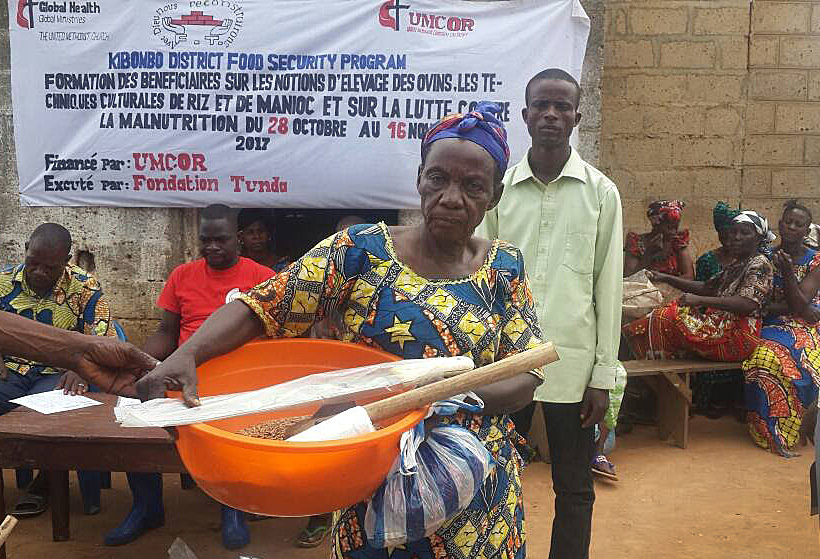
The Global Health unit of the United Methodist Board of Global Ministries is helping farmers in the East Congo Conference improve agricultural production.
The mission agency has provided a grant to support a food security project implemented by the Tunda Foundation to help fight malnutrition in the area. The Tunda Foundation is a nonprofit that was founded in 2004 by United Methodist Chief Prosper Tunda, whose family welcomed the first Methodist missionaries to the area in 1922.
The 12-month project was launched in September and targets United Methodists from 10 local churches in the Kibombo district, with 200 households participating.
HOW TO HELP
Learn more about the Global Health initiative of The United Methodist Church or donate to the World Hunger and Poverty Advance #982920.
Kibombo is a large town in the province of Maniema with a population of more than 200,000. Accessible by rail and road, it is 72 miles from Kindu, the capital of Maniema.
According to the most recent Demographic and Health Surveys report (2013-14 edition), 12.4 percent of the people living in Kibombo are considered malnourished, with 5.1 percent of those suffering from severe acute malnutrition.
Emmanuel Ndalimbuzi, coordinator of the National Nutrition Program for the Maniema office, said the threshold of severe acute malnutrition is 2 percent. When it goes beyond that threshold, intervention is required. Malnutrition has serious consequences for children's health, he said, including making them more vulnerable to disease and weakening their bodies and intellect. It also affects the community as a whole.
"Malnutrition increases susceptibility to disease and leaves people weak and lethargic, reducing their ability to work. It lowers productivity, hampers economic growth and the effectiveness of investments in health and education, and increases poverty,” Ndalimbuzi said.
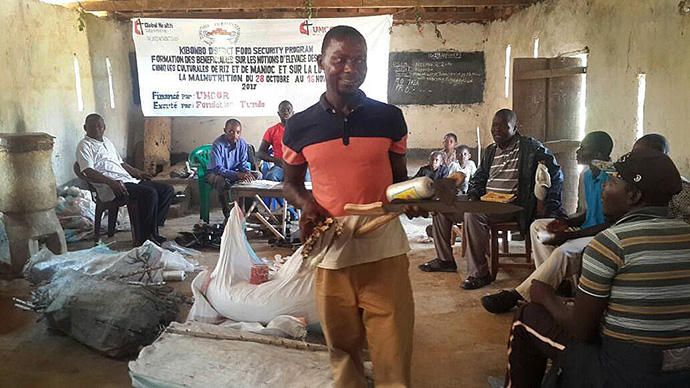
A man carries a machete, a hoe and samples of cassava cuttings that were distributed to United Methodists in Kibombo in October to help farmers improve agricultural production. Photo courtesy of the East Congo Annual Conference.
The situation in Kibombo requires intervention before it goes from bad to worse, said Tunda. He said malnutrition has been compounded by agricultural difficulties, including whitefly-borne viruses that have ravaged local crops.
In April 2015, whiteflies destroyed more than 3,000 hectares (approximately 7,400 acres) of rice fields in the Kibombo territory. Three years before, an epizootic outbreak killed thousands of livestock leaving many breeders empty-handed.
Local communities, the majority of whom are United Methodists, are in need of seeds that are able to resist the mosaic virus and whitefly to help remedy the problem and combat malnutrition, Tunda said, adding that it’s one of the reasons the foundation applied for the grant.
An extensive campaign, which included nutritional and agricultural education, was conducted for beneficiary households in the Kibombo district in the fall. People also participated in capacity-building workshops to learn techniques for fighting the whitefly, among other skills.
“At the end of these training courses, 200 households received — thanks to the project financed by Global Health — an agricultural kit consisting of a machete, two hoes, strings, ax, lime and improved seeds,” says Raphael Penge, a technical officer of the Tunda Foundation.
To ensure that the beneficiaries practice the concepts they learned, agronomists will continue to provide local support through September, Penge said.
Yema Maki, a United Methodist from Kiyungi United Methodist Church, is one of the project participants. She produced a 50-square-meter rice field that she said has been more successful than in previous cropping seasons. Maki plans to keep some rice to feed her family and sell the rest to pay for her children's school fees.
Kashinde Katembo, a member of Likeri United Methodist Church, echoed that same idea and said she also plans to share the seeds with non-United Methodist farmers.
The district superintendent of Kibombo, the Rev. Shako Yungi, is pleased with the agricultural improvements so far this growing season.
“Thanks to the support of the Tunda Foundation and Global Health in the framework of the food security project, we note that more than 80 percent of the fields cultivated by the Methodist faithful are a success this season,” he said.
“Thanks to the United Methodists’ humanitarian activities in this district, new members are joining more and more in our churches and souls are being saved. To carry out humanitarian activities is another way of evangelizing the word of God.”
The Rev. Omba Nyembo, pastor of Okasa United Methodist Church, said the food produced in the United Methodist fields will help fight malnutrition. With such successful crops, he said, it is likely that the food products also will be exported to Kindu.
This month, Global Health also is planning to distribute to United Methodists more than 100 livestock for breeding. The goal is to supplement animal protein deficiency to further aid in the fight against malnutrition.
Londe is a communicator of the East Congo Conference. News media contact: Vicki Brown at (615) 742-5470 or [email protected]. To read more United Methodist news, subscribe to the free Daily or Weekly Digests.
Like what you're reading? Support the ministry of UM News! Your support ensures the latest denominational news, dynamic stories and informative articles will continue to connect our global community. Make a tax-deductible donation at ResourceUMC.org/GiveUMCom.


