
Noting that Methodism founder John Wesley often warned about the dangers of schism, a United Methodist theologian said he considers this year to be "particularly dangerous" to the unity of the church.
"I don't think it would take that much to tear our church apart," said the Rev. William Abraham, the Albert Cook Outler Professor of Wesley Studies at Perkins School of Theology in Dallas. He cited the crisis in the Episcopal Church, sparked by the ordination of a gay bishop, as an example of the threat to unity.
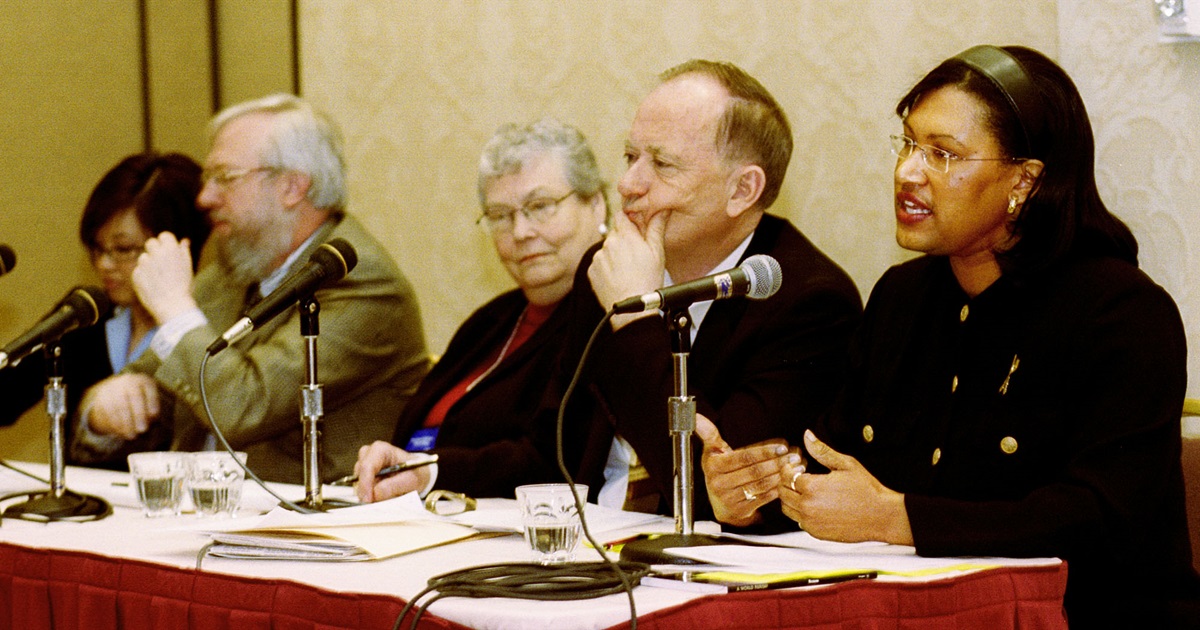
Abraham was one of four panelists discussing issues that divide and unite United Methodists during a session on "The Nature of the Church" at the Pre-General Conference News Briefing Jan. 29-31 in Pittsburgh. The event, sponsored by United Methodist Communications, was in preparation for the 2004 General Conference, the denomination's top legislative body, which meets April 27-May 7.
Pointing out that one of the functions of General Conference is to bring people together to dialogue, Abraham said United Methodists must recommit to being connectional. That will involve listening to others, setting aside stereotypes, and speaking in truth and love, he added.
Who is included and who is excluded in the church also can lead to divisions, according to Courtney Goto, a doctoral candidate at Emory University Graduate School of Religion in Atlanta and a director of the United Methodist Commission on Christian Unity and Interreligious Concerns.
Goto, who called herself a "longtime beneficiary" of the church's policy of inclusion, said those efforts "have helped heal the chasm that has existed between people of color and the white majority church." But she also believes that a "shadow culture of exclusion" can be found within the denomination.
Getting people to acknowledge "white privilege" is difficult, and it's easy to use inclusive policies "as an excuse not to examine how power and privilege (are) used in the church," she said.
For the Rev. Don Messer, the Henry White Warren Professor of Practical Theology at Iliff School of Theology in Denver, exclusion is what leads to chasm.
Messer recalled the 1964 General Conference of the Methodist Church, where delegates "refused to change their ways" of segregation, no matter how visible the sins of racism and discrimination.
"The issue of excluding gays and lesbians...cannot be ignored," he said. "I believe that the essence of the church is inclusion."
He also believes the importance of the 2004 General Conference will not be measured by how the denomination's book of law is revised or how many pages are added to the socially oriented Book of Resolutions, but by how United Methodists allocate their dollars. "The budget will reflect what the theological nature of the church is," he said.
The Rev. Joy Moore, assistant professor of preaching at Asbury Theological Seminary in Wilmore, Ky., said disagreement is not necessarily unhealthy, "for it means that discussion is taking place."
But Moore, also a director with the Commission on Christian Unity, thinks theology is being manipulated. "The story we tell becomes the substance that defines us, but we don't tell the story of our church."
How the story is told will be different for the oppressed than for the power brokers, but the content of the story does not change, she said.
Bishop Judith Craig, the panel moderator, concluded the session by encouraging those at the briefing to pay attention to the Holy Spirit and be gentle with one another at General Conference. "The nature of the church is just that: the strength of gentle care for each other."
*Bloom is a United Methodist News Service news writer based in New York. News media can contact her at (212) 870-3803 or [email protected].
Like what you're reading? Support the ministry of UM News! Your support ensures the latest denominational news, dynamic stories and informative articles will continue to connect our global community. Make a tax-deductible donation at ResourceUMC.org/GiveUMCom.


