
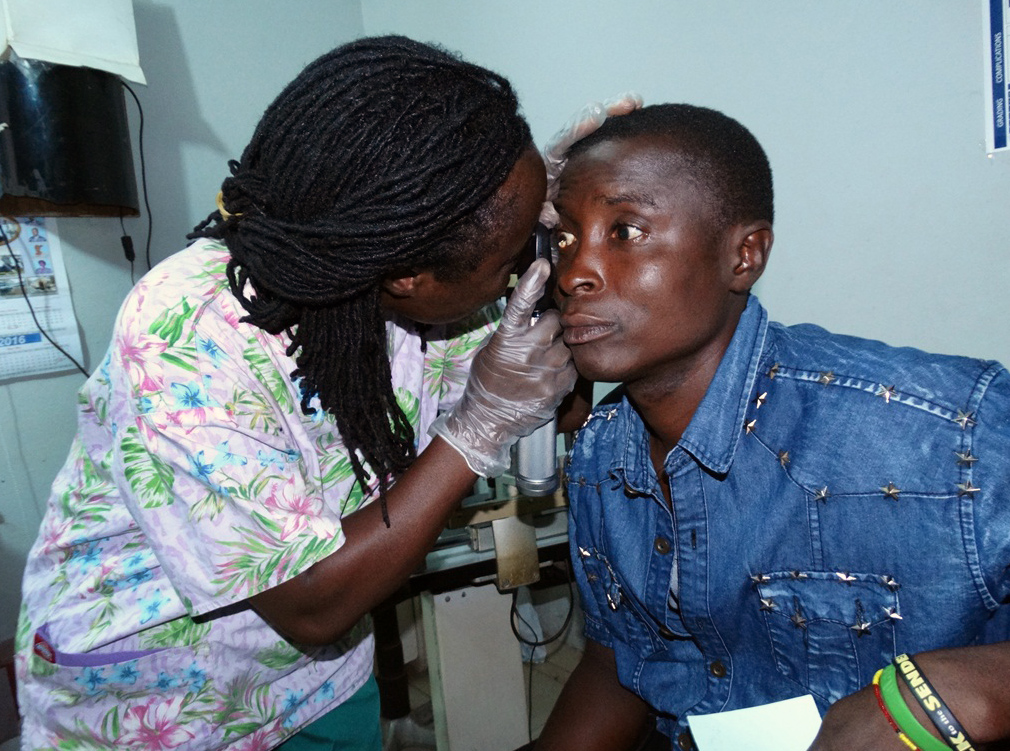
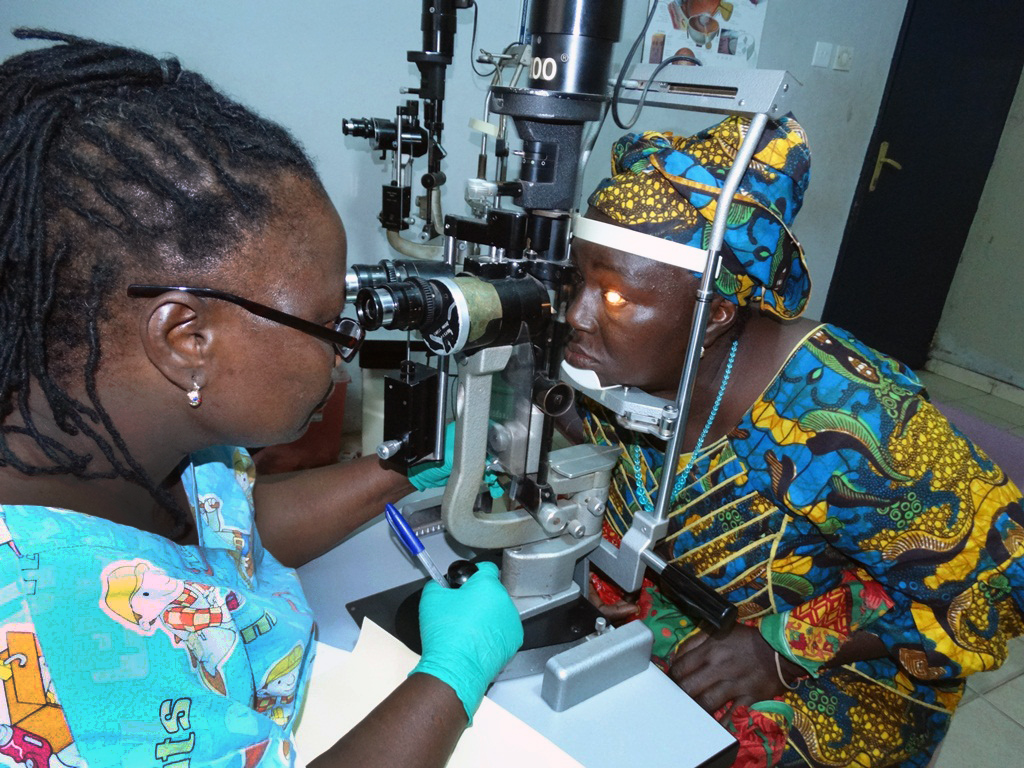
A United Methodist eye hospital is working to help save the sight of Ebola survivors by providing free treatment of a dangerous eye inflammation related to the deadly virus.
In 2014, Ebola claimed nearly 4,000 lives in Sierra Leone. In November 2015, the World Health Organization declared the West Africa country Ebola free, although a new case resulted a quarantine that ended this month.
However, many Ebola survivors suffer from an eye inflammation called uveitis. Uveitis produces swelling, destroys eye tissues and can cause permanent blindness if not treated. People experiencing uveitis can now receive free treatment at the Lowell and Ruth Gess United Methodist Eye Hospital in eastern Freetown. About 750 patients have already gotten free care, and new patients continue to pour in, according to hospital administrator Ibrahim Conteh.
Mohamed Kamara, 38, lost his wife and 23 other relatives to Ebola. He had itching in both eyes. Kamara did not know about the service, but other survivors called him to inform him about it and called again to make sure he went to the hospital.
Aminata Bangura visited the clinic for the second time. She, too, suffers from itching in the eyes. Playing on her lap was her 8-year-old granddaughter, also an Ebola survivor. Bangura lost four members of her family to Ebola.
The hospital’s work is funded through a two-year project of the Christian Blind Mission. The project, which ends in 2017, helps Ebola survivors who suffer from eye problems because of their infection. Although the project covers survivors in the entire country, Gess Hospital directly implements in the western and northern areas while providing logistics and supervision for other eye-care facilities in the south and east. The hospital runs mobile clinics in the north.
Survivors’ network
“We enjoy a huge response from the Ebola survivors,” Conteh says. “They are turning out in droves. The survivors have a very good network, and we work through their organization to reach out to survivors in any district we visit. They furnish us with information on the number of Ebola survivors in the country down to district level.”
Even before Ebola, blindness was prevalent in northern Sierra Leone. The Ebola outbreak worsened the situation. Hence, the Ebola survivor project focuses more on the north.
The shortage of ophthalmologists led to the creation of a comprehensive eye-care program. Doctors rotate their services in the eye-care facilities in Sierra Leone. Dr. Harrison Williams, a Ugandan-trained ophthalmologist, interns at the government Connaught Hospital. He alternates his services weekly between the government hospital and Gess Hospital and sees Ebola patients both in the hospital in Freetown and on clinic days in the north.
“We ask that [patients] come for reviews at least once every three months,” Williams explains. “We have noticed that sometimes they look normal, but the eye conditions change with time. The most common is allergic conjunctivitis – an inflammation of the membrane covering the white part of the eye due to allergy.”
Gess Hospital has two clinic days a week. Ebola patients in the Freetown area come for treatment or checkups. Williams sees between 40 and 50 such patients on clinic days. In the north, patient turnout can sometimes reach 100.
“Specific instruments … guide us as to which patients require specialist attention and which ones our ophthalmologist nurses can handle.” By asking basic questions, Williams says, his staff can triage people into two groups – “Those who have serious conditions and those who can be managed by our trained support staff.”
Lack of resources proves challenging
Williams says it is difficult to get complete recovery, and most of the diseases with the survivors take time to recover.
At the time of this interview, two districts in the north – Port Loko and Bombali – had already been covered, with plans to start clinics in Tonkolili and Koinadugu districts.
Working with the Ebola patients can be challenging because of lack of important resources, Williams admits. “A patient comes in, and you realize we cannot help this patient … even though it is very possible their conditions [could] be reversed if we had the right equipment or drugs.” He recently saw a patient in his early 20s who had started developing complications of retinal detachment.
“We needed a Vitector machine,” he says. “Then you advise the patient to get help out of the country, but you know that is almost impossible because they cannot afford it. Seeing a young man like that going blind and spending the rest of his fruitful life in blindness can be very painful, especially when you know that this is a case I could have saved if I had the right equipment.”
But his job offers moments of joy.
“This is why I like my job,” Williams says. “We are giving sight to people every day – people who had already accepted that blindness is something that happens and they should just take it. They don’t even see the need to come for treatment.” Then someone brings the patient to the clinic.
“After surgery – by the grace of God – the patient comes out. They begin to see, first with one eye. The next day the patient is walking around … without support, on their own. You feel so much gratification, and you begin to enjoy what people were experiencing when Jesus was around.”
Phileas Jusu is director of communications, Sierra Leone Annual Conference. News media contact: Vicki Brown at (615) 742-5470 or [email protected].
Like what you're reading? Support the ministry of UM News! Your support ensures the latest denominational news, dynamic stories and informative articles will continue to connect our global community. Make a tax-deductible donation at ResourceUMC.org/GiveUMCom.


