
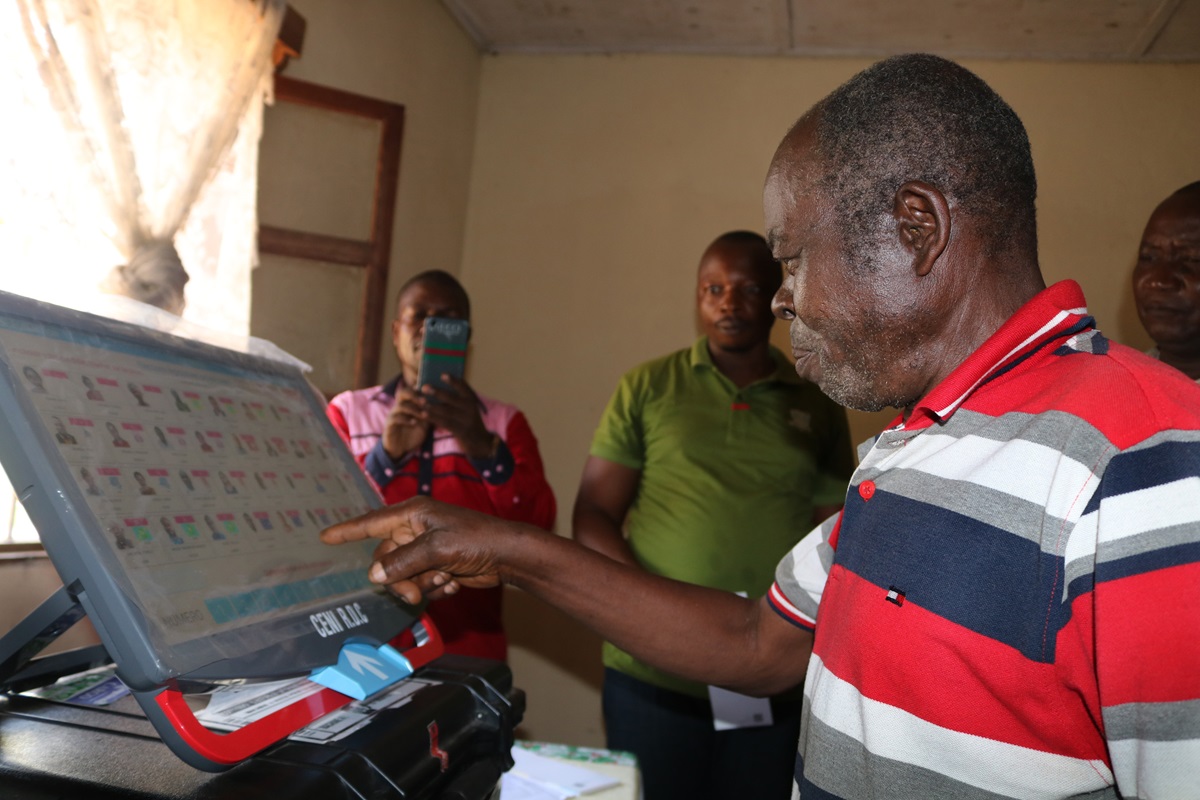
With the Democratic Republic of the Congo’s long-awaited presidential elections to replace President Joseph Kabila set for Dec. 23, voter education is focusing on semi-electronic voting — a first for the country.
Introduced in December 2017, the semi-electronic machines could prove challenging to many Congolese who have never seen or used a computer.
Thanks to The United Methodist Church in the Congo and the Independent National Electoral Commission, pastors and laypeople are learning how to use the new technology through demonstrations and voting simulation.
According to Bishop Gabriel Yemba Unda, who serves the Eastern Congo Episcopal Area, the goal is to prepare all United Methodist faithful to use the computer to vote. “If we call a village United Methodist farmer to vote with this machine,” he said, “he will not know how because he has never seen a computer. We believe that everyone must touch this voting machine even once before going to the polls.
“Many people have never been in front of a computer screen,” he said. Without the sessions, “people may fear and not vote. We have to make this machine known to our faithful to facilitate the voting process and allow everyone to vote easily. We want this voting machine to be touched by everyone in our provinces to allow the majority of the population to know how to use (it).”
The Rev. Kanda Salumu Boya, Tokolote Moto-Moto United Methodist Church in Kindu, was thrilled with his new technical knowledge. He vowed to talk to his family, friends and colleagues about this vital part of voter education.
“The use of this voting machine is not difficult,” he commented. “If everyone has the chance to touch it even once, the vote will not be so complicated and everyone can then choose our leaders without difficulty.”
The Rev. Kalema Tambwe, superintendent of the Kindu South District, agreed. He promised to talk to others and to recommend the voting simulations.
Alexis Selemani, youth coordinator for the East Congo Conference, organized the sessions. “There are many young people in the DRC,” he said. “We think it is important that young United Methodists also know the use of this machine to be able to vote in the next elections.”
Not everyone supports the new technology. They argue that the voting machines could encourage and allow the government to cheat the vote, which could plunge the country into a wave of contesting election results that could lead to violence, similar to what happened in 2006 and 2011.
The bishop, who chairs the Commission for Integrity and Electoral Mediation in Maniema, called on all political candidates to reach a consensus on the use of the voting machine in time for elections in December. “If political actors do not find a consensus and accept the voting machine,” he warned, “we will continue to get complicated and the elections may not be held at the end of this year.
“We must adhere to the use of this machine because it allows us to organize the elections and the people (to) elect new leaders.”
Londe is a communicator for the East Congo Annual Conference. Media contact: Julie Dwyer at 615-742-5470 or [email protected]. To read more United Methodist news, subscribe to the free Daily or Weekly Digests.
Like what you're reading? Support the ministry of UM News! Your support ensures the latest denominational news, dynamic stories and informative articles will continue to connect our global community. Make a tax-deductible donation at ResourceUMC.org/GiveUMCom.


