
Note: In the article below, the former prisoners’ first names have been changed and last names omitted.
Prisoners in Sierra Leone have received Christ, been baptized and even been released thanks to a thriving United Methodist prison ministry.
“I committed murder,” said 41-year-old Janet, who served time in a prison in the city of Moyamba, and later at the Freetown Female Correctional Center. “My rival used to taunt me that I was barren. She used to call me names. … In the society where we live, barrenness is viewed as a curse or a terrible disease, and I was laughed at each day. I used to weep day in and day out, and many times I thought of committing suicide. I could bear the torment no longer and took the opportunity to revenge one day. I asked my rival’s son to accompany me to the farm where I killed him.”
Janet sees the prison ministry as God’s grace. “I was touched with what the United Methodist pastors told us about the love of God – that Jesus did not come to call the righteous but sinners to repentance; that Jesus died for our sins including my own sin!” she said. “That gave me hope. I started looking forward to the weekly visits from the Rev. Daisy Gbloh and Mama Edith Rogers. They counseled me as I poured out my heart to them.
“My life changed. I decided to give my life to Jesus, whether I was released from prison or not. I started telling others, especially the new inmates, about the love of God.”
Janet is one of two female prisoners recently released from the Freetown Female Correctional Center, thanks to the Sierra Leone Conference’s prison ministry intervention. The other, Musu, is overwhelmed with gratitude for the prison ministry.
"My sentence was reduced from six years to 10 months,” she said. “I still cannot believe that I am really out of prison.”
Musu grapples with the reality of her newfound freedom. She went to prison after she failed to pay a loan (equivalent to $1,200) she owed a microcredit organization.
Modeling Christ’s love
Apart from advocating release of incarcerated women, the prison ministry shares food and gives gifts to prisoners at the female correctional center, especially during Christian holidays.
The goal is “to show them the love of Christ,” said Elmira Sellu, a United Methodist Women regional missionary and co-founder of the ministry. “God gave us Christ at Christmas. We do the Christmas visit and sharing as a way to emulate what God did for us.”
Over the years, the missionaries recruited volunteers with skills to support the work in the prisons. Before the 2014 Ebola crisis, the team divided into two groups. On Mondays, Gbloh, assistant pastor at King Memorial United Methodist Church in central Freetown, and Edith Rogers, another volunteer with the prison ministry, reached out through Bible studies, worship services, counseling and group therapy.
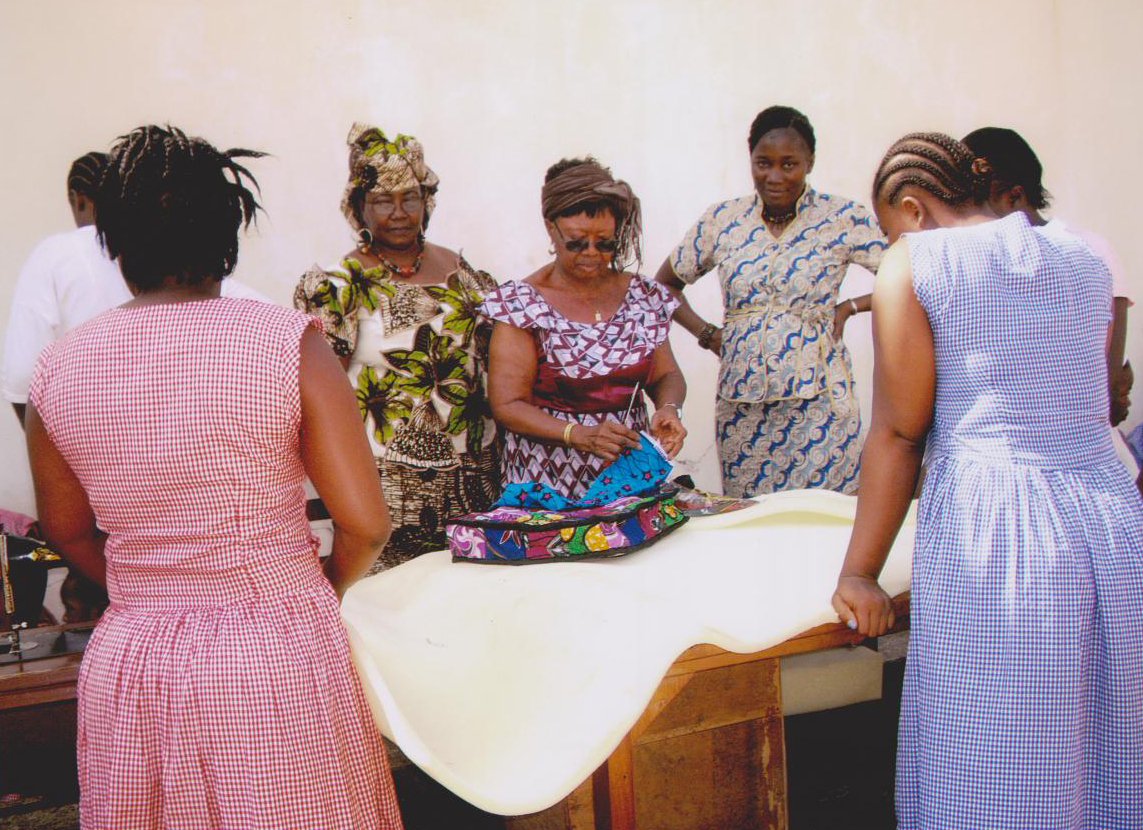
On Thursdays, Millicent Yambasu and Marian Bah offered training in tailoring, floral and balloon decorations, hall decoration, soap making, arts and crafts. The training sessions continued to attract many female prisoners with attendance peaking at 80 per session.
“We strongly believe that the prison is not the final destination for them and that, one day, they would come out with skills that make them self-reliant,” explained Finda Quiwa, another United Methodist Women missionary and co-founder of the ministry.
Yambasu, who teaches floral and balloon decoration, considers prisons ministry one of the church’s most important forms of outreach.
“The Bible tells us we should visit those in prison [and] feed the hungry because when Christ shall come, he’d assure you, ‘When I was in prison, you visited me.’” Yambasu said. “The response is very positive, because even when they are in incarceration the women are thinking about income-generating in life after prison.”
Ebola training saves lives
Gbloh too enjoys prison ministry.
“I’m very happy and grateful to God for the successes we have made,” she said. “That people in prison can know God and give their life to Christ is a source of joy for me.”
Some become involved in the church. The ministry, Gbloh added, “has helped to shape their lives in many ways. Even in prison, some of them were doing terrible things. Now they come openly and confess when we minister to them.”
One day, Gbloh baptized 10 women at the prison.
“We prayed together; we fasted together,” she said. “Most of them are out of prison today. This has impacted my work so much because I always want to meet common people … with very little hope, especially those who feel dejected; those who feel they’ve done the worst and are nowhere.”
The prison ministry completed some training before Ebola struck. The team then planned Ebola prevention training for the incarcerated women.
“We were aware that there were new prisoners coming in every day,” Quiwa said. “We needed to give them training so that they could know how to deal with Ebola. We taught them about Ebola and basic hygiene. We encouraged them to focus more on the preventive measures to make sure they were safe.
“We were the first to take Ebola training, banners and posters to the female prison,” she continued. “By the time of our intervention, all the inmates knew was that there was a deadly disease in the country called Ebola. But they did not have detailed information on prevention, care and treatment.”
About 10 children – newborns through toddlers – lived in the female prison during the Ebola outbreak. The team provided clothing and food for the children, too.
Quiwa and Sellu started the prison ministry in 2013. They wanted to promote Christianity within the prisons and transform prisoners through pastoral care, equip women with skills for self-reliance after serving prison terms, cater to the needs of babies of female prisoners and foster rehabilitation and integration into communities.
Jusu is a United Methodist communicator in Sierra Leone.
News media contact: Vicki Brown, Nashville, Tenn., (615) 742-5470 or [email protected].
Like what you're reading? Support the ministry of UM News! Your support ensures the latest denominational news, dynamic stories and informative articles will continue to connect our global community. Make a tax-deductible donation at ResourceUMC.org/GiveUMCom.


