
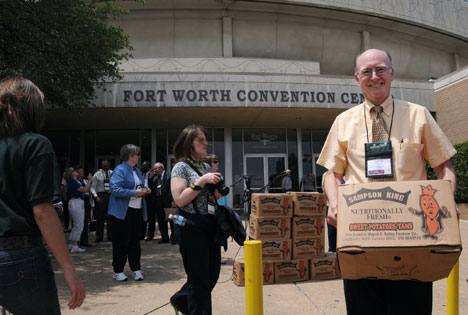
As the hot, Friday afternoon sun beat down on the Fort Worth Convention Center, delegates, bishops, general agency staffers and visitors to the 2008 United Methodist General Conference left the center's air conditioning to help load 40,000 pounds of sweet potatoes into trucks, vans and trailers for distribution to area social service agencies that feed the hungry.
The bulk of the sweet potatoes more than 17,000 pounds went to the Tarrant Area Food Bank, a Second Harvest central warehouse that sends food to 300 central Texas soup kitchens, food pantries, senior citizen centers, after-school programs and other agencies.
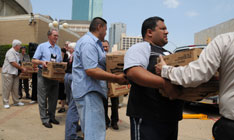
Delegates and visitors to the 2008 United Methodist General Conference help
load 20 tons of sweet potatoes.
"On average, every pound is a meal," said Susan Frye, the food bank's community events director. "So, you guys are donating 17,000 meals to us today."
Frye said the food bank supplies food for 30,000 to 40,000 families per month. "Nowadays, with the high cost of food and groceries, it is becoming increasingly difficult to get quality, nutritious food to distribute," she said. "It's a tough time. Everybody's dollars are tight. So, it's a real boost for us to get fresh produce. That's hard to get these days."
The "potato drop" was sponsored by The Society of St. Andrew, a national hunger relief agency based in Virginia, and the Task Force on Hunger of the Central Texas Conference of The United Methodist Church. The potatoes were provided by Texas Sweet Potato Distributing Inc., a division of W. E. Bailey Produce of North Carolina.
Carol Breitinger, Society of St. Andrew communications director, said another 15,000 pounds of potatoes went to the North Texas Food Bank and 5,000 pounds went to United Community Centers. First Street Methodist Mission received 2,000 pounds and 1,000 pounds went to Arlington Urban Ministries.
"This 20-ton load of sweet potatoes will provide about 120,000 servings of nutritious food to individuals and families in the region within days, perhaps hours, of the spuds being donated to the agencies serving the needs of the poor throughout the Dallas-Fort Worth area," Breitinger said.
Frye noted that 35 percent of those receiving food from the Tarrant Area Food Bank are children.
"A lot of those children aren't looking forward to summer," Frye said, because they will not be getting school lunches provided by the Federal Free and Reduced Lunch Program.
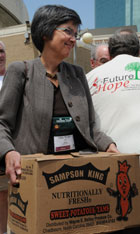
United Methodist Bishop Hope Morgan Ward
does her part.
Frye told a story about a 13-year-old girl who told her that when she didn't have enough food, she ate grass "because it was like eating salad."
"There is hunger right here in Fort Worth," Frye said. But, she added, the potatoes will help fight that hunger. "The United Methodists are making a difference, and we really appreciate that."
The Society of St. Andrew is a nationwide, nondenominational, nonprofit organization that salvages fresh produce that otherwise would go to waste and distributes it free to those in need throughout the continental United States. It is headquartered in Big Island, Va., where it was founded in 1979.
The organization has submitted a petition to the General Conference asking the denomination to designate it as "the principal nationwide organization within The United Methodist Church to alleviate hunger in the United States."
The Rev. Ken Horne, Society co-founder, said the petition is intended to make ending domestic hunger a priority of the church, adding, "Only when we forge a 'critical mass' of people demanding an end to hunger will it become a national priority."
*Rhodes is Director of Communications of the Virginia Conference of the United Methodist Church.
News media contact: Kathy Noble or Tim Tanton, e-mail: [email protected].
Phone calls can be made to the General Conference Newsroom in Fort Worth, Texas, at (817) 698-4405 (817) 698-4405 until May 3. Afterward, call United Methodist News Service in Nashville, Tenn., at (615) 742-5470(615) 742-5470.
Related Articles
General Conference headlines
United Methodist Men promote hunger awareness
Resources
Like what you're reading? Support the ministry of UM News! Your support ensures the latest denominational news, dynamic stories and informative articles will continue to connect our global community. Make a tax-deductible donation at ResourceUMC.org/GiveUMCom.


