
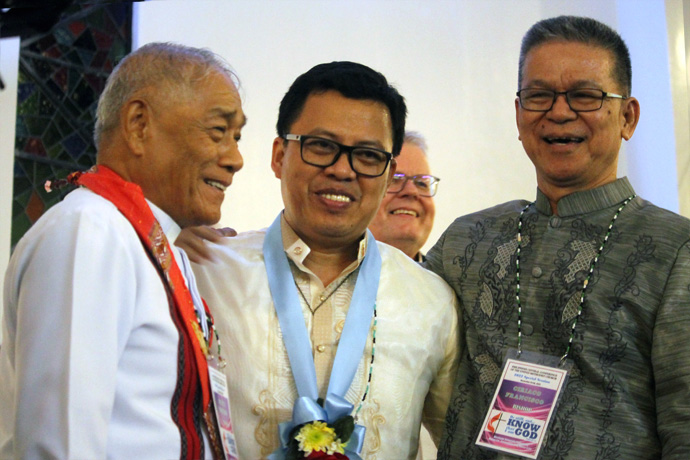
The Rev. Israel M. Painit, the country director of mission in Southeast Asia, has been elected as bishop in The United Methodist Church’s Philippines Central Conference.
Delegates elected Painit, 46, on the 23rd ballot on Nov. 26 at the central conference’s meeting at Wesleyan University-Philippines in Cabanatuan City. He received 360 votes out of 453 valid ballots cast. He needed 302 to be elected.
Painit was the third bishop elected at the Nov. 24-26 meeting.
In his remarks after receiving the episcopal pin from Council of Bishops President Thomas J. Bickerton, Painit relayed how God had called and prepared him by saving his life from drowning as a baby.
“One day in Esperanza in Agusan del Sur, our raft slid down the river, with my mother, my grandmother and my brother. The first search to rescue the adults, they didn't know there was a baby. It was amazing that I was felt by somebody’s feet under the water. I was 11 months old then; everybody thought I was dead, but after a few minutes, I burst out (of the) water.”
Painit said that he had not been baptized at the time. When baptism happened, his aunt had named him Israel, saying, “Israel would someday lead and unify people.”
Painit finished his basic education in Tungao in Butuan City. He finished AB Theology from Southern Philippines Methodist Colleges Inc. in Kidapawan City, North Cotabato, and attended Ateneo de Davao University to study law for two years. He holds a Master of Divinity from Wesley Divinity School from Wesleyan University-Philippines and a master’s in Public Administration from the University of Southeastern Mindanao.
Currently, Painit serves as the country director of mission in Southeast Asia under the United Methodist Board of Global Ministries.
He started his journey as a student pastor in 1993 at Kabacan Central United Methodist Church and Tungao Mission. Then he continued to become an administrative pastor in several local churches in Kabacan, North Cotabato, Davao del Norte and Davao City, and as district superintendent in the Southeast District in East Mindanao Philippines.
He then served as center director at Davao United Methodist Mission Center before he became the country director of mission in Southeast Asia.
The central conference’s delegates, an equal number of United Methodist clergy and laity from the country’s three episcopal areas, elected Painit. The assignments of bishops in the Philippines Central Conference were announced during the consecration service on Nov. 26. Painit will serve the Davao Episcopal Area.
Bishops in the Philippines serve four-year terms before they face reelection or retirement.
Painit was the endorsed candidate of the East Mindanao Philippines, Mindanao Philippines and Northwest Mindanao Philippines annual conferences.
In The United Methodist Church, bishops are ordained elders who are called to “lead and oversee the spiritual and temporal affairs of The United Methodist Church.” Bishops, in consultation with district superintendents, are responsible for appointing clergy. They also preside at annual conferences, jurisdictional conferences and General Conference, the denomination’s top lawmaking assembly.
He and other new bishops are coming aboard as the denomination deals with the continuing fallout of the COVID-19 pandemic and rising congregational disaffiliations amid a denominational splintering.
Painit told UM News that he loves community organizing.
“Empowering people and building their capacities is what I have so loved doing,” he said.
Painit also credited Global Ministries for granting him the opportunity to be equipped and become a roundtable facilitator. He said doing so has enabled him and empowered him with facilitation and negotiation skills.
“Everybody has a space at the table of grace,” Painit said.
“To grant each one a space, everyone must be listened to, especially the small voices which are not really heard.”
Mangiduyos is a UM News correspondent in the Philippines.
News media contact: Julie Dwyer, news editor, [email protected] or 615-742-5469. To read more United Methodist News, subscribe to Free Daily or Weekly Digests.
Find all of UM News’s coverage of the 2022 episcopal elections of The United Methodist Church on our landing page.


