
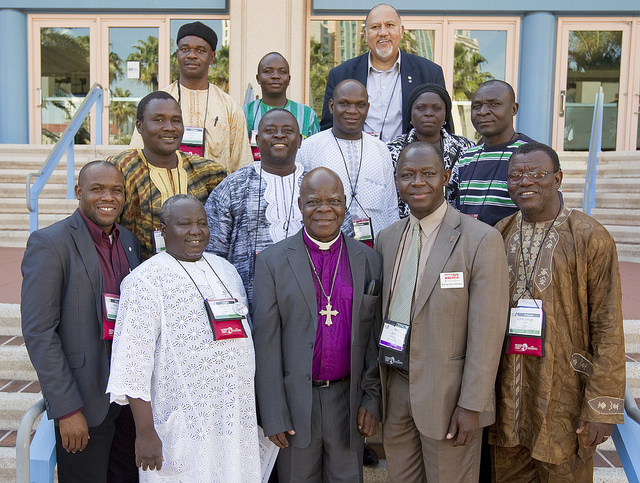
The United Methodist Church in Nigeria is growing — so much, in fact, there aren’t enough pastors to serve all its members, leaders say.
Within the past two to three years, 15 to 30 new churches have launched — each with 200 to 300 members. And since 2006, the total number of members in the Nigeria Area has doubled from an estimated 600,000 people to 1.8 million, according to John Wesley, administrative assistant to Bishop Arthur Kulah, interim bishop of Nigeria, and a member of the 30-person Nigerian delegation attending the 2012 General Conference.
Two of the area’s three annual conferences have been renamed from cities to regional areas to better reflect the expanding reach of the church. Gwateng Conference is now the Central Annual Conference; Pero is the Northern Annual Conference. Those join the area’s Southern Conference.
Bishop John Yambasu of the Sierra Leone Area says that growth comes after years of struggle and conflict.
Yambasu is secretary of the Council of Bishops of the West Africa Central Conference and coordinator of the program for Nigeria. He was appointed to serve on a special task force on Nigeria, he says, to pave the way for a smooth transition to elect a new bishop this year.
When missionaries first founded the church in the early 1980s, its headquarters were located in a remote area of the country, Yambasu said. As time passed and the country expanded, the location became even more isolated, he said, and church leaders decided they needed a place that was more centrally located, “where communication and everything else was easy.” The headquarters is now in Jalingo in the northern part of the country.
Early church leaders “felt deprived of their heritage,” Yambasu said, which caused tension. Tribal influences have also played a role. Where the church was founded, a small tribal group was welcomed and included, but with a focus on evangelizing the country’s other tribes, the church grew and new leadership began to dominate decision-making in the church, Yambasu said.
“It was difficult for the original group that founded it to accept the leadership of this new people who came into the church,” he said.
The catalyst for growth was the realization among leaders that the church couldn’t continue amidst the turmoil.
“Instead of pushing them forward, all of that conflict had just taken the church backward,” Yambasu said, adding they realized they were “all just the same people in Jesus Christ.”
“All of the leaders in the area came together to say, ‘No more of this. We are brothers and sisters. We need to go ahead with the church,’ ” Yambasu said.
A national peace and reconciliation conference several years ago that was replicated in each district was the start. And a team was formed to develop a plan for the conference that included a major evangelism emphasis.
Now, Yambasu says, there are too few pastors to meet the church’s needs, prompting increased efforts at intentional theological education and training of pastors.
New ministries, such as water and sanitation projects that are providing wells for hospitals and schools, and a reorganization of the conference’s men’s, women’s and youth groups, are other signs of the church’s growth, Yambasu said.
Those efforts, as well as a number of retreats and revivals for all ages, are “bringing many, many people to the church,” Kulah said.
“Even non-Methodists are coming back to the church,” Wesley added, “because they feel The United Methodist Church has a positive bearing on people’s lives.”
With a population of about 160 million in Nigeria, Wesley says the church has a lot more to do.
Like what you're reading? Support the ministry of UM News! Your support ensures the latest denominational news, dynamic stories and informative articles will continue to connect our global community. Make a tax-deductible donation at ResourceUMC.org/GiveUMCom.


