

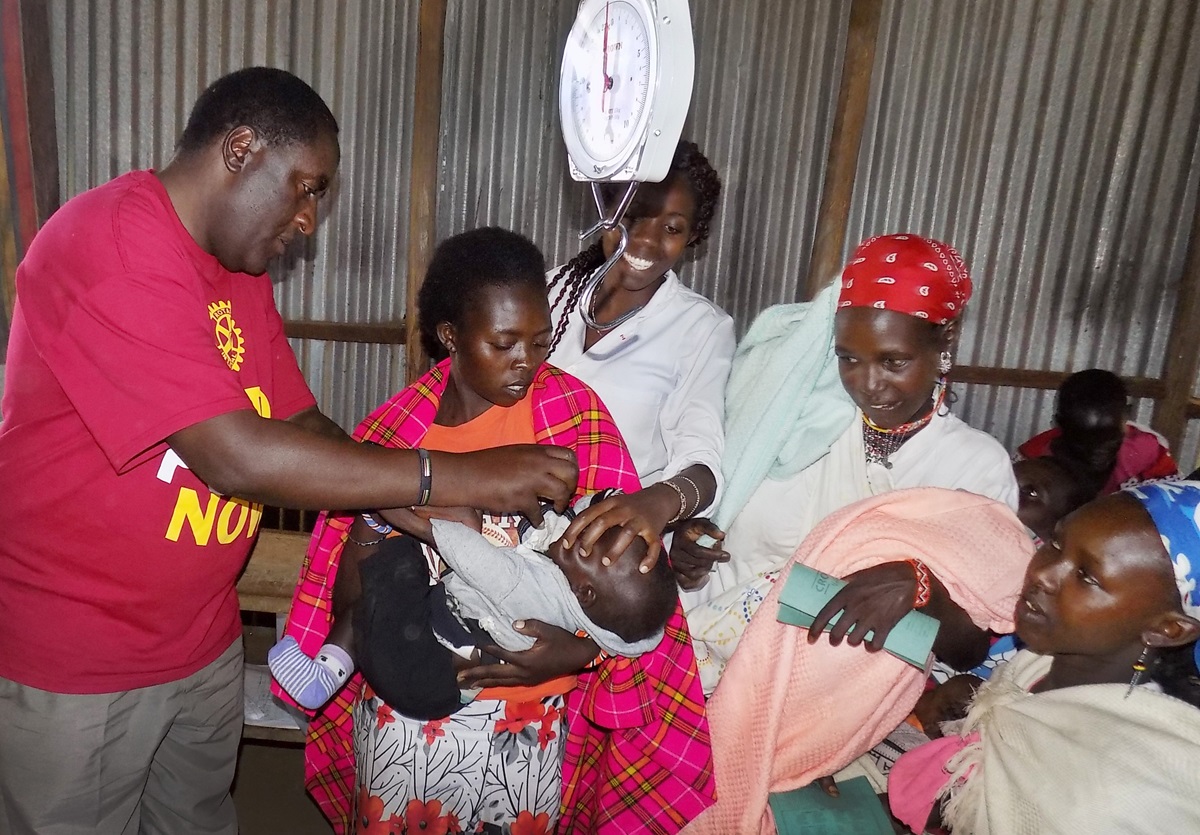
For many years, Angela Miloti from Kenya’s Tikoko village depended on traditional herbalists for her children’s health care. The mother of eight had lost four children before their 10th birthdays. She had never taken any of her children for immunization because of the taxing, four-hour walk to the nearest clinic.
Thanks to the Trinity Mobile Clinic, Miloti’s last baby was immunized.
Thousands of people across five interior villages in Kenya now have access to health services through collaboration between Trinity Mission Dispensary, a Trinity United Methodist Church project, and the Rotary Club of Gilgil. A 270-member congregation, Trinity is in the Narok District of The United Methodist Church’s Kenya Ethiopia Conference.
Since 2005, people have flocked to the dispensary for medical services. This is especially due to its proximity to the Nairobi-Nakuru highway, which connects the port of Mombasa to neighboring countries such as Uganda, Rwanda and Burundi.
However, needy communities deep in the villages sometimes were overlooked. Today, through the mobile clinic, The United Methodist Church serves thousands of people in Sogonoi, Nturumenti, Enosubukia, Sikutiek and Ole Tipis villages. A vehicle equipped with a mobile dental chair and assorted medical equipment is taken to a village a day for five days.
“I thought my children used to die due to being cursed,” Miloti said, “but through the outreach program, I now understand that it must have been due to lack of proper health care.”
Like Miloti, Grace Sikindai from Siyepei village would not take her children for immunization because of the long distance to the nearest health care center.
But this was not the only challenge Sikindai faced. She feared attacks by wild animals as she wound her way through bushes and thickets to the health center, almost nine miles from her home. Her husband could not accompany her, she said, because “he is usually busy looking after his cattle and goats.” That left her with no choice but to depend on traditional herbalists.
“Since the medical outreach started,” Sikindai said, “many people in our village have surrendered their lives to God. My husband, who used to abuse me so much, has stopped after attending the medical outreach and listening to the holy Gospel.”
Before the nurses start treatment in the morning, the Rev. Joe Kamau, Narok District superintendent, shares God’s word. This has also inspired village elders to slowly abandon such cultural practices as forcing girls to undergo female genital mutilation and early marriages.
Sikindai wishes The United Methodist Church would construct a church in her village, both for worship and to house a medical clinic. The facility, she said, would also empower local women, most of whom have never been to school.
Peter Turere, a village elder, said he is ready to donate land for church construction and other community projects to transform the local people.
“After starting of the medical outreach,” Turere said, “our children are now healthy, and our people are increasingly enrolling girls [in] schools. The nurses who attend to us during the outreach are young, educated women. It is our desire one day to see our women treating us.”
Rotary International chose Trinity Mission Dispensary to run the mobile clinic because of its proficiency in record keeping, financial management, accountability and transparency. A nonprofit, the dispensary focuses on bringing health care services closer to the people, not on making money, said Moses Njoroge, Rotary Club president.
Residents of Sogonoi village, for example, would pay up to $5 U.S. to travel to and from a government hospital. Most people in this community live on less than a dollar a day.
“Some mothers could barely afford to take their children for immunization and would prefer to go without having their children vaccinated,” said Stephen Kamau Maina, a community health worker and a local pastor assigned to Sogonoi United Methodist Church.
Since the mobile clinic began in March 2018, thousands of people — especially women and children — have accessed free, convenient medical services.
According to clinic records, more than 50,000 children across 98 schools were treated for parasitic worms between March and October, while 3,480 children were immunized. Through the same project, 12,754 people received curative medical services. A similar number received health education services, while 1,601 others were counseled on family planning. Additionally, 7,502 people were offered free HIV/AIDS counseling and testing, while 1,813 women received prenatal services.
Patients are nourished spiritually as God’s word is shared. Through the free medical services, the community has come to appreciate the church’s role in offering a holistic Gospel.
Trinity United Methodist Church and the Rotary Club of Gilgil have collaborated closely with the government through the ministries of education and health. The Ministry of Health provides vaccines, contraceptives and de-wormers, while the Ministry of Education offers the use of classrooms during the free medical camps, health education talks in schools and treatment of parasitic worms.
Through collaboration with local churches in the villages, mobile medical services are provided on their premises. This has enhanced ecumenical evangelism as it brings together different denominations for the glory of Christ.
Wanjiru is communications director for the Central/Narok District of the Kenya Ethiopia Conference.
News media contact: Vicki Brown at (615) 742-5470 or [email protected]. To read more United Methodist news, subscribe to the free Daily or Weekly Digests.
Like what you're reading? Support the ministry of UM News! Your support ensures the latest denominational news, dynamic stories and informative articles will continue to connect our global community. Make a tax-deductible donation at ResourceUMC.org/GiveUMCom.


