
When Martin Boehm began preaching to a wider group of believers, Mennonite leaders were so displeased they ex-communicated him.
Now — more than 240 years later — Mennonites have renounced “the small-mindedness of religious thinking” used against the former Mennonite bishop who became a founder of the present-day United Methodist Church.
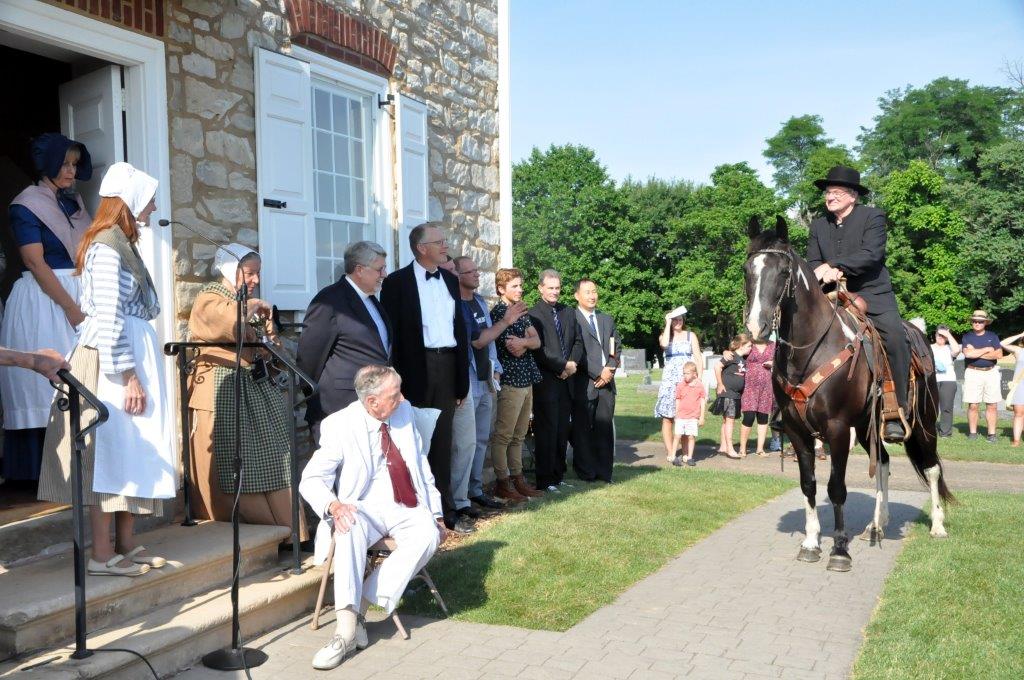
A ceremony restoring Boehm’s Mennonite credentials, including a formal confession of wrongdoing, was held June 26 at Boehm's Chapel, a United Methodist heritage landmark near Lancaster, Pennsylvania.
The chapel also marked its 225th anniversary over the weekend with worship, special meals, an “ice cream blitz” for kids, a time-capsule ceremony and community hymn sing.
The Rev. Chris Eden, pastor of Boehm’s United Methodist Church, adjacent to the chapel in Willow Street, Pennsylvania, and Dolores Myers, executive director of Boehm's Chapel Society, led the team that organized the weekend’s events. Joining the United Methodist volunteers were Mennonites and members of other area churches.
Among the participants was the Rev. Alfred Day, top executive of the United Methodist Commission on Archives and History. “To history geeks, this is a big story,” he said.
Brothers in Christ
Boehm and Philip Otterbein, from the German Reformed Church, were the key players in forming the Church of United Brethren in Christ, a predecessor body of The United Methodist Church.
It was an uncommon alliance. At the time, Day pointed out, the German Reformed were part of the religious establishment, while Mennonites were seen as radical outsiders and had been treated with disdain and even violence in the not-so-distant past in Germany. “There are incidents of German reformed people drowning Mennonites in mockery of adult baptism,” he said.
Boehm, raised a Mennonite, was outwardly religious but had no personal engagement with God, Day added, until he had a religious experience similar to that of John Wesley, the founder of Methodism, when Wesley found his heart “strangely warmed.”
Then Boehm started preaching, drawing large crowds, and he encouraged others to evangelize. Hearing him at Long’s Barn, Otterbein addressed him, saying, “we are brothers,” and creating “the backstory” for the United Brethren in Christ, Day said.
‘Packed to the rafters’
When it came time for the 4 p.m. service June 26, tiny Boehm’s Chapel “was packed to the rafters and there were people who spilled out the doors,” reported Day. He spoke to those gathered about the significance of historical landmarks within The United Methodist Church. Eden put the count at 230 people inside and 20 outside.
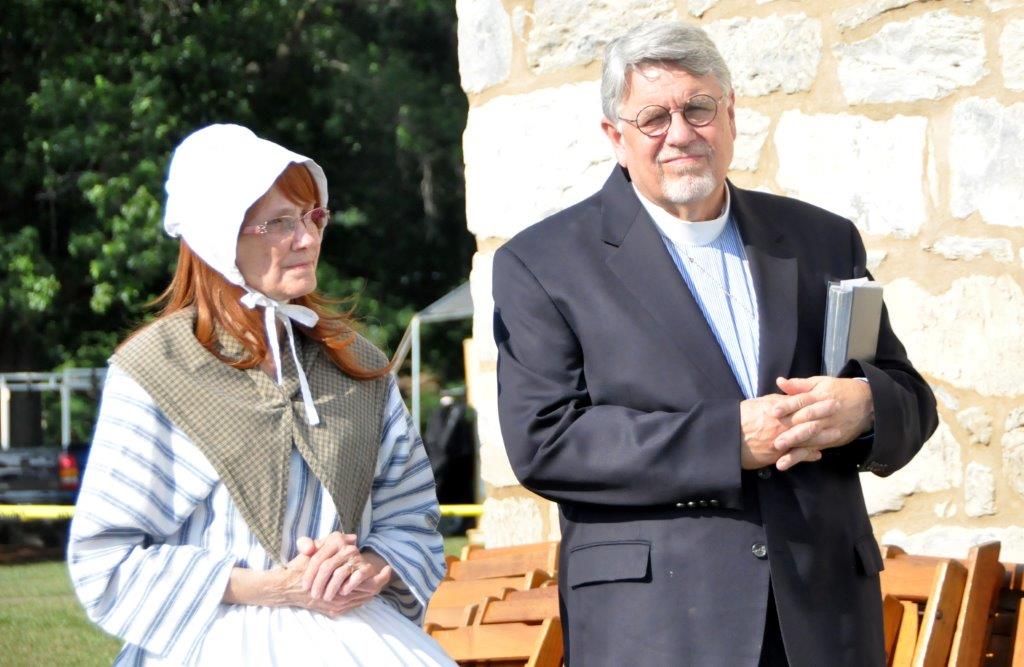
The preacher was United Methodist Bishop Peggy Johnson, Eastern Pennsylvania Conference, who dressed in colonial costume as Eva Boehm, Martin’s wife.
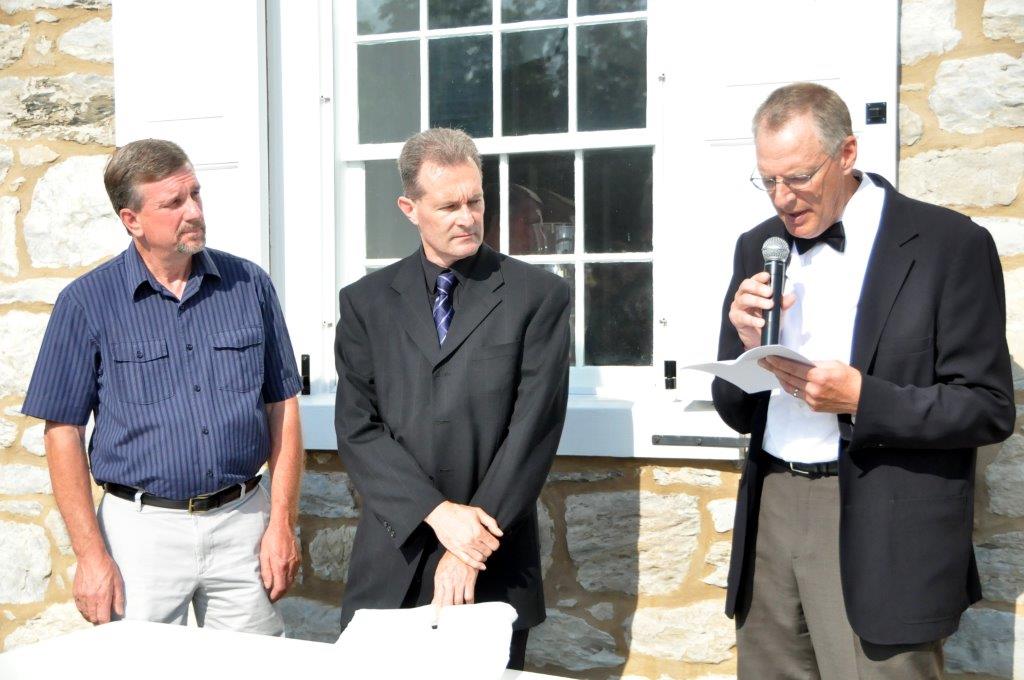
After a short procession to a large marble grave marker for the couple, three representatives of the Lancaster Mennonite Conference Board of Bishops — Bishops Stephen Weaver, Robert Brody and Lloyd Hoover — shared and signed the board’s confession and resolution. About a dozen of the Mennonites present joined them up front.
Additional photos of June 26 event
See more photos of the service reinstating Martin Boehm in the Mennonite church.
Weaver explained that Mennonite leaders of the day reacted fearfully to Boehm’s evangelistic zeal, trying “to regulate the Holy Spirit” and how it moved among them.
“As Martin’s anointed ministry to the surrounding communities increased, we put .observers in his meetings to mark and note his words,” Weaver read. “These notes later became the grounds for the deliberations surrounding his censure of excommunication and the stripping of his credentials.”
The local Mennonite community suffered spiritually as a result, he said. “Oh, our farms, the backbone of our communities thrived, but we became a marginal, reclusive people. A people our Anabaptist founders would not have recognized. Our boldness and Christ-like zeal were gone.”
The confession renounced the use of fear over faith, of misapplying Scripture and trying to exert too much control.
“We confess having tried ‘to catch’ Martin in his words or taking things that he said out of context,” Weaver read.
In the intervening years since Boehm’s excommunication in 1775, Mennonites have kept preachers and bishops “on a short-leash, spreading slander when their words convicted or disagreed with us,” he added.
“We renounce the small-mindedness of religious thinking that attempts to snare the servant of God in his anointed work.”
Adopted Feb. 26, the resolution rescinded the ban and censure of Martin Boehm and restores him as a bishop emeritus of the conference.
“Bishop Johnson, will you forgive us and offer us absolution?” Weaver asked after reading the statement.
The bishop offered her forgiveness. “I think that if we, in this spirit of humility, could start a movement, there’s no telling where this is going to end and how many hurts will be healed and how many lives will be changed because we’re willing to bind this up,” she said.
‘Reunifying experience’
Copies of the confession and resolution were given to Johnson and Boehm’s Chapel Society President Marv Adams, who recalled how, a year ago, two Mennonite board members for the chapel society took a board agenda item about Martin Boehm and decided to right a wrong.
“You’ve made it not just an historic day but one for our lives,” Adams told the Mennonite bishops. “We are brothers and sisters now.”
Many people embraced, some in tears, after the ceremony and many went to dine together under a large tent afterward.
Eden said it would be hard for his church to forget the experience. “The Boehm's Church congregation has been studying Bishop Boehm's story for decades, especially over the past few months,” he explained. “I know many of our Mennonite brothers and sisters have, too.
“On Sunday, we were 250 students receiving a master class on confession and repentance hosted by none other than the Holy Spirit.”
Day said the Boehm’s Chapel ceremony offers a lesson about healing and reconciliation “that particularly speak to our church at this moment in time.”
Past hurts and divisions can end without losing identity and heritage, he noted. “This is a reunifying experience after hundreds of years of brokenness.”
Bloom is a United Methodist News Service multimedia reporter based in New York. John Coleman, communications director, Eastern Pennsylvania Conference, contributed to this report. Follow Bloom at https://twitter.com/umcscribe or contact her at (615) 742-5470 or [email protected]
Like what you're reading? Support the ministry of UM News! Your support ensures the latest denominational news, dynamic stories and informative articles will continue to connect our global community. Make a tax-deductible donation at ResourceUMC.org/GiveUMCom.


