
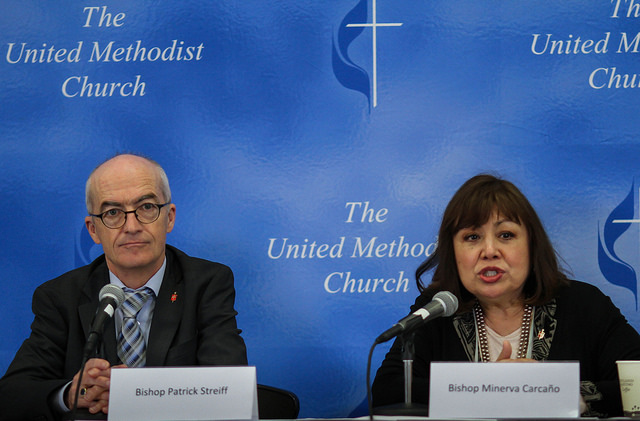
General Conference delegates spent two hours on May 11 on Christian conferencing, the practice of engaging in respectful and honest conversations. Leaders expressed hope that the session will set the tone as legislative committees begin meeting.
“The purpose of Christian conferencing is to grow together in holiness and seek to discern God’s voice through conversations with one another,” said Bishop Patrick Streiff, leader of the Central and Southern Europe Episcopal Area.
On the eve of legislative committee meetings, the 864 delegates met with their respective committees to share details about themselves, their ministry settings and their own ideas about living out the mission of The United Methodist Church. In groups of 12 sitting around round tables, the discussions among some of the groups evolved into relaxed, respectful conversations over the two-hour period.
“Once it became clear that we were just going to get to know one another, then I felt people loosen up,” said Ginger Gaines-Cirelli, a delegate from the Baltimore-Washington Conference and Christian conferencing participant. “For me, personally, it felt good to be in a context where I felt I could connect with some people that I didn’t know before and think about the beautiful diversity that’s going on throughout the world in the name of The United Methodist Church.”
Cynicism lifted
Andreas Elfving, a delegate from Finland-Sweden who also is a member of The Standing Committee on Central Conference Matters and is attending his fifth General Conference, admitted his usual cynicism was lifted by the Christian conferencing experience.
“This process we’re doing here shows there is hope that we can do things in a different way,” Elfving said. “Perhaps we can focus less on demonstration and find things we have in common. One of the hopes by doing this work now is that it will help the committees do their work in a different way and then when we gather in the big body of 864, that this will have an impact on the proceedings.
“Our faith in Jesus Christ and the way that we are all saved is something we have in common no matter where we are from,” said Elfving. “If we can get that feeling to be more important than the political agendas we have, then there is hope that we can move forward.”
Following the Christian conferencing session, Streiff and Los Angeles Episcopal Area Bishop Minerva Carcaño held a press conference to explain why Christian conferencing is vital to the future communication of the denomination.
In addition to sharing their personal experiences with Christian conferencing, the bishops described how Christian conferencing can be used to reach the goal of developing a global Book of Discipline.
“As we work toward a global or general Book of Discipline, it is important to listen to the realities and the challenges within our church,” Streiff said, adding that through Christian conferencing the worldwide nature of the church can be best revealed.
Please share this article with the hashtag #UMCGC
Caviness is a public relations specialist with United Methodist Communications. Contact her at [email protected] or 615-742-5470.
Like what you're reading? Support the ministry of UM News! Your support ensures the latest denominational news, dynamic stories and informative articles will continue to connect our global community. Make a tax-deductible donation at ResourceUMC.org/GiveUMCom.


