
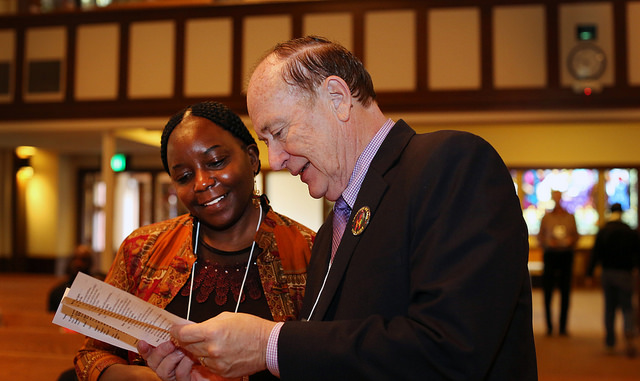
In a world where 37 million people are living with HIV/AIDS, a budget of $62,000 for the United Methodist Global Aids Fund is “a sin, a scandal, an embarrassment and a shame” said Bishop Gregory Palmer at a fund event on May 9.
“AIDS is Not Over! ... Global Issues and the Church” was a daylong workshop featuring United Methodist leaders and laity from around the world, an AIDS scientist and people living with HIV/AIDS. The event was held at Rose City Park United Methodist Church, one day before the denomination’s 2016 General Conference.
“I think the theme of this event says it all: AIDS is not over yet,” said the Rev. Don Messer, who has been working to raise funds for AIDS since the 2004 United Methodist General Conference approved the Global AIDS Fund. The church at that time committed to raise $3 million through apportionments and match it with an additional $5 million through Advance gifts.
The fund has raised over $3.5 million as of today and the money has gone to 284 projects in 44 countries, he said.
‘We can do more’
“We can do more; we must not leave this General Conference lacking the resources we need to do this work,” Palmer said.
Dr. Nancy L. Haigwood, scientist and leading researcher in the field of HIV, told participants when she works to raise funds for AIDS research she is often told that “the problem has been solved.”
AIDS is no longer the death sentence it was 30 years ago, but resources are very limited in many areas of the world, she said.
Joyce Torio, an AIDS advocate from the Philippines, said there are 22 new cases of HIV/AIDs every day in her country. “It is projected we will have 133,000 infected by 2022. One in four young people from the ages of 15-24 have HIV/AIDS."
AIDS education is a top priority, she said. “We need to go to the villages, churches and schools.”
Bob Skinner, who is HIV/AIDS positive, works with the Oregon-Idaho Conference to sponsor retreats for people living with AIDS. Infected in the 1990s, he lived for years without knowing. He said he spends $3,000 a month for his treatments.
“But how can you put a price on a person’s life?” he asked. “There is no reason for new infections.”
Preventing transmission
In a workshop on preventing mother-to-child transmission of HIV, Colette “Coco” Ramazani from the Democratic Republic of Congo told her story of getting HIV/AIDS when she was raped by her employer on her first job. She was also a victim of rape by soldiers and a Pentecostal pastor. She escaped to the U.S. and told her story in a book, “Tell This to My Mother,” by Joseph Mwantuali.
“I wished for death every day of my life but I am still breathing,” she said. “This is personal for me because I have wanted to be a mother since I was a child.
“I must be the last one (to get AIDS),” she said.
We are still trying to wake a sleeping church, Messer said.
“We have the capacity to end AIDS in our lifetime, but we will not do that as long as the church remains silent and apathetic, as long as education and messages of care and prevention are not shared with all the people of the world.”
Gilbert is a multimedia news reporter for United Methodist News Service. Contact her at (615) 742-5470 or [email protected].
Like what you're reading? Support the ministry of UM News! Your support ensures the latest denominational news, dynamic stories and informative articles will continue to connect our global community. Make a tax-deductible donation at ResourceUMC.org/GiveUMCom.


