
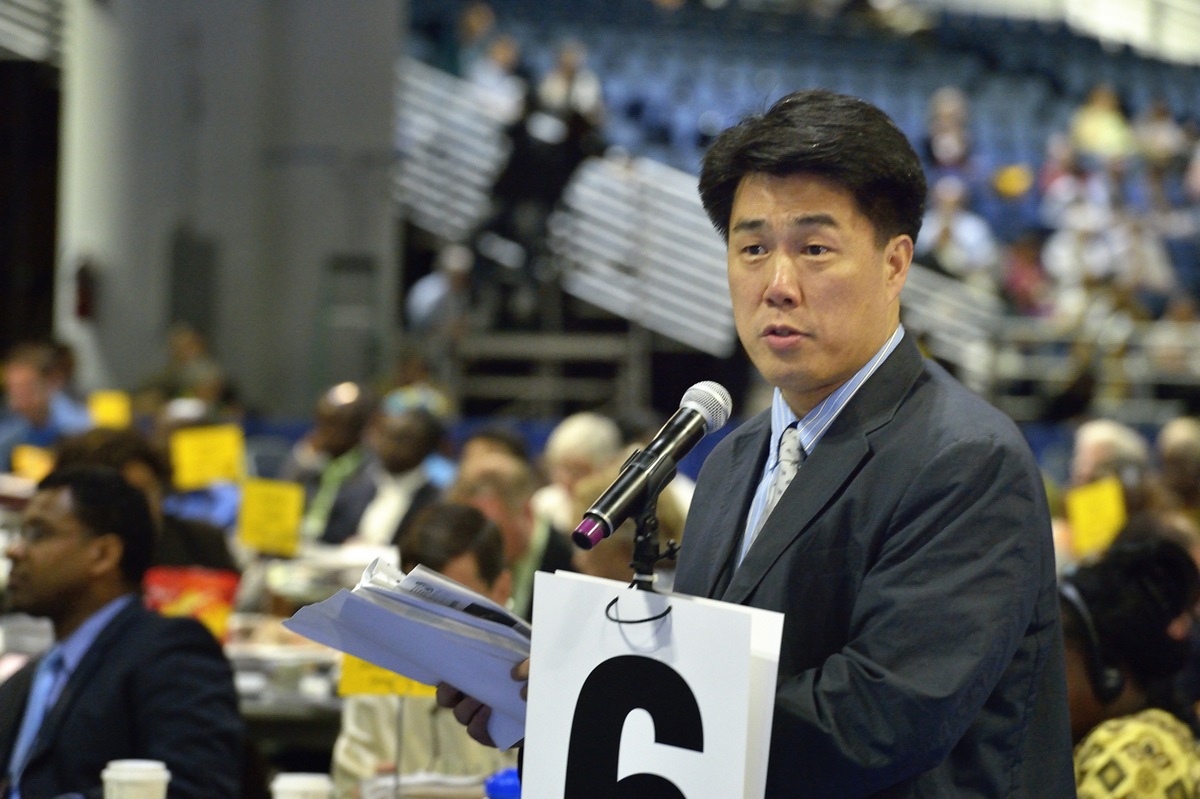
Many delegates were surprised and even shocked by how quickly a far-reaching proposal that takes away the security of guaranteed appointments for ordained elders breezed by The United Methodist 2012 General Conference.
The item was approved as part of a large number of proposals in the assembly's April 30 consent calendar. The consent calendar is a tool used by General Conference to expedite legislation wherein recommendations from legislative committees with no more than 10 votes in opposition are grouped and approved together.
There was a motion to reconsider the item but that motion also failed by a vote of 564 to 373.
Under this new legislation, bishops and cabinets will be allowed to give elders less than full-time appointment. The legislation also would permit bishops and their cabinets, with the approval of their boards of ordained ministry and annual (regional) conference's executive session, to put elders on unpaid transitional leave for up to 24 months. Clergy on transitional leave would be able to participate in their conference health program through their own contributions.
Under the legislation, each annual conference is asked to name a task force to develop a list of criteria to guide the cabinets and bishops as they make missional appointments.
The cabinets shall report to the executive committees of Board of Ordained Ministry the number of clergy without fulltime appointments and their age, gender and ethnicity. Cabinets also will be asked to report their learnings as appointment-making is conducted in a new way.
Earlier the assembly voted down a proposal that would have allowed elders and deacons to be eligible for ordination as soon as they complete their educational requirements and after serving a minimum of two years as a provisional elder or deacon.
The commission stated security of appointments for elders has been a major stumbling block for missional appointments.
Focus on mission
"Although I knew it was coming, I'm shocked at how fast it just passed right by in front of us," said the Rev. Gloria Kymn, pastor of Marysville (Wash.) United Methodist Church and delegate of the Pacific Northwest Annual (regional) Conference. She said she is "grieving" the loss of United Methodist heritage this petition brings.
"I am a true disciple of Jesus Christ, I am United Methodist and I am an effective clergy," she said. However, as a woman from an ethnic minority, she has experienced discrimination.
The Rev. Vance Ross, pastor of Gordon Memorial United Methodist Church, Nashville, Tenn., said guaranteed appointments have been critical to discouraging cultural bigotry.
"We have put something in place that allows an awful amount of opportunity to move in ways that are not part of the diverse and including values that we get from Jesus of Nazareth."
Security of appointment was established in 1956 to protect women clergy and later clergy of color, said the Rev. Tom Choi, Hawaii district superintendent and a member of the ministry study commission.
"These days, the group most protected by security of appointment is ineffective clergy," Choi said. "To that point, I have sometimes felt that there has been a distortion to a line in the Covenant Prayer in the Wesleyan Tradition: 'Let me be employed for Thee, or laid aside for Thee.' The cynical side of me thinks that a handful of elders and associate members have the attitude of 'Let me be employed for Thee, or let me be employed for ME.'
"My opinion is that the actual numbers of clergy affected by this legislation is very small."
The Rev. We Hyun Chang, pastor of Belmont (Mass.) United Methodist Church and a delegate of the New England Annual (regional) Conference, said guaranteed appointments were represented as something outside of missional appointments.
"Without (security of appointments) we would still be a male-dominated denomination &ellipsis; with even smaller numbers of ethnic clergy compared to any other denominations. It has served the church missionally and I regret that is promoted as one of the reasons we are losing our members."
In the United States, one in three churches have less than 40 in worship on Sunday, said the Rev. Ken Carter, chair of the Western North Carolina delegation and co-author of the ministry study report.
"What we have done is to displace local pastors often in poor and marginalized areas or created charges that are sometimes artificial and not helpful to the local churches to try to provide employment for elders," he said. They have continued despite ineffectiveness and this has done harm to local churches."
Carter said an amendment to the legislation allows for the monitoring of cabinets and bishops by an independent group of people not placed there by the bishop or cabinet.
"Most of our local United Methodist churches cannot provide continued appointment," he said. "The future may well look more like a bi-vocational ministry for a substantial number of our clergy."
*Gilbert is a multimedia reporter for the young adult content team at United Methodist Communications, Nashville, Tenn.
News media contact: Kathy L. Gilbert, Tampa, Fla., (813) 574-4837, through May 4; after May 4, Nashville, Tenn., (615) 742-5470, or [email protected].
Like what you're reading? Support the ministry of UM News! Your support ensures the latest denominational news, dynamic stories and informative articles will continue to connect our global community. Make a tax-deductible donation at ResourceUMC.org/GiveUMCom.


