
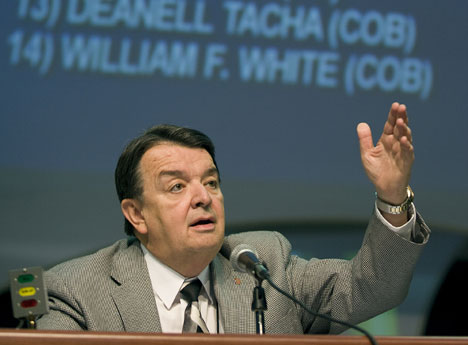
The 2008 General Conference on April 28 elected five new members to the top court of The United Methodist Church.
The nine-member Judicial Council acts as the church's top legal arbiter and will be made up of five clergy and four laity through 2016.
Angela Brown of California-Nevada and Ruben Reyes of the Philippines were elected to fill the two open slots for laity, while the Revs. Kathi Austin-Mahle of Minnesota, F. Belton Joyner of North Carolina and William B. Lawrence of North Texas were elected to fill the three clergy openings. All five elected were nominated by the Council of Bishops, which is made up of the top clergy leaders of the denomination.
The new Judicial Council members begin their eight-year terms at the closing of General Conference, the denomination's top legislative meeting held once every four years and ending May 2.
Among the lay people elected:
- Brown is an assistant district attorney and retired commander in the U.S. Navy who has served on all levels of the church, including as a conference lay minister and certified lay speaker.
- Reyes is an associate justice for the Supreme Court of the Philippines and is a member of Central United Methodist Church in Manila. He previously was presiding judge of the Court of Appeals and president of the Philippines Association of Law School professors.
Among the clergy elected:
- Austin-Mahle is coordinator of congregational resourcing in the Minnesota Annual (regional) Conference and chairs the United Methodist Higher Education Foundation. She has been elected to five General Conferences.
- Joyner is a retired pastor who served as district superintendent, assistant to the bishop and director of connectional ministries. He has been a delegate to eight General Conferences and has written several books. He also served as a Judicial Council alternate, 2000-2004.
- Lawrence is the dean of the Perkins School of Theology in Dallas and a past member of the United Methodist Commission on Religion and Race. He has served churches in Pennsylvania, New York and Washington D.C.
General Conference also elected 12 alternates to serve through the end of 2012.
The six lay alternates, with their annual conferences, are Jay Arthur Garrison, Holston; William F. White, Wisconsin; Raymond Mande Mutombo, North Katanga; Deanell Tacha, Kansas East; Thomas Byerly, West Michigan; and Mary Daffin, Texas.
Among the first alternates, Garrison is an attorney and serves as chancellor of the Holston Annual Conference. May is pastor at Anderson United Methodist Church in Jackson, Miss., and is a member of the United Methodist Board of Church and Society.
Members of the council are eligible to serve two consecutive eight-year terms, according to the church's Book of Discipline.
Current Judicial Council officers Daffin (vice president) and the Rev. Keith Boyette (secretary) of Virginia were nominated but not re-elected. The Rev. Shamwange P. Kyungu of the Northwest Katanga Conference in the Democratic Republic of the Congo was eligible for re-election but not nominated. He was elected as first alternate in 2004 and became a full member later that year when the Rev. Larry Pickens resigned to become chief executive of the church's Commission on Christian Unity and Interreligious Concerns. Because of travel and other difficulties, Kyungu has been able to attend two of the eight Judicial Council meetings during the most recent four-year period.
Dr. James Holsinger, a physician from Kentucky who has served as Judicial Council president for 2004–2008, and Rudolfo Beltran, an attorney from the Philippines, are retiring.
Council members Jon Gray, Beth Capen, the Rev. Susan Henry-Crowe and the Rev. Dennis Blackwell were elected in 2004 to eight-year terms.
*Caldwell is editor of the Virginia United Methodist Advocate and covers Judicial Council for United Methodist News Service.
News media contact: Marta Aldrich, e-mail: [email protected].
Phone calls can be made to the General Conference Newsroom in Fort Worth, Texas, at (817) 698-4405 until May 3. Afterward, call United Methodist News Service in Nashville, Tenn., at (615) 742-5470.
Related Articles
General Conference headlines
Judicial Council to be 'on call' at General Conference
Resource
Like what you're reading? Support the ministry of UM News! Your support ensures the latest denominational news, dynamic stories and informative articles will continue to connect our global community. Make a tax-deductible donation at ResourceUMC.org/GiveUMCom.


