

Prayer has replaced cocaine in the life of former addict Romeo “Jean Papi” Sonpon, one of the first people to be treated at the New Life Recovery Center here.
Sonpon, 32, said he now prays every morning upon waking and every evening before going to bed. Before becoming one of the first to get treatment at the new center, he hadn’t prayed for many years.
“My life here at the center has helped me reestablish my relationship with my mother, who has welcomed me into the family because of the role of the center in my life,” Sonpon said. “She is learning to trust me again.”
Substance abusers—called “residents”—meet weekly for counselling and rehabilitation at the center.
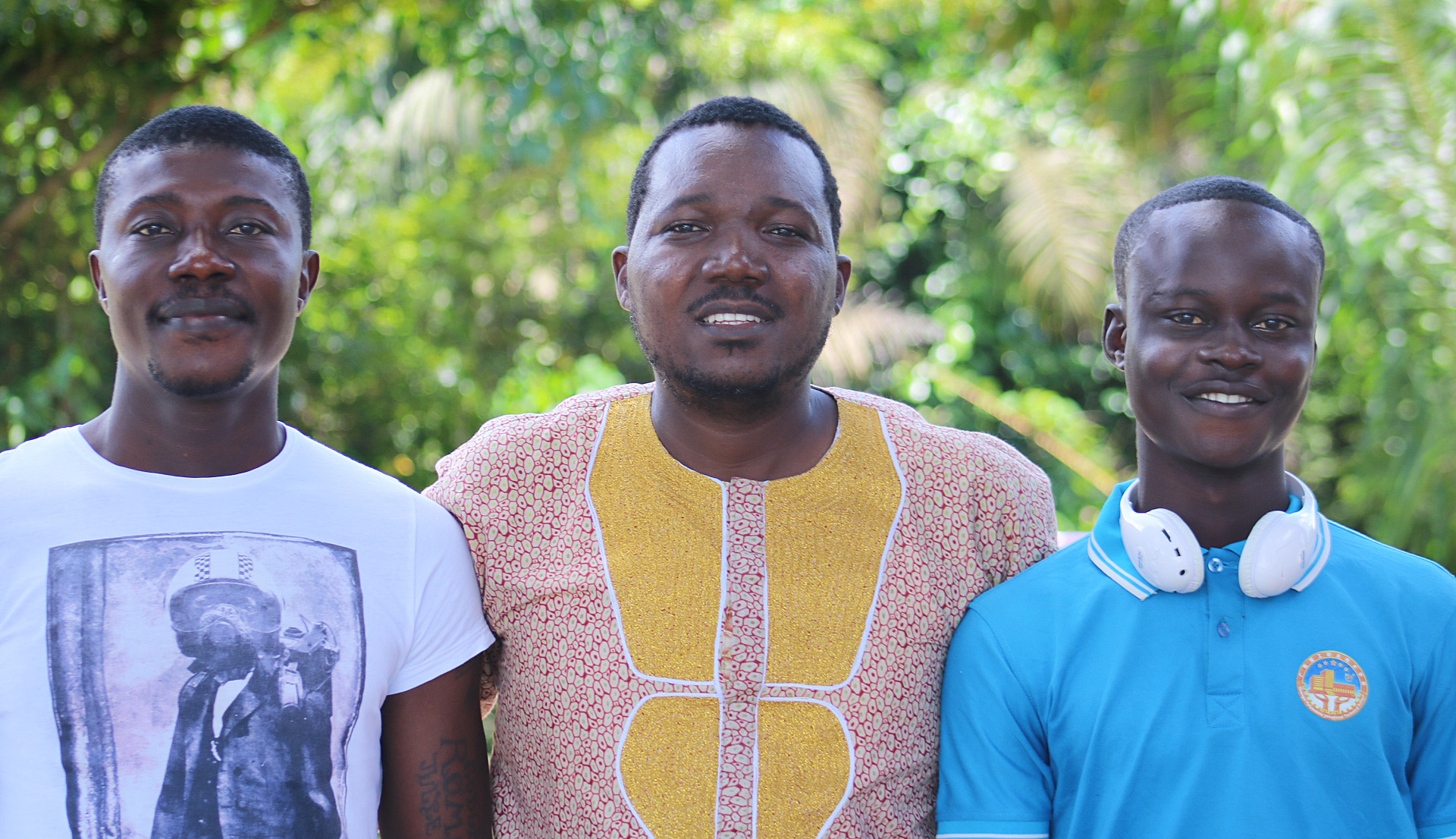
Jefferson Knight (center), director of the human rights agency of The United Methodist Church in Liberia, stands with residents of the New Life Recovery Center, Romeo “Jean Papi” Sonpon (left) and Life Buan. Photo by E Julu Swen, UMNS.
“The war on drugs is tough, but we as a church need to play a role that will ensure that young people will not remain victims of drugs,” said Jefferson Knight, director of the Human Rights Monitor of the United Methodist Church in Liberia.
The 20-bed center was built by The United Methodist Church through its human rights department, with contributions from other Christian churches in Liberia. More than $30,000 of the construction money came from members of The United Methodist Church of the Resurrection in Leawood, Kansas. The goal of the center is to help remove substance abusers from the streets of Monrovia and its environs, Knight said.
“We are using the center to help government fight its war against substance abuse and addiction in the country,” Knight said.
Sonpon, who dropped out of school in the fourth grade, said that the center is making him feel like he is needed in Liberian society. He hopes that his friends who are still hooked on drugs will also receive help.
“I am having three meals a day with vocational and academic educational activities, which will put me in a place that I was never going to get on my own,” he said.
Another patient, 18-year-old Life Buan, said his short stay at New Life Recovery Center has been rewarding, especially considering he is learning to read and write. Buan and Sonpon are even learning to bake at the center, with Buan’s mother doing the teaching.
“I can now make donuts for us to eat during breakfast,” Buan said.
Buan and Sonpon hope to make money by selling pastries in the community in which the center is located.
The requirements are strict to receive treatment, said Oliver Pratt, head of the residents at the center. Pratt has been key to the establishment of six recovery centers around Monrovia including West Point.
“No resident is allowed to handle or hold their own money for the first six months of being at the center,” Pratt said.
Residents are expected to uphold all the rules of the center, and must clear their bodies of illicit drugs before they can gain admittance to the program.
Pratt pointed out that once a resident is deemed clean and fit to go without the threat of relapse, he or she will be allowed to hold their own money.
Buan wants to return to school, but only under the supervision of the center.
“I don’t want to be overpowered by my friends who were using these substances when I am alone among them at any facilities like the school,” he said.
The $30,000 funding effort for the center at The United Methodist Church of the Resurrection in Leawood, Kansas, was led by the Rev. Jeff Kirby, his wife Michelle Kirby, men’s leader Tom Langhafer and church member Ron Smith.
Swen is a communicator in Liberia. News media contact: Vicki Brown, Nashville, Tennessee, (615) 742-5470 or [email protected]. To read more United Methodist news, subscribe to the free Daily or Weekly Digests.
Like what you're reading? Support the ministry of UM News! Your support ensures the latest denominational news, dynamic stories and informative articles will continue to connect our global community. Make a tax-deductible donation at ResourceUMC.org/GiveUMCom.


