Key points:
- General Conference normally holds staggered elections for the church court’s lay and clergy membership, but the pandemic has thrown off that schedule and required a reset.
- Half of those approved were elected to eight-year terms, while the rest were elected to four-year terms, parameters set by General Conference on April 30.
- Only two current Judicial Council members were re-elected, but two others are familiar faces on the court.
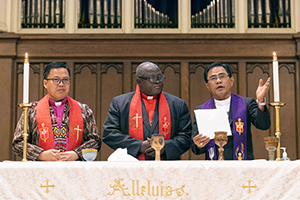
In a break from previous sessions, General Conference held elections May 1 for all nine spots on the Judicial Council, The United Methodist Church’s top court.
General Conference normally holds staggered elections for the church court’s lay and clergy membership, who serve eight-year terms. The goal is to periodically rotate between the majority of members being lay or clergy. But the pandemic has thrown off that schedule and required a reset.
Half of those approved were elected to eight-year terms, while the rest were elected to four-year terms, parameters set by General Conference on April 30.
Those new Judicial Council terms will begin May 3 at the close of General Conference. It is expected that the church court will gather before the close of the Charlotte gathering and elect officers.
The results, after multiple rounds of voting, are that only two current Judicial Council members have been re-elected: clergy members The Rev. Øyvind Helliesen of Norway and the Rev. Luan-Vu Tran of the California-Pacific Conference.
Helliesen has served on the Judicial Council since 2016 and was one of the editors on the adapted Book of Discipline for Northern Europe. Tran is a Harvard Law School graduate who holds a doctorate in Constitutional Law from McGill University.
Subscribe to our
e-newsletter
Two other clergy elected are familiar faces on the Judicial Council.
Top vote-getter the Rev. Angela Brown, a former district attorney in San Francisco, was elected in 2008 and resigned in 2016 when she was ordained a deacon in the California-Nevada Conference. The Rev. Susan Henry-Crowe served on the church court for 16 years and was president of the body from 2008 to 2012. The South Carolina Conference member recently retired as the top executive of the United Methodist Board of Church and Society.
The additional clergy member elected was the Rev. Jonathan Ulanday from the East Mindanao Philippines Conference. He has experience on the Philippines Central Conference Judicial Court and is a former district superintendent and assistant to the bishop.
The lay members elected on May 1, in order, were:
- Harriett Jane Olson, who a year ago retired as the top executive of Women in Faith (formerly United Methodist Women). She is a Harvard Law School graduate, and prior to working for the church, she practiced environmental law in New Jersey.
- Molly Hlekani Mwayera, currently a member of the Supreme Court of Zimbabwe. She is a member of the Zimbabwe East Conference.
- Bill Waddell, who has served as chancellor for the Council of Bishops from 2009-2024. Prior to that, he was chancellor of the Arkansas Conference.
- Andrew Vorbrich, the current chancellor of the Michigan Conference who also is serving as president of the church’s Chancellors Association.
Lay alternate members elected are, in order: Erin Hawkins, Jessica Vittorio, Kent Fulton, Thomas Lee, Thomas Starnes and Laurie Day.
Clergy elected as alternate members for Judicial Council are, in order: The Revs. Tim Bruster, Taylor Walters Denyer, Paul Perez, Beverly Wilkes Null, Mark Grafenread and Kate Croskery-Jones.
Caldwell is freelance journalist in the Western North Carolina Conference.
News media contact: Julie Dwyer at (615) 742-5470 or [email protected]. To read more United Methodist news, subscribe to the free daily or weekly Digests.