
One would think six months adequate time to pull off a trip from Nashville, Tennessee, to Wembo Nyama, Democratic Republic of Congo. Complex schedules forced three postponements, but the need remained unchanged. Pastors in training in the heart of the Congo urgently needed library and study resources.
The objectives were to reach theology students at Patrice Emery Lumumba University, deliver a library with e-readers and train students and faculty to use the tablet. The selected e-reader can contain around 1,000 e-books, works well without Internet and holds an electrical charge for two to four weeks — critical in remote locations that depend mostly on solar chargers. The e-readers contain 340 French e-books and theological documents: multiple versions of the Bible, dictionaries and John Wesley’s sermons, as well as texts on theology, pastoral care, United Methodist beliefs and liturgy, church history and classics, including contributions by African authors.
HOW YOU CAN HELp
Learn more about the E-Reader Project or donate online.
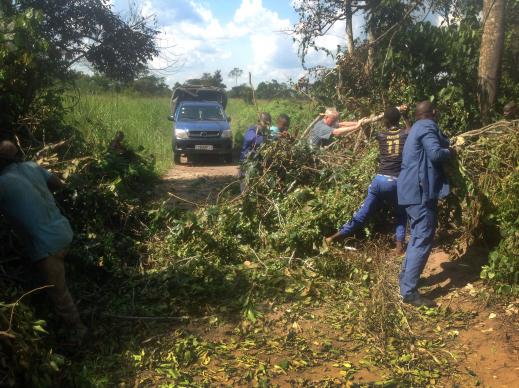
Arriving in Kinshasa on March 3, the Rev. Stephen Bryant, associate general secretary for central conference relations and resourcing, United Methodists Discipleship Ministries, joined me for a 600-mile journey by Congolese domestic airline and often-treacherous travel by four-wheel-drive truck.
Three days later, we reached Wembo Nyama. A warm welcome awaited us. A choir sang, children brought flowers, students expressed excitement and the school authorities were delighted to see us arriving after postponing the trip multiple times.
Training students, faculty, pastors
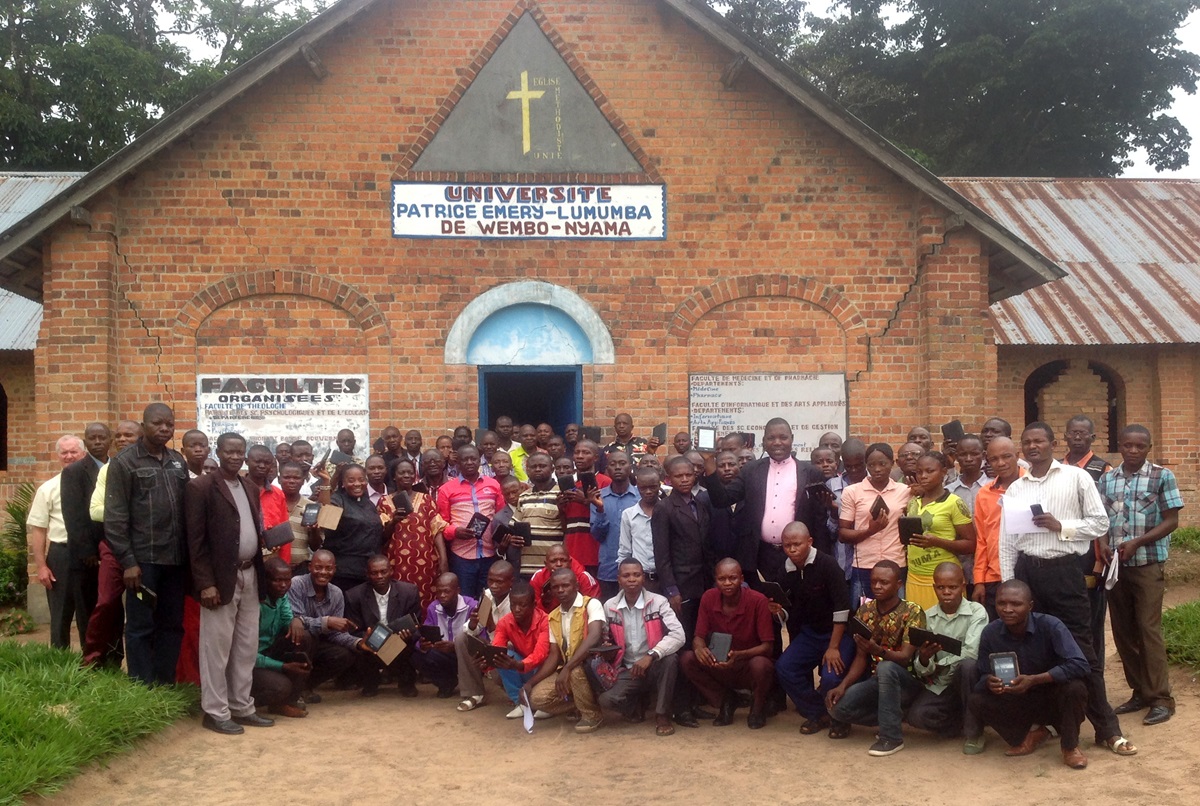
From March 7 to 9, Bryant and I trained 63 students in the faculty of theology, 15 lecturers and university authorities, and 22 active pastors. We taught about e-reader functions and care. We demonstrated how to charge the tablets and add more books to the device. Today, Wembo Nyama has 58 e-readers, offering an adequate library, though we plan to keep expanding it. At the end of the training, Discipleship Ministries and the Wembo Nyama Faculty of Theology formed an alliance for the future of the e-reader project.
The university dean, the Rev. Daniel Lunge Onashuyaka, opened the training with prayer. “By your son, Jesus Christ, you have enlightened us, and you said that my people, who were dying because of lack of knowledge, will be saved by the intelligence and wisdom which can come only from God.” Student Nsele Malanu, president of spiritual life, said, “This is a big contribution in the process of the globalization of our church.”
“Jesus taught [that] with faith, we can move a mountain,” Bryant said. “Through faith, we are moving a mountain — a mountain of books — from one part of the world to another and now to Wembo Nyama.”
A university leader expressed hope that, with faith and collaboration, the e-reader project eventually would serve beyond the faculty of theology. Active pastors and lay leaders voiced similar hope for having an electronic pastoral library to carry with them.
“What would make my joy complete,” Bryant said, “is to see you finish your studies feeling fully equipped and ready to be United Methodist pastors.” Holding up the “alliance cross” he received from the dean of the faculty of theology, he added, “We are truly united through the cross, which represents our alliance, but also represents the cost of progress and the sacrifice involved in God’s work for the sake of the world.”
What is the e-reader program?
In 2012, Discipleship Ministries launched an experiment with Gbarnga School of Theology in Liberia to address the scarcity of resources. The United Methodist Board of Higher Education and Ministry endorsed the experiment and joined in. Together, the two agencies sponsored and supported the pilot project. The United Methodist Publishing House provided (and continues to provide) access to their theological books at a discounted rate.
The African Association of United Methodist Theological Institutions embraced the idea for all 16 member schools. Manila Episcopal Area Bishop Rodolfo Alfonso Juan asked Discipleship Ministries to take the program to United Methodist seminaries in the Philippines. The program evolved as a partnership between the agencies and the seminaries. By the end of 2016, the program will have reached 22 seminaries — 18 in Africa and four in the Philippines.
The program has three main objectives: to create affordable access to core theological texts via e-reader (tablet); to enhance possibilities for teaching, learning and scholarship in pastoral education; and to develop sustainable funding through a combination of faculty and student fees, grants, fundraising and church sponsorships.
The program is being implemented in English, French and Portuguese and in faculty, student and evaluation phases. It involves periodically replenishing and updating e-reader libraries. Each school appoints a project manager and a team as needed. It requires commitment to good stewardship of the content and equipment, faithful care and use of the e-readers for their intended purpose, and communication of progress with partner agencies and donors.
The ultimate goal is to improve the quality of pastoral education and leadership in The United Methodist Church.
Pierre T. Omadjela is special projects manager for ICT4D and Church Initiatives, United Methodist Communications/Congo Central Conference. Omadjela, who grew up in the Wembo Nyama area, served as the primary trainer, teaching in French and Otetela.
Like what you're reading? Support the ministry of UM News! Your support ensures the latest denominational news, dynamic stories and informative articles will continue to connect our global community. Make a tax-deductible donation at ResourceUMC.org/GiveUMCom.


