
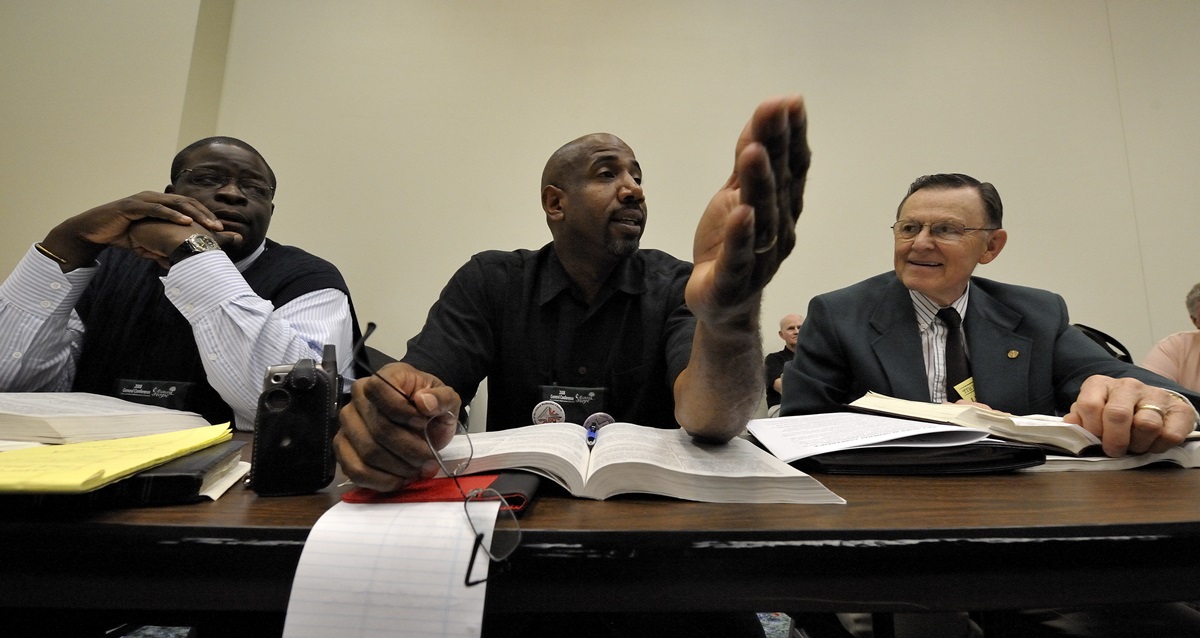
The Rev. A. Lynn Hill of Tennessee speaks in committee.
Delegates to the 2008 United Methodist General Conference rejected two petitions dealing with clergy ineffectiveness and guaranteed appointments.
The delegates followed the recommendations of the ministry and higher education legislative committee and voted 824-25 to not amend paragraph 334.1 of the United Methodist Book of Discipline. The petitions asked that bishops appoint an ineffective pastor to less than full-time service.
Because the petitions were placed on a consent calendar, delegates also voted on April 30 to reject an effort involving clergy evaluations. The legislation would have allowed a district superintendent to initiate changing the pastor's conference relationship after three evaluations found a pastor to be ineffective and not likely to become effective through training and counseling.
The General Conference also voted to keep the Clergy Retirement Security Program which was approved by the 2004 General Conference. The new pension plans for clergy and employees of United Methodist agencies became effective in January 2007. They provide a program that follows "the best practices of major corporations" by combining the characteristics of a defined benefit and a defined contribution plan.
In a vote of 763-38, delegates declined to rescind the Clergy Retirement Security Program, which was changed from the Ministerial Pension Plan.

Tara Thronson of Southwest Texas addresses fellow delegates.
The rejected petition, submitted by the Memphis Annual (regional) Conference, noted that money for the clergy retirement program is primarily deposited into pooled funds rather than placed in individual accounts as under the former plan.
A related petition to give individuals one of three choices for each payroll period was also rejected. The current defined-benefit program provides the same benefit to all clergy across the church, based on a formula of 1.25 percent of the Denominational Average Compensation multiplied by years of credited service. It includes a defined contribution component of 3 percent of actual compensation, which allows participants to accumulate cash in a self-directed individual account.
The rejected petition would have allowed an individual the option of contributing 3 percent of compensation, 3 percent of the conference average compensation or 3 percent of the denominational average compensation.
According the United Methodist Commission on Religion and Race, in collaboration with the Dakotas Conference, amending the defined contribution plan of the Clergy Retirement Security Program was necessary to "give justice to our racial/ethnic minority pastors and to clergy women."
*Green is a United Methodist News Service news writer based in Nashville, Tenn.
News media contact: Linda Green, e-mail: [email protected]; call (615) 742-5470.
Resources
Like what you're reading? Support the ministry of UM News! Your support ensures the latest denominational news, dynamic stories and informative articles will continue to connect our global community. Make a tax-deductible donation at ResourceUMC.org/GiveUMCom.


