
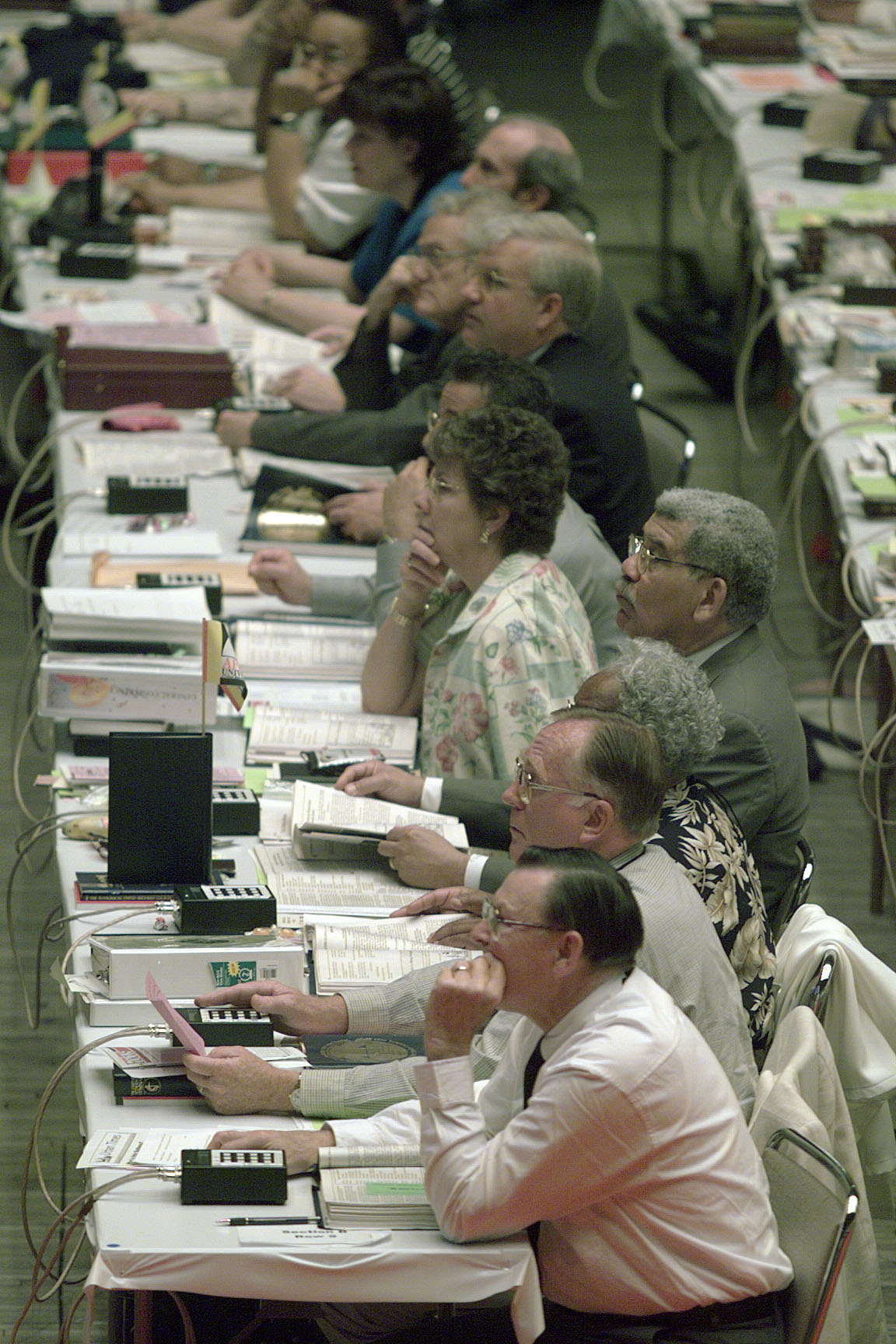
A survey of delegates to the upcoming United Methodist General Conference shows homosexuality is one of the top issues facing the denomination as well as society at large.
General Conference, the denomination’s top legislative body, gathers every four years. This year, 998 delegates, elected by their annual (regional) conferences, will meet April 27-May 7 in Pittsburgh.
The survey, conducted by the denomination’s Office of Research & Planning, General Council on Ministries, also listed war and violence, racism, poverty and “engaging a changing world” among the top five issues facing society.
Church finances, membership loss and restructuring were named as the other major denominational issues.
While “diversity and inclusivity” was considered the fifth top issue facing General Conference, the fifth issue facing the United Methodist Church as a whole was “unity for the denomination.”
The church’s major concerns are not new. Craig This, a council executive, noted that delegates have listed homosexuality, church finances, restructuring and membership loss as the top issues before General Conference in surveys since 1988.
Last October, 800 surveys for the 2004 General Conference were distributed to U.S. delegates, and 573, or 72 percent, of those polled gave responses. At the time, a lack of mailing addresses prevented mailing surveys to delegates outside the United States, according to the Office of Research and Planning.
The report on those surveys, A Hitchhiker’s Guide to U.S. Delegates at the 2004 General Conference, provides a description of the delegates — who they are, what they believe, where they serve the church, and what issues they see facing the church.
Of those responding, 35 percent are serving as delegates for the first time, compared to 38 percent in 2000. In terms of gender, 57 percent are male and 42 percent female. The number of clergywomen continues to increase, but “the number of laywomen appears to be declining,” the report said.
Nine out of 10 delegates polled reported an intense involvement in their local congregations, which included attending worship every week, assuming leadership roles and “regularly giving 5 percent or more of their net income” to their local church.
“A common perception is that General Conference delegates are nothing more than politicians,” the report stated. “General Conference delegates, by the very nature of their work, are called to be political — to debate, to caucus, to vote — but they bring to General Conference the qualities of individuals who are well-equipped to discern the will of God for the United Methodist Church.”
Seventy-two percent of the responding delegates are lifelong United Methodists. Among those who are not, 33 percent are former Baptists. Sixty-one percent serve or attend churches with 500 or more members, 56 percent are age 55 or older, and 30 percent are retired.
General Conference delegates tend to be more educated and have higher incomes than both the average person attending a local church and the U.S. population as a whole, according to the report. For example, while 12 percent of U.S. households have annual incomes of $100,000 or more, 35 percent of delegates earned at that level. Only 15 percent of delegates have household incomes of $50,000 or less, compared to 58 percent of the overall U.S. population.
More than three-fourths of the respondents — 79 percent — are white. Blacks and African-Americans represented 14 percent; Asians and Pacific Islanders, 3 percent; Hispanics and Latinos, 2 percent; and Native Americans, 1 percent.
“As a denomination, the United Methodist Church tends to reflect (the demographics) of other mainline denominations in terms of race and ethnicity,” the report said.
A copy of A Hitchhiker’s Guide to U.S. Delegates at the 2004 General Conference can be downloaded at http://www.gcom-umc.org/pdfs/methodistics/2004_report_2.pdf online.
*Bloom is a United Methodist News Service news writer based in New York.
News media can contact Linda Bloom at (646) 369-3759 or [email protected].
Like what you're reading? Support the ministry of UM News! Your support ensures the latest denominational news, dynamic stories and informative articles will continue to connect our global community. Make a tax-deductible donation at ResourceUMC.org/GiveUMCom.


