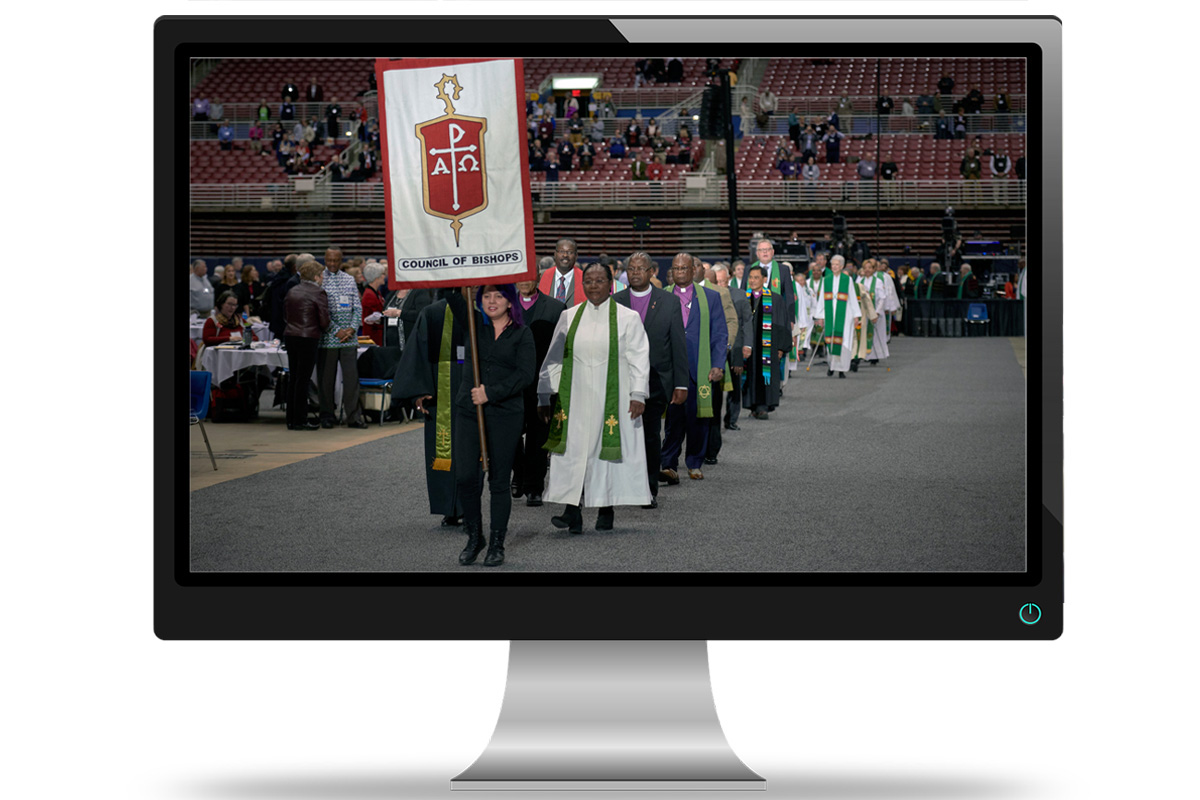
A group of delegates is pushing back against the bishops’ plans to hold a virtual one-day General Conference and put off new U.S. episcopal elections this year.
“We believe that the Bishops’ plan, in its current form, constitutes an ‘episcopal overreach,’” said the statement circulated by General Conference and jurisdictional delegates in the United States.
The U.S. delegates released the document “Christian Conferencing: Discerning United Methodism’s Path through a Pandemic,” ahead of a closed-door Council of Bishops meeting planned for March 22.
The statement urges bishops to work more cooperatively with delegates — who, like them, are elected to help discern the church’s future.
So far, six U.S. delegations — from the Greater New Jersey, Iowa, Michigan, New England, Northern Illinois and Oregon-Idaho conferences — have endorsed the five-page document. Fifteen delegates from 13 conferences are among the document’s writers and original signatories, with more delegates able to sign at umc-conferencing.org.
“I genuinely hope the Council of Bishops hears and takes seriously the delegates' appeal to greater collaboration and transparency,” the Rev. Jay Williams, head of the New England delegation and one of the statement’s co-writers, told United Methodist News.
Bishop Cynthia Fierro Harvey, Council of Bishops president and leader of the Louisiana Conference, said in this unprecedented season of multiple pandemics, United Methodists have been forced to adapt and done so at all levels of the church.
"The special sessions of the jurisdictional conference and General Conference are essential as we continue to adapt for the sake of the mission, now and in the future," she said be email. "Our collaboration with general boards and commissions, leaders of delegations, delegates to the General Conference and Jurisdictional Conference, committees on episcopacy and jurisdictional secretaries has been extensive, informative and helpful."
At a time when many church members are planning for a denominational split, the statement signers are delegates who, for the most part, hope to remain in The United Methodist Church.
The problem, as the delegates’ statement puts it, is that the bishops’ actions cut delegates out of the deliberation process and potentially tie their hands on the question of bishop elections.
Faced with depleting financial reserves, the bishops are urging that no new U.S. bishops be elected until 2024. At the same time, 16 U.S. bishops — more than a third of the country’s 46 bishops — plan to retire this year. That means the remaining U.S. bishops may end up serving expanded areas, or retired bishops will serve on an interim basis with voice but not vote at Council of Bishops meetings.
“The Council’s proposals — including not electing new bishops until 2024 — limit rather than empower delegates through Christian conferencing to make transformational decisions that shape our shared future,” the delegates’ statement said.
Many delegates see the bishops’ proposal as more extreme than necessary and see a way to elect at least some new bishops in a way that’s financially sustainable.
Still, the delegates acknowledge that church leaders are dealing with challenges never anticipated in church laws.
Because of COVID-19’s continuing threat, General Conference organizers postponed the global United Methodist lawmaking assembly for a second time — to Aug. 29-Sept. 6, 2022, in Minneapolis. Organizers said they saw no way for nearly 900 delegates from four continents to gather for a full meeting this year either in-person or online.
In the meantime, the Council of Bishops has called for a special virtual General Conference on May 8. However, the bishops’ call makes clear that the brief online meeting is intended only to gain a quorum to suspend the rules and open the way for delegates to vote by mail on a very limited agenda.
Bishops are asking delegates for an up-or-down vote on 12 legislative items that mainly deal with finances and other functions until a full General Conference can meet. Not on the agenda are any proposals to split the denomination or restructure it.
The statement supports delaying these big decisions until delegates can meet in person. However, given the unequal access to the internet around the globe, delegates have questions about whether even a brief online session can take place.
“The suggested process disenfranchises folk for the exact same reasons mentioned above, and the proposal to use mail-in paper ballots also causes much concern for us — around equity, transparency and trust,” the Rev. Alka Lyall, one of the statement’s co-writers, told United Methodist News. She is the head of the Northern Illinois delegation.
Subscribe to our
e-newsletter
However, the proposed legislation makes no explicit allowance for the five jurisdictions — the U.S. counterparts to the seven central conferences — to elect successors to any of their retiring bishops in this in-between time.
Instead, the Council of Bishops has called for special virtual jurisdictional conferences in July this year — but only for the purpose of retiring U.S. bishops, announcing coverage of episcopal areas and determining if jurisdictions will elect any bishops in 2022.
The delegates’ statement asserts the bishops’ call not only prevents the election of U.S. bishops but also elections of new general agency board members.
While a virtual General Conference must contend with technological inequities and a broad stretch of time zones, the statement notes, these challenges are less prevalent in U.S. jurisdictions.
The document asks bishops to call regular sessions of the jurisdictional conferences for the summer of 2021, in order to elect new bishops and board members of agencies. If the bishops do not, the statement says, church law allows jurisdictional conferences to call their own meetings.
“I understand that there may be challenges and changes to the manner in which the jurisdictional conferences might be held,” said the Rev. Bryant Oskvig, co-writer and delegate from the Baltimore-Washington Conference. “But I trust that the committees responsible for the gatherings can arrive at processes and ways of faithfully gathering, even if virtually.”
The Rev. Cedrick Bridgeforth, head of the California-Pacific delegation, told UM News he sees no urgency to act on the 12 items proposed by the bishops. He is troubled about the hold on bishop elections.
“We saw in the delegate elections for 2020 more younger people, more people of color and more first-time delegates,” he said. Many of the U.S. delegates were elected expressly because of their desire to end the denomination’s blanket bans on same-sex weddings and “self-avowed practicing” gay clergy along with their intent to elect bishops who share their view.
The delegates’ statement expresses hope for the denomination’s future. It urges bishops to work with delegates in a transparent manner in order to build consensus in shaping the missional, administrative and financial agenda for this season of change.
Williams said bishops and delegates need to be better stewards of the time offered by the delay of General Conference.
“We hope that the Council of Bishops amends its calls to General and Jurisdictional Conferences, as shaped by serious engagement with heads of delegations,” he said.
Hahn is assistant news editor for UM News. Contact her at (615) 742-5470 or [email protected]. To read more United Methodist news, subscribe to the free Daily or Weekly Digests.
Like what you're reading? Support the ministry of UM News! Your support ensures the latest denominational news, dynamic stories and informative articles will continue to connect our global community. Make a tax-deductible donation at ResourceUMC.org/GiveUMCom.


