
Assembly also honors ecumenical leaders, elects Judicial Council members
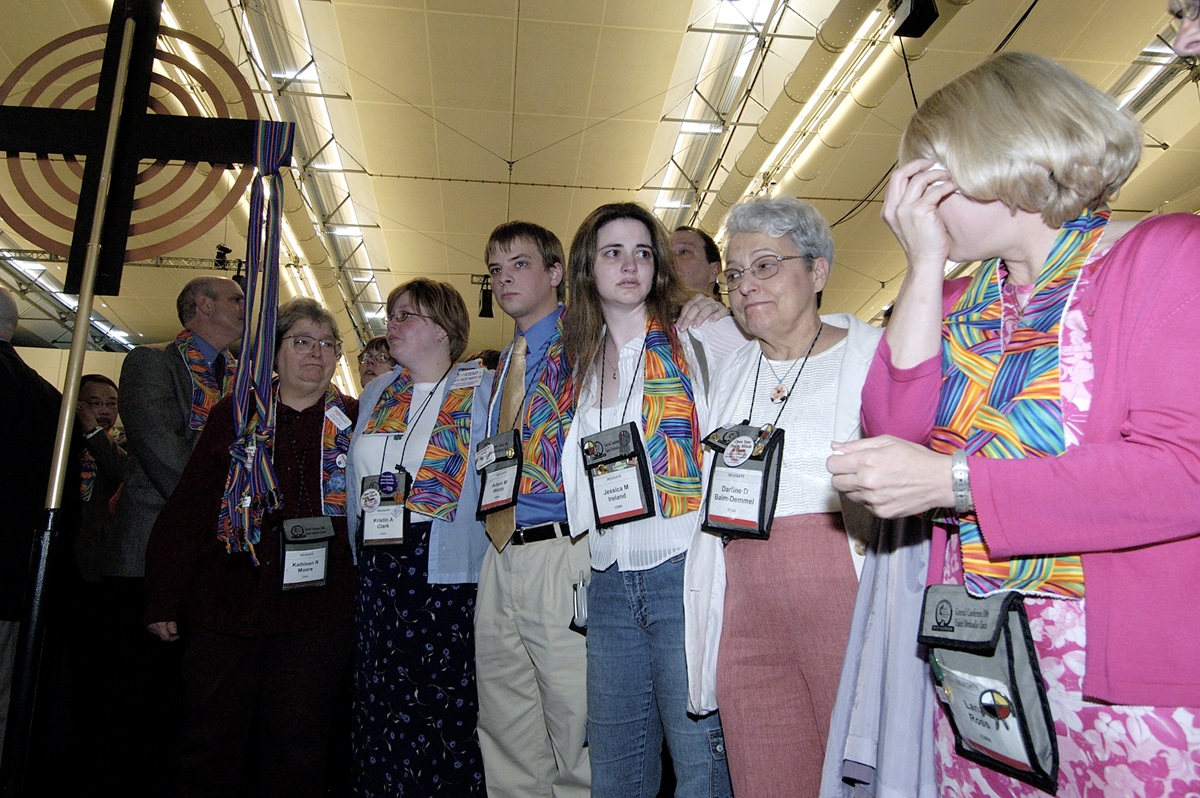
In vote after vote May 4, delegates to the United Methodist General Conference retained the denomination’s current positions on homosexuality.
Although delegates voted to alter slightly the language in Paragraph 161.G of the church’s Social Principles, they still affirmed that homosexual practice is incompatible with Christian teaching and rejected a proposed additional sentence to the paragraph that would have read, “We recognize that Christians disagree on the compatibility of homosexual practice with Christian teaching.” A clause was added that United Methodists “will seek to live together in Christian community.”
The Rev. Eddie Fox of Nashville, Tenn., said in a press conference after the 579-376 vote that if the church had not retained the language of Paragraph 161.G, “serious consequences could have happened (and) a possible hemorrhage could have occurred.”
But the Rev. James Preston of Rockford, Ill., declared that “hemorrhaging has already occurred.” The church did not speak the truth about itself and had a “healing option” but chose not to use it, he said.
While delegates made a few minor adjustments, prohibitions against the ordained ministry of self-avowed practicing homosexuals were upheld. The language in the 2004 United Methodist Book of Discipline will now read: “The practice of homosexuality is incompatible with Christian teaching. Therefore, self-avowed practicing homosexuals are not to be accepted as candidates, ordained as ministers or appointed to serve in the United Methodist Church.”
Following much debate, delegates defeated a minority report that would have given each annual or central conference — regional units of the church — the responsibility of determining how each will approach homosexuality as it relates to a person’s fitness for ministry.
Attempts to adjust language in Paragraph 162H, which deals with equal rights regardless of sexual orientation, were defeated by 2-1 margins. One defeated petition suggested the addition of a sentence supporting the right of same-gender couples to the same protections and benefits as married couples. Another petition would have added a sentence opposing “heterosexism in all its forms.”
Speaking to the equal rights issue, Tom Wilson, a lay delegate from the Pacific Northwest Annual (regional) Conference, voiced concern about the treatment of gays and lesbians by the denomination. “How much longer are we going to slam our church doors on them because of who they love?” asked the married father of three. “We need these people to share their stories in our homes, our churches and, yes, our pulpits.”
But the barring of gays from the pulpit was reaffirmed once again by the Judicial Council. On May 4, the church’s highest court ruled that a bishop may not appoint a pastor who has been found by a trial court to be a “self-avowed practicing homosexual.”
That decision came after the council was asked by delegates for rulings on the application of the Book of Discipline on the ruling of the clergy trial court in the Karen Dammann case and the “meaning, application and effect of Paragraph 304.3” regarding appointments.
Dammann, a clergy member of the Pacific Northwest Annual Conference, was found not guilty in March of the charge of engaging in “practices incompatible with Christian teaching,” even though the trial jury found she openly admitted to be a practicing homosexual.
Judicial Council did decide it had no authority to review the outcome of the Dammann trial. The council also stated that while a bishop may not appoint a clergy person who has been found by a trial court to be a self-avowed practicing homosexual, “it is up to the trial court to make that determination,” the ruling continued.
Seven of nine council members issued both dissenting and concurring opinions regarding the May 4 rulings.
In a 497-418 vote, delegates approved legislation prohibiting promotion of the acceptance of homosexuality and added a new section to the responsibilities of the Conference Council on Ministries in the Book of Discipline.
Wanting to ensure that no annual conference group gives church money to promote the acceptance of homosexuality, the delegates gave conference treasurers and councils on finance the authority to stop such transactions. The only exceptions to the rule are for ministries addressing HIV/AIDS or educational events where the church’s official position on homosexuality is evident.
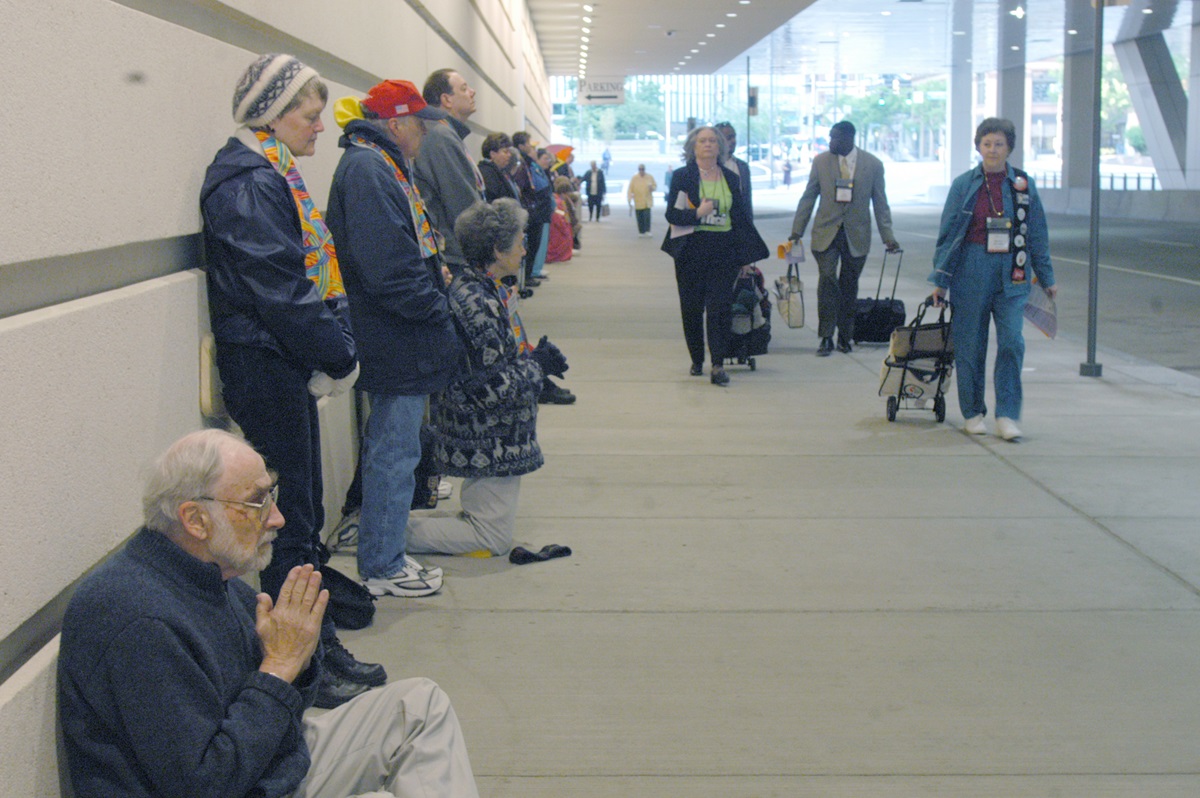
Before the May 4 actions were taken by General Conference, more than 200 United Methodists braved the near-freezing temperatures of early morning to kneel or stand in prayer in front of the David L. Lawrence Convention Center in silent witness to their desire for inclusiveness.
“I’m here this morning trusting in God’s spirit to work,” said Bishop Susan Morrison of the Albany (N.Y.) Area. “Prayer is the way to tune into the spirit. How could I be anywhere else?”
Sue Laurie of the Reconciling Ministries Network, an unofficial advocacy group, noted that the prohibition against ordination was not the only way to exclude. “Many times the church says, ‘Welcome, our doors are open,’ but lesbian, gay, bisexual and transgender people know when people don’t want their family photos in the church directory, or their flowers on the piano, or them teaching Sunday School.”
The day was not entirely consumed by legislation about sexual orientation. A morning “Service of Christian Unity” was held before a wide array of ecumenical guests, and two United Methodists were recognized for their contributions to ecumenical relations.
The Rev. Bruce Robbins, who served as chief executive of the United Methodist Commission on Christian Unity and Interreligious Concerns, received an award for ecumenical witness from the denomination’s Council of Bishops. A certificate of appreciation was presented by the Commission on Christian Unity to the Rev. Robert Edgar for his work in restoring “vitality and visibility” to the National Council of Churches during the past four years.
In his sermon during the worship service, Bishop McKinley Young of the African Methodist Episcopal Church told delegates that God is calling the churches “to do together what we cannot do apart.”
Young –– a prominent leader in the National Council of Churches, World Council of Churches and World Methodist Council –– reminded the gathering that the ecumenical movement has a collective commitment to society. “We, as the church, must not become the hands of government but must remain the conscience of government,” he said.
In other business, delegates elected two lay and two clergy members to eight-year terms on the nine-member Judicial Council. The election had been delayed one day because of difficulties with electronic voting machines.
Those elected and their annual conferences are Jon Gray, Missouri, and Beth Capen, New York, as lay members, and the Rev. Susan Henry-Crowe, South Carolina, and the Rev. Dennis Blackwell, Greater New Jersey, as clergy members.
So many people have been interested in the actions of General Conference that its official Web site,www.gc2004.org, has been overwhelmed with hits. On May 3, a record 1,875 people simultaneously visited the site, a number that is expected to increase before the meeting’s May 7 adjournment. Staff of United Methodist Communications has added capacity to accommodate the anticipated usage.
*Bloom is a United Methodist News Service news writer.
News media contact: (412) 325-6080 during General Conference, April 27-May 7.After May 10: (615) 742-5470.
Radio Stories
Like what you're reading? Support the ministry of UM News! Your support ensures the latest denominational news, dynamic stories and informative articles will continue to connect our global community. Make a tax-deductible donation at ResourceUMC.org/GiveUMCom.


