
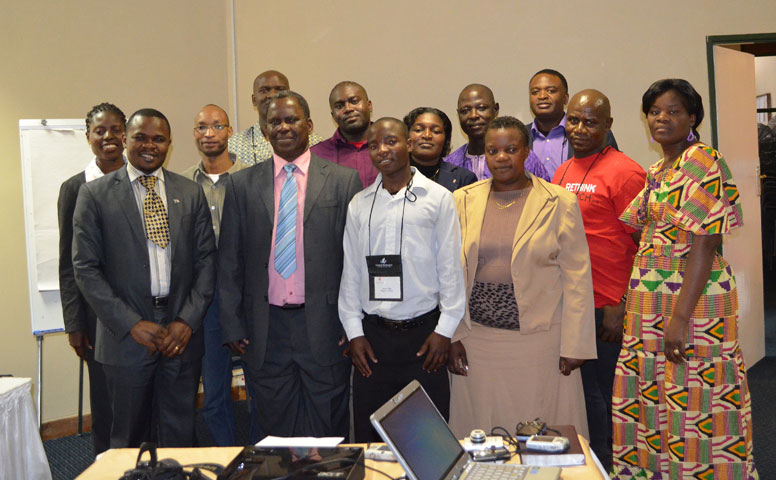
Fanuel Tagwira, the vice chancellor of Africa University, has challenged African United Methodists to use multiple channels of communications to reach various audiences.
Tagwira issued the challenge Monday, Aug. 27, in his keynote address to the African Communicators Workshop in Harare, Zimbabwe.
"Communication is at the center of what every organization/institution does, including the church," said Tagwira, who heads the United Methodist-related institution of higher learning.
He said those people who control and are able to use the media effectively shape values and opinions because they have learned the art of communication. He called for training people in various media forms. Unless you train people, he said, they would continue to use their old ways of communication.
"Communication is the key thread in the fabric of our church and any organization,'' Tagwira said, adding that communication was the nervous system of any organization. "It shapes us mentally, socially, emotionally and spiritually. It forms and sustains society."
Need for goals
As the world increasingly becomes a global village, there is need for The United Methodist Church in Africa to set goals in which new media can be used to reach all communities as the church works to alleviate poverty, improve global health and develop vital congregations and leaders.
"If the apostles (of Jesus Christ) lived today, they would use the Internet; they would use Facebook," Tagwira noted. He pointed out that if it is important to communicate, Africans need to know how to communicate.
He urged the communicators to learn how to use cell-phone texting, email, Facebook, Twitter and other emerging social networking tools.
Offering examples of how Africa University has adapted the new media, he pointed out how different groups of people use different types of social-media tools. For example, since it takes more than two months to get a letter from Zimbabwe to West Africa, the institution uses online facilities for admissions, grading and inquiries.
Tagwira gave another example of how some students at the institution rely more on Facebook than email to get their messages and respond. So, there was need to be aware, he said, of the choices that people make in getting information.
Remember the human touch
He, however, encouraged the communicators not to neglect the human touch, for which Africa University is known. He pointed out that 85 percent of the student applicants heard about the university by word of mouth.
The workshop, which continues until Sept. 1, has attracted 15 representatives from Sierra Leone, Nigeria, Malawi, Mozambique, Uganda, Liberia, Democratic Republic of Congo, Zimbabwe, South Africa and Zambia.
Some of the participants were encouraged by Tagwira's message.
"It was a timely message, given the high demand by people in Africa looking for more information in different ways," said Grace Nakajje, a communicator from East Africa Annual (regional) Conference.
For Naftal Massela Naftal, a communicator from Mozambique Episcopal Area, it was an inspiring message. He said he looks forward to learning more about how to improve his writing for the new media.
"The message will help to improve the use of technology in various annual conferences in Africa," said John Nyadaufe, a Malawian Provisional Annual Conference communicator.
Dauda Marafa Goding, a communicator from Nigeria, said he was especially moved by the call for African leaders to seize the opportunity to understand the value of effective communication.
The training is being conducted by the United Methodist Communications central conference director of communication, Tafadzwa Mudambanuki, and the Upper New York Area director of communications, the Rev. Maidstone Mulenga.
*This story was written by African communicators from Sierra Leone, Nigeria, Malawi, Mozambique, Uganda, Liberia, Democratic Republic of Congo, Zimbabwe, South Africa and Zambia.
News media contact: Tim Tanton, Nashville, Tenn. (615) 742-5475 or [email protected].
Like what you're reading? Support the ministry of UM News! Your support ensures the latest denominational news, dynamic stories and informative articles will continue to connect our global community. Make a tax-deductible donation at ResourceUMC.org/GiveUMCom.


