
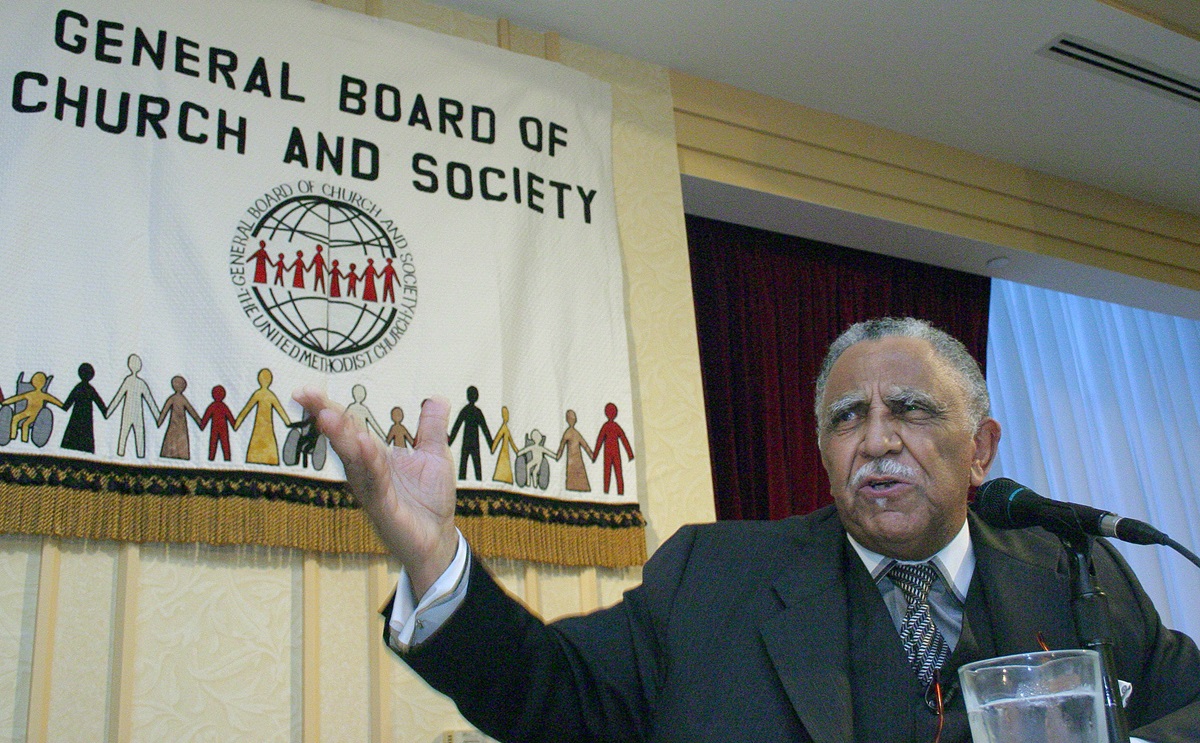
The Rev. Joseph Lowery often hears people wonder these days when the world is going to be “normal” again.
But, as he told participants at an April 30 dinner sponsored by the United Methodist Board of Church and Society, what the world is experiencing today is normal — a “new” normal.
“The challenge to the church is not to like it, but to love it,” the 82-year-old civil rights activist said. “It’s not comfort we’re called to experience, but courage.”
Lowery, a United Methodist pastor, knows a lot about living in a turbulent world. Called the dean of the civil rights movement by the NAACP and one of the country’s 15 greatest black preachers by Ebony Magazine, he has been involved in civil rights work since the early 1950s. Lowery and the Rev. Martin Luther King Jr. formed the Southern Christian Leadership Conference in 1957.
Because of recent problems with vertigo, Lowery remained seated as he quoted Micah 4:3 about beating swords into plowshares and spoke of the importance of rivers in African-American culture, about how being “down by the riverside” can provide both freedom and escape.
“The church is called today, I think, to take the nation down by the riverside,” he said.
His voice grew stronger and more insistent as he pointed to the inequities between rich and poor, categorizing minimum wage and lack of health care coverage as “weapons of mass destruction.” He suggested beating missiles into “morsels of bread” and tanks into tractors.
Lowery considers same-sex marriage to be more of a state than church issue but believes “people of faith can differ on this issue and respect each other.”
“I’m not an absolutist, but I know this much — I’m going to be on the side of inclusiveness, not exclusiveness,” he said. After years of struggle as an African-American, he explained that he could not refuse “to grant to anyone the rights that I enjoy.”
Lowery also expressed his distress over the war and continuing problems in Iraq. “Don’t we have something better to offer the world than swords and missiles and smart bombs on stupid missions?” he asked.
“The God I serve loves the motherless child in Baghdad as much as he loves the motherless child in Boston,” he declared.
*Bloom is a United Methodist News Service news writer.
News media contact: (412) 325-6080 during General Conference, April 27-May 7. After May 10: (615) 742-5470.
Like what you're reading? Support the ministry of UM News! Your support ensures the latest denominational news, dynamic stories and informative articles will continue to connect our global community. Make a tax-deductible donation at ResourceUMC.org/GiveUMCom.


