
Key Points:
- General Conference approved a plan to add two more bishops in Africa, increasing the number from 13 to 15 on the continent where the church is growing.
- But a number of delegates expressed frustration that the number was below the five initially sought by the 2016 General Conference.
- Also, delegates voted to adjust the boundaries of African central conferences so there will be four, instead of three, starting in 2025.
The United Methodist Church in Africa is getting two additional bishops, but not the five originally planned by the 2016 General Conference.
General Conference voted by 645 to 96 to add the two African bishops and voted by 692 to 43 to reshape The United Methodist Church’s map on the continent.
The April 29 votes supported petitions brought forward by the Standing Committee on Central Conference Matters, a permanent General Conference committee that works on issues involving church regions in Africa, Europe and the Philippines. Central conferences are the bodies responsible for holding United Methodist bishop elections in their respective regions.
The approved legislation increases the number of African bishops from 13 to 15, and it adjusted the boundaries of the three central conferences on the continent so there will be four starting in 2025. Changing central conference borders requires at least a two-thirds vote at General Conference, and that vote received 94%.
But debate — especially over the number of bishops to add — stretched across the morning and after lunch, with many delegates expressing frustration that the number was below the five bishops initially sought.
Delegates passed two amendments to that legislation, including one aimed at speeding up the addition of more episcopal leaders in the denomination’s fastest-growing region.
In 2016, the full General Conference authorized the standing committee to develop a comprehensive plan to add five bishops and potentially change the number and boundaries of central conferences on the continent. The standing committee submitted legislation in 2019 to do just that — before the global pandemic led to General Conference’s postponement from 2020 to this year.
Subscribe to our
e-newsletter
With the upheaval of COVID and the disaffiliation of a quarter of U.S. churches, the denomination’s financial situation has changed dramatically. As a result, the standing committee decided to revisit its legislation in consultation with United Methodist leaders from across Africa. Immediately before General Conference, the standing committee met and reduced the proposed additional bishops to two.
“We did our work throughout this protracted quadrennium with the intention of fulfilling completely the intentions of the voting delegates to the 2016 General Conference in Portland (Oregon), which did say five new bishops,” said West Ohio Conference Bishop Gregory V. Palmer. He led the standing committee’s task force that developed the Africa Comprehensive Plan.
“Subsequent to all of the challenges that The United Methodist Church has faced — some of which have been talked about here on the floor during this discussion — we attempted to work collaboratively with all of the voices … and we got to the number of two.”
The African continent currently has three central conferences — Africa, Congo and West Africa. Each includes multiple countries and languages.
The standing committee’s legislation adds one bishop to the current Congo Central Conference, bringing the total to five. It also adds another bishop to the current Africa Central Conference, bringing that total to six.
The legislation renames the Congo Central Conference as the Mid-Africa Central Conference and splits in two the Africa Central Conference — so named because it’s the oldest on the continent.
Under the legislation, the four central conferences, beginning in 2025, will be as follows:
- Mid-Africa Central Conference — consisting of Central African Republic, Democratic Republic of Congo, Gabon, Republic of Congo, Tanzania and Zambia. The central conference will have five bishops.
- East Africa Central Conference, formed from part of the Africa Central Conference — consisting of Burundi, Ethiopia, Kenya, Rwanda, South Sudan and Uganda. The central conference will have two bishops.
- Southern Africa Central Conference, formed from the other part of the Africa Central Conference — consisting of Angola, Botswana, Malawi, Mozambique, Namibia, Swaziland, South Africa and Zimbabwe. That central conference will have four bishops.
- West Africa Central Conference — Burkina Faso, Cameroon, Côte d’Ivoire, Guinea, Guinea-Bissau, Liberia, Mali, Niger, Nigeria, Senegal and Sierra Leone. The central conference will have four bishops.
In the legislation as submitted, the standing committee asked to continue to work to increase the number of African bishops after the 2028 General Conference. Delegates voted to amend the legislation so that the standing committee could bring its recommendation to “the next regular or special session of General Conference, whichever comes first.”
The Council of Bishops has announced its intent to call a special General Conference in 2026, but it has not yet issued a specific call about what that special session might consider.
Still a number of delegates said more bishops are desperately needed.
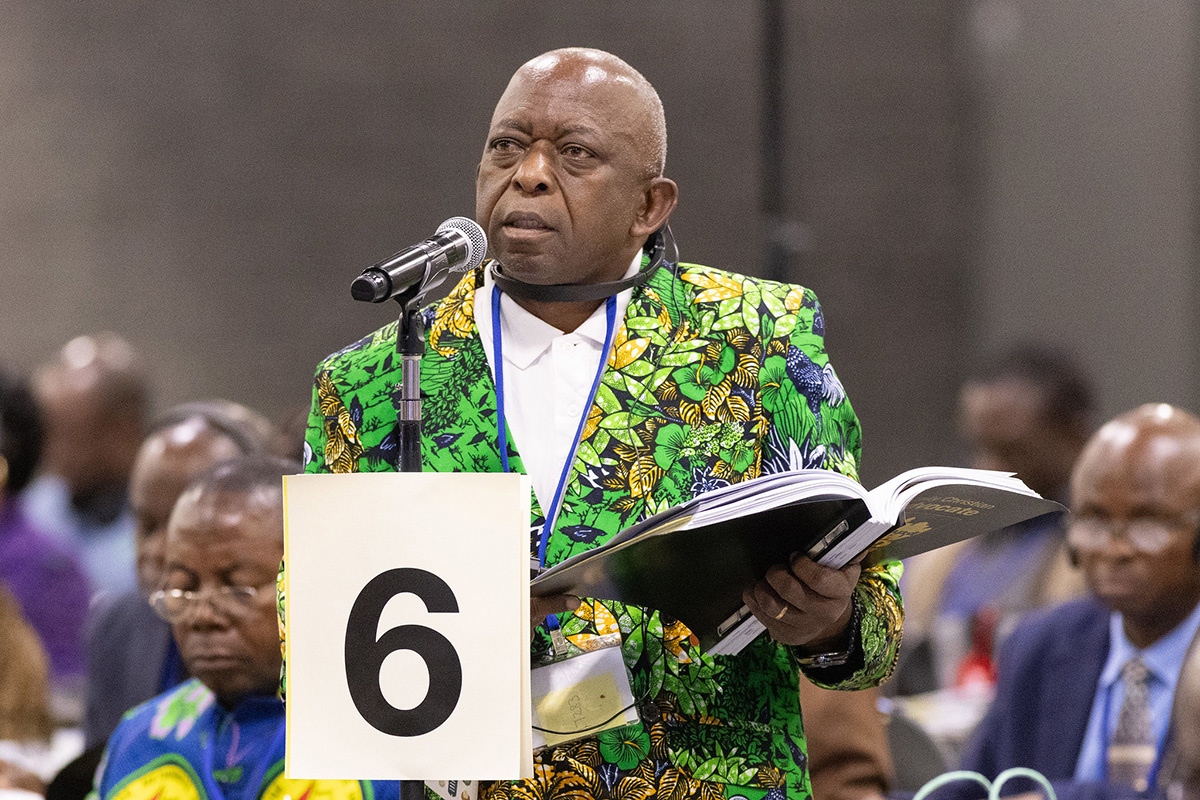
“Only giving one additional episcopal area to Congo Central Conference will create conflict,” Henoc Mwenze, delegate from South-West Katanga in Congo, said through an interpreter.
General Conference photos
Other delegates spoke up in favor of the legislation.
“I would like to respect the work that was done by the standing committee, and going into the future it was shared that more bishops will be added gradually,” said Maxwell Mironga, a delegate from the East Zimbabwe Conference.
One sticking point was that the legislation recommended how to adjust episcopal areas for the new bishops.
In the new East Africa Central Conference, the standing committee recommended creating a new episcopal area in Burundi.
In the Mid-Africa Central Conference, the standing committee recommended creating a new episcopal area from parts of North Katanga and South Congo episcopal areas.
Most controversially, within the Southern Africa Central Conference, the standing committee recommended combining the Angola East and West episcopal areas into one and adding an episcopal area to Zimbabwe.
The Rev. André Cassule Vieira, a delegate from Eastern Angola, pointed out that Bishop José Quipungo is about to retire.
“We deserve another bishop to replace Bishop Quipungo,” he said through an interpreter. “We deserve justice.”
Standing committee members clarified that these were recommendations and only central conferences can make the final decisions.
Nevertheless, delegates voted to amend the legislation to strike the recommendation to combine the episcopal areas in Angola.
By far, the biggest source of contention was the impact that adding more than two bishops in Africa would have on the budget.
The General Council of Finance and Administration, the denomination’s finance agency, has submitted a denominational budget that is 42% less than the budget that General Conference passed in 2016. The budget cuts the number of bishops in the U.S. Nevertheless, it includes funding for two more bishops in Africa.
African United Methodists contribute to the denomination’s Episcopal Fund, which supports bishops. But about 98% of funding for the denomination-wide budget, including bishops, comes from the United States.
With the U.S. struggling from disaffiliations, the Rev. Moses Kumar — the finance agency’s top executive — stressed that African United Methodists will have to increase giving significantly to pay for their bishops. At present, collection rates of apportionments — shares of church giving — in the U.S. are at 86% compared to 59% for the much lower apportionments in central conferences.
Some delegates suggested that African central conferences could choose to fund bishops independent of the budget.
But that is not how United Methodist governance works, said the Rev. Matthew Laferty, a delegate of the East Ohio Conference.
“In our United Methodist polity, decisions about money of our annual conferences are decisions of annual conference sessions themselves. Unfortunately, a delegation cannot make that commitment on behalf of their annual conference,” he said.
Germany Area Bishop Harald Rückert, the standing committee’s chair, said the legislation is the result of the tension the denomination is living between managing its financial strain and providing more episcopal leadership in growing areas.
“This petition before you as amended is the result of a long process of conversation, listening, consulting going back to 2016 or earlier,” he said. “Secondly, it’s about the increase in bishops from 13 to 15, and those two bishops are already included in the budget.”
Hahn is assistant news editor for UM News. Contact her at (615) 742-5470 or [email protected]. To read more United Methodist news, subscribe to the free daily or weekly Digests.


