

Key Points:
- The United Methodist Church has launched an emergency plan to combat measles in Congo.
- The strategy includes intervention in four priority areas: awareness, surveillance, vaccination and case management.
- Global Health is working with the coordinators of the church’s four Congolese health councils to implement the program
Faced with a resurgence of measles in the Democratic Republic of Congo, The United Methodist Church is preparing to play a major role in the fight against the disease.
With support from the United Methodist Board of Global Ministries’ Global Health unit, the church is implementing a joint emergency-response plan against measles. According to Kathleen Griffith, team leader and director for Global Health, the proposed interventions include:
- Community engagement and social mobilization;
- Community surveillance and referral of all children with measles to health facilities;
- Vaccinations; and
- Investigation and case management in health facilities. Examples are diagnosis, treatment and prevention of complications.
Griffith said these interventions are in addition to planning, training and monitoring. She said Global Health grants will cover “the most affected areas that our health boards support. We are also seeking funding from like-minded organizations as part of this essential response.”
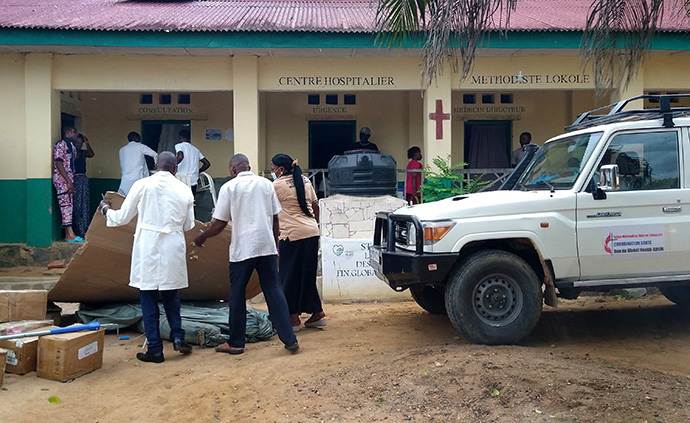
Global Health is working with coordinators of the church’s four Congolese health councils, under the leadership of Dr. Megh Jagriti, program manager for the unit’s maternal, newborn and child health and Health Systems Strengthening expert, and Dr. Philippe Okonda, consultant and former president of The United Methodist Church’s health council in Eastern Congo.
Thirteen health facilities in 13 priority health zones were selected, Okonda said. More than 214,000 people live in these areas.
“The choice of these facilities,” he said, “was made after analyzing the situation, based primarily on the incidence of the disease and the risk of negative repercussions on the communities served by the church's maternal, newborn and child health program.”
The plan calls for supporting health facilities in terms of medicines for patient care, as well as training for staff at all four health-coordination centers to promote data quality.
Community groups will learn to raise awareness of vaccination to protect children against measles.
“They also will visit households to look for sick children and refer them to health facilities,” Okonda said. “Emphasis will be placed on improving data quality to inform on progress.”
Measles cases in Congo continue to rise. According to data from the Congolese Ministry of Health, the number of suspected measles cases reached 311,500 in 2023, including 5,799 deaths. All 26 of the country's provinces are affected by the epidemic. The previous year, 2022, some 148,638 cases were recorded, with 1,875 deaths.
Dr. Damas Lushima, coordinator of The United Methodist Church’s health department in Eastern Congo, said measles is a potentially fatal disease, especially for children.
A highly contagious viral disease, measles can cause serious complications, including pneumonia, encephalitis and death.
“Children under the age of 5 are most at risk,” Lushima said. “A person carrying the virus can infect up to 90% of the unvaccinated people around them, so ensuring maximum vaccination coverage is vital.”
Subscribe to our
e-newsletter
The vaccine offers almost total protection, if administered twice, said Dr. Joseph Assumani, coordinator of the Expanded Program on Immunization in South Kivu.
“The problem we face in the DRC,” he said, “is that, in some cases, routine vaccination is not effective for various reasons.”
The lack of temperature-controlled supply chains to preserve vaccines, shortages of inputs in health facilities, difficulties for families to access health centers and the reluctance of some parents to vaccinate are some of the challenges.
“Measles,” Assumani said, “has no specific treatment. The best way to fight it is through vaccination. Unfortunately, some children miss their doses.”
Okonda said the project involves working together for the common good.
“This plan,” he said, “is a pilot initiative in which the four health councils will have to work together in a joint response to a public health problem.”
The initiative demonstrates The United Methodist Church’s commitment to improving the state of health of the Congolese people, Okonda said.
Lushima said health workers also are committed to the project.
“Along with other health coordinator colleagues,” Lushima said, “we are determined to do everything in our power to fight this disease and protect the children of the DRC.”
Londe is a communicator and UM News correspondent in Congo.
Contact: Julie Dwyer, Editor, [email protected] or 615-742-5469. To read more news from The United Methodist Church, subscribe to our free daily or weekly newsletters


