
Key Points:
- The United Methodist Church has helped 5,000 survivors of two fires that ravaged a camp for displaced persons in Malicha, Congo.
- Funding from the United Methodist Committee on Relief enabled the purchase of 74 tons of food and non-food items, including rice, corn flour, vegetable oil, salt, sugar, beans, soap, basins, empty fuel containers, toothbrushes and more.
- Jean Tshomba, coordinator of the disaster management office, said survivors were living in exceedingly difficult conditions.
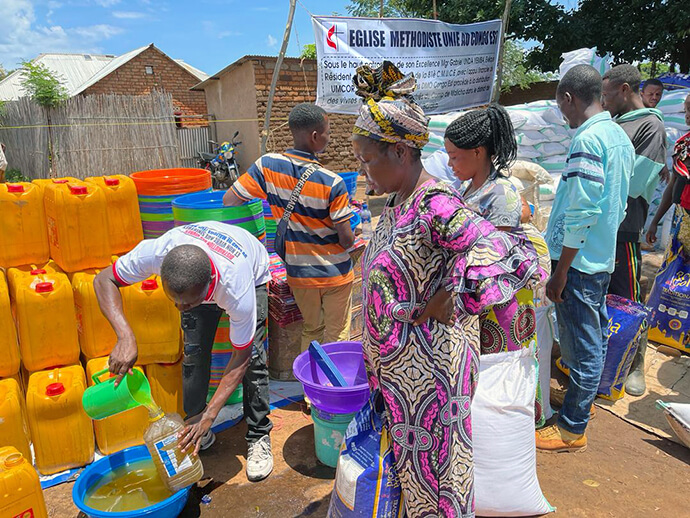
Thousands of fire survivors received food and other supplies distributed by The United Methodist Church in eastern Congo.
Two fires ravaged the Malicha internally displaced camp in South Kivu in August and October. More than 4,000 makeshift shelters were destroyed, leaving people without possessions, shelter, food or means of subsistence.
A team from the church’s disaster management office — the humanitarian arm of The United Methodist Church in Eastern Congo supported by the United Methodist Committee on Relief — visited the Fizi District to help. More than 1,000 households, about 5,000 people, benefited from the aid.
Jean Tshomba, coordinator of the disaster management office in Eastern Congo, said survivors were living in exceedingly difficult conditions.
“Thousands of households were forced to leave their villages, fields and livelihoods to flee the hostilities,” Tshomba said. “They are doubly victimized, because in addition to fleeing the war, they were victims of two fires that completely ravaged their camps, leaving them once again empty-handed.”
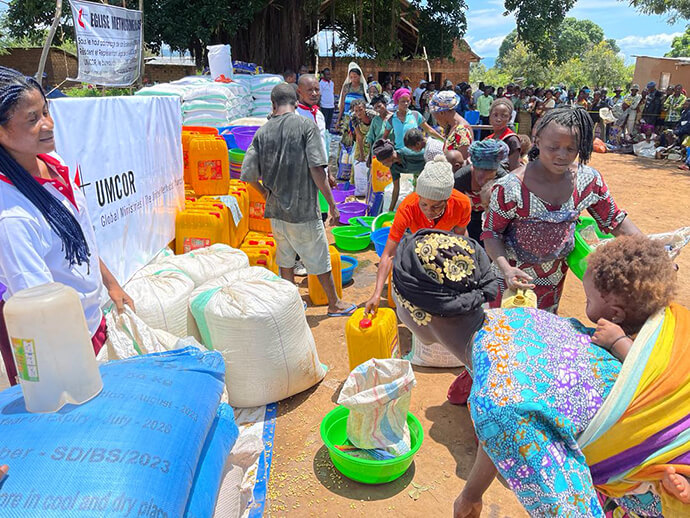
Funding from UMCOR enabled the purchase of 74 tons of food and non-food items, including rice, corn flour, vegetable oil, salt, sugar, beans, soap, basins, empty fuel containers, toothbrushes and more.
“The help provided by The United Methodist Church was an immediate relief for us,” said Asende Lumumba Milando. “We had lost everything we owned and were in a desperate situation.”
Eastern Congo Area Bishop Gabriel Yemba Unda declared that the church was obliged to aid the people, calling the humanitarian situation on the ground “very worrying.”
“The loss of their homes and essential possessions had exacerbated their already-existing vulnerability,” Unda said. “That’s why it was vital, not to say morally obligatory, for the church to provide them with immediate support in terms of food and non-food items.”
How to help
Support relief and recovery efforts around the world through the UMCOR International Disaster Response and Recovery Advance #982450.
Tamasha Salima, a mother of five, expressed relief.
“I’m so grateful to The United Methodist Church for their help,” she said. “We had lost everything in the fire and did not know how we were going to get through it. This help gives us a new lease on life and allows us to start living again. I am very hopeful that we will be able to rebuild our lives and offer our children a better future.”
Appreciation also was expressed by Mwanashamba Useni, who heads a family of eight.
“This is an extraordinary gesture from The United Methodist Church,” Useni said. “This aid is of great importance to us, as it enables us to provide for our family’s basic needs. We feel supported and accompanied in this difficult ordeal. The solidarity of the church gives us the courage to face the future.”
In December 2023, after a period of relative calm, fighting resumed between the M23 rebels, who receive support from the Rwandan army, and the Congolese armed forces in the province of North Kivu.
Resumption of hostilities triggered a new wave of population displacements, aggravating the already precarious humanitarian situation in the region, Tshomba said.
Thousands of people were forced to flee their homes and now live in internally displaced camps or with host families, without access to basic services such as food, drinking water, sanitation and health care.
According to the United Nations Office for the Coordination of Humanitarian Affairs, over 2.5 million internally displaced people have been registered since the start of hostilities.
Subscribe to our
e-newsletter
“The United Methodist Church has stepped up its humanitarian aid in the area in recent years,” Tshomba said. “But the needs are multiplying every day because of the war.”
Salima expressed gratitude to the church and the generous donors who made the help possible. “Your compassion and support,” she said, “have brought us immense joy and given us the strength to carry on.”
“May God bless The United Methodist Church and all those who have contributed to this humanitarian aid,” Useni added. “Your generosity has brought us immense comfort and allowed us to regain a little hope.”
Urging continued support for displaced people and survivors of natural disasters, Milando said, “Your help is essential to enable us to rebuild our lives and regain a better future.”
Londe is a broadcaster and UM News correspondent in Congo.
News media contact: Julie Dwyer, news editor, [email protected] or 615-742-5469. To read more United Methodist news, subscribe to the free daily or weekly Digests.


