
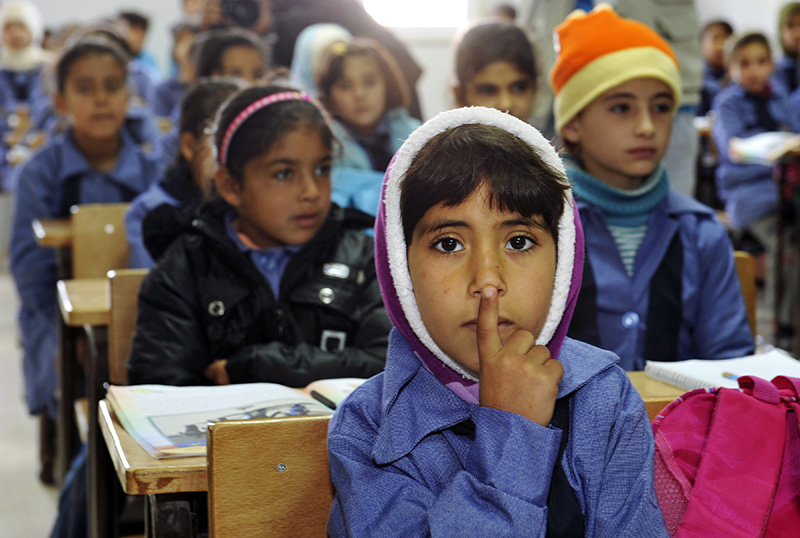
Every day, an estimated 5,000 Syrians flee their homes and the civil war that engulfs their country.
That’s the startling new figure released Sept. 3 by the United Nations as the global debate on how to respond to chemical weapon attacks against Syrian civilians intensified. The total number of Syrians seeking safety in neighboring countries now exceeds 2 million.
In a statement, António Guterres, the U.N.’s High Commissioner for Refugees, called Syria “the great tragedy of this century,” noting the suffering and high level of displacement. “The only solace is the humanity shown by the neighboring countries in welcoming and saving the lives of so many refugees,” he said.
But those countries cannot shoulder the entire burden. Humanitarian organizations, including the United Methodist Committee on Relief and Church World Service, have been working through partner agencies for months to address critical needs.
Basic services, education, protection
This week, for example, Church World Service will be among those assisting some of the more than 100,000 Syrian refugees living in Cairo, Egypt.
Funded by a grant from the U.S. Department of State’s Bureau of Population, Refugees and Migration, the Church World Service program will provide basic services, education and protection in partnership with St. Andrew’s Refugee Services.
The Rev. John McCullough, a United Methodist pastor and the humanitarian agency’s president, acknowledged the crucial needs under volatile conditions. “We are hopeful for a nonviolent solution in Syria and for a calming of tensions in Egypt,” he said in a statement. “Recognizing the incredible needs in the region right now, we must respond.”
Erol Kekic, who heads the Church World Service immigration and refugee program, noted that while the standard model for assistance is housing large groups in one place, “it’s now a well-known fact that 50 percent of world refugees don’t live in refugee camps.”
Difficult to find way to help
The international community has struggled with how to offer assistance to this population for the past decade. “When refugees find themselves in urban situations, they’re flying under the radar,” Kekic told United Methodist News Service. “It’s very difficult to reach them.”
Church World Service’s extensive experience of refugee resettlement in the United States, including the participation of many United Methodist congregations, has demonstrated the importance of relationships with local community members.
The agency’s own research, comparing urban refugee situations in large cities in Cameroon, Indonesia and Pakistan, mirrors that emphasis on an international level. “Basically, what we’ve concluded is… relationship is the driving force for any successful outcome of any resettlement experience,” Kekic said.
It’s not surprising, Kekic said, that Syrians are joining refugees from other countries — such as Libya, Iraq, Somalia, Sudan and South Sudan — who have gone to Cairo, the largest city on the African continent, for work, education, health services “and to find protection in anonymity.”
About 15 percent of the refugees assisted in Cairo by Church World Service’s yearlong grant will be Syrian and 85 percent non-Syrian, he added.
UMCOR mobilizes relief-supply networks
As with any disaster, natural or man-made, UMCOR is cooperating with partners on the ground to assist affected communities, bringing hope to those in need, noted the Rev. Jack Amick, the executive for international disaster response. “In the case of Syria, we have been working primarily with refugees from this disaster,” he said.
UMCOR mobilized its relief-supply network, including UMCOR Sager Brown in Louisiana and UMCOR West Office and Depot in Utah, to provide items such as health kits, school kits, layette kits, and birthing kits for uprooted families.
A container full of those supplies arrived this summer in Amman, Jordan, to assist refugees gathered at Jordan’s border with Syria. The agency also is starting to assist Syrian refugee children in Turkey and Armenia.
Within Syria, UMCOR is providing hygiene kits and school kits for distribution by International Orthodox Christian Charities and the Greek Orthodox Patriarchate of Antioch through November.
“We hope and pray for the day in the future when these refugees will be able to return home,” Amick said. “In the meantime, we are working through a variety of partners to provide hope in the present.”
UMCOR continues to seek donations for its work with Syrian refugees.
*Bloom is a United Methodist News Service multimedia reporter based in New York. Follow her at http://twitter.com/umcscribe. Contact her at (646) 369-3759 or[email protected].
Like what you're reading? Support the ministry of UM News! Your support ensures the latest denominational news, dynamic stories and informative articles will continue to connect our global community. Make a tax-deductible donation at ResourceUMC.org/GiveUMCom.


