
United Methodist leaders are hoping a change coming to the 2016 General Conference will make voting faster and possibly less stressful for delegates.
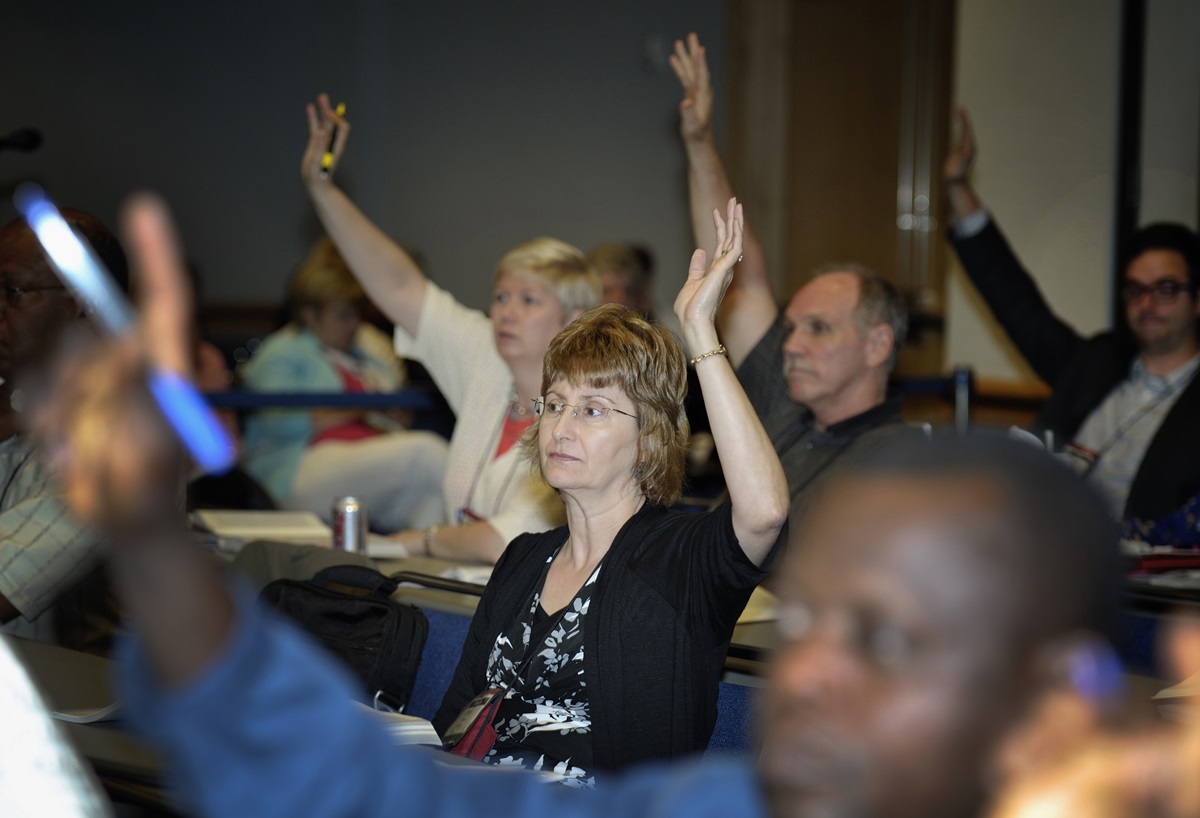
For the first time, delegates will use handheld electronic devices to log their votes in legislative committees, just as they do during plenary sessions of the full General Conference. Essentially, the move means delegates will have secret ballots in both locations.
Previously, the delegates in committee typically would vote legislation up or down by a show of hands.
Legislative committees are the first stop for petitions at the denomination’s top lawmaking assembly, which will be May 10-20 in Portland, Oregon.
The United Methodist Commission on the Status and Role of Women requested the change after the agency’s monitors reported that delegates faced pressure from observers during the 2012 General Conference legislative sessions.
“There was a concern that the atmosphere created a tense environment that had the capacity to cause a chilling effect on delegates,” said Dawn Wiggins Hare, the commission’s top executive and a General Conference delegate herself.
Her agency brought the issue to the attention of the Commission on General Conference, the group of clergy and lay volunteers who plan the big meeting.
Sara Hotchkiss, the General Conference business manager, researched the cost of adding electronic voting devices so each of the 864 delegates would have access to two machines — one for committee and one for plenary.
She said her team negotiated a price that was less than what the commission paid in 2012 to cover the machines. The cost includes some extra devices in case of problems and the necessary support personnel.
A number of delegates are looking forward to the change.
Betty Spiwe Katiyo, a delegate from the West Zimbabwe Conference, said that some delegates are told ahead of General Conference to vote in a way that goes against what they think is right. “I think that having the voting devices will make people vote freely without the others knowing what or [whom] they are voting for,” she said.
Steve Furr, another veteran delegate from Alabama-West Florida Conference, served in the Church and Society 2 legislative committee. That committee deals with some of the gathering’s most sensitive issues including how the church ministers with lesbian, gay, bisexual and transgender individuals. He said he has seen delegates face pressure from other delegates as well as people in the galleries, both advocating for various perspectives.
He expects the change will not have much effect on the final vote tally on any given issue.
“I suspect there will be a few people who will flip their votes on both sides of the issues,” he said. “However, it’s probably the best way to get a true sense of the body on any one issue.” He added that the change might help delegates more comfortably vote on topics their cultures consider too taboo to discuss openly.
The Rev. David Dodge, a Florida Conference delegate, expects the change also will encourage delegates to prepare better to vote rather than simply following the lead of others.
Committees can only use the new machines for when they vote as a whole, Hotchkiss said.
However, Dodge and others hope there will be some kind of private ballot when committees break into subcommittees to consider legislation.
When committee chairs meet for orientation during General Conference, Hare plans to ask that subcommittees use paper ballots.
For now, the new machines are a good start, Hare said.
“This small change,” she said, “has the capacity to assure that all voices will be heard in a non-hostile environment.”
Hahn is a reporter for United Methodist News Service in Nashville, Tennessee. Contact her at (615) 742-5470 or [email protected].
Like what you're reading? Support the ministry of UM News! Your support ensures the latest denominational news, dynamic stories and informative articles will continue to connect our global community. Make a tax-deductible donation at ResourceUMC.org/GiveUMCom.


