
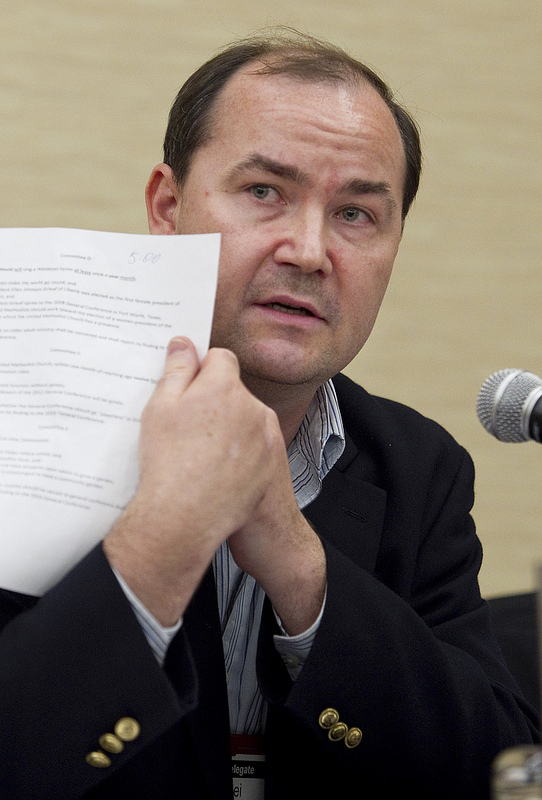
Tampa, Florida, May 3, 2102—The fact that The United Methodist Church has a worldwide reach is “inspiring and encouraging” to students of the denomination’s theological seminary in Moscow, Russia.
Dr. Sergei V. Nikolaev, president of the 15-year-old Russia United Methodist Theological Seminary, made the observation at an early morning meeting of seminaries attending the 2012 General Conference of the church. More than 30 students, most of them from the United States, came to hear him.
Methodism in Russia, said Nikolaev, is a small majority often viewed by society as a “sect or a cult.” Nikolaev indicated that an awareness of the larger United Methodist connection gives validity to the pursuit of a theological degree and ordination.
The United Methodist Church has branches in the United States, Africa, the Philippines, continental Europe, and Eurasia. It actively relates to other Methodist denominations and are linked in the World Methodist Council, which represents some 75 million members.
The Moscow seminary serves the embryonic United Methodist Church in Russia and surrounding countries. Its 52 students are primarily from Russia, the Ukraine, and the Central Asia Republics. There are now some 125 United Methodist churches in Russia, all of them with indigenous pastors, most trained by the school Nikolaev heads.
In his presentation, the seminary president described changes that have taken place in his school’s approach to the equipping of pastors and other church professionals.
“We started out with a regular three-year, residential seminary program, but we found that this did not fit the work and other schedules of the students. We now have a modular approach that involves intensive courses of short durations at the seminary and field work programs.”
All students are now engaged in the new approach. Students come for two-week periods two or four times a year, taking two classes that last eight hours per day and also taking part in community worship and fellowship. Those coming four times a year can complete their degrees in three years; those coming two-times annually take six years.
The field education, he said, helps the seminaries deal with what it means to be a Christian and a United Methodist in their contexts and in a society that may be hostile to them.
Like what you're reading? Support the ministry of UM News! Your support ensures the latest denominational news, dynamic stories and informative articles will continue to connect our global community. Make a tax-deductible donation at ResourceUMC.org/GiveUMCom.


