
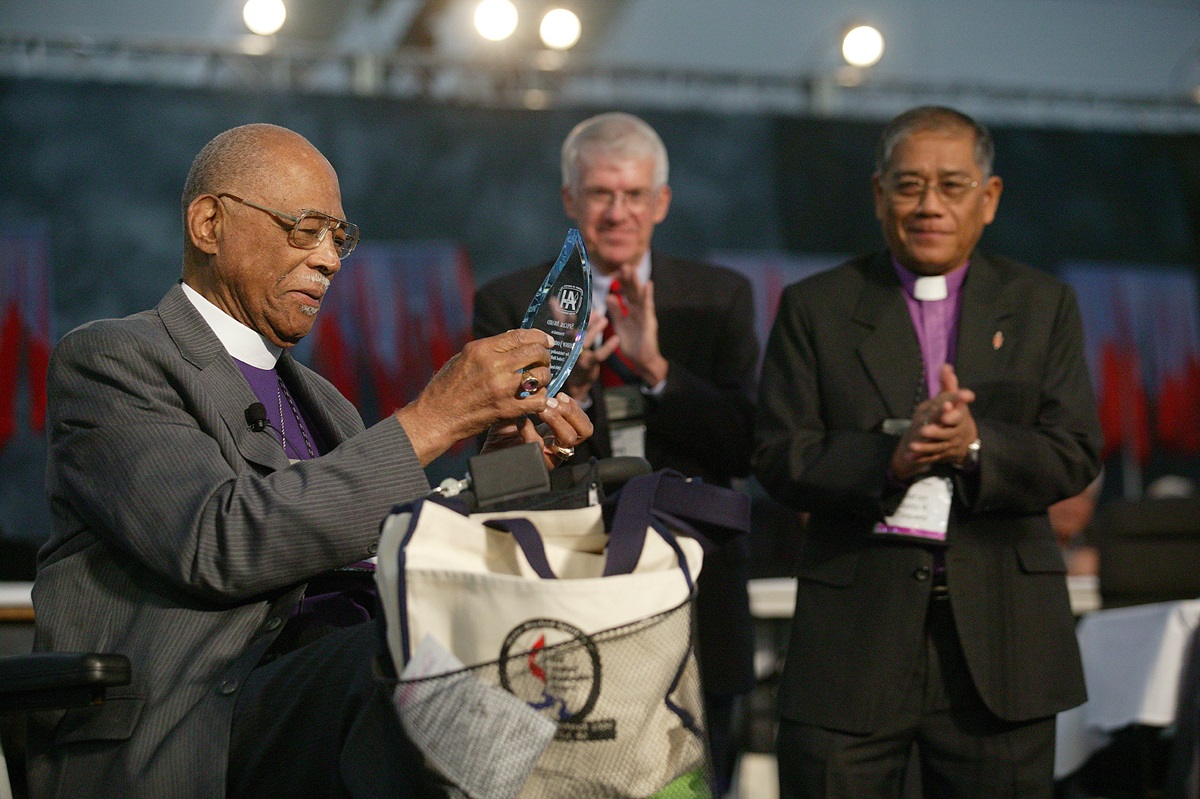
The United Methodist agency responsible for retaining historical records honored retired Bishop James Thomas for his contributions in the former Central Jurisdiction and for his role in eliminating that racially segregated structure in 1968.
Thomas received an award from the General Commission on Archives and History during a General Conference session that celebrated the contributions of African Americans who stayed with the Methodist Church while others left to form new denominations.
During an April 30 interview, Thomas reflected on the difference between this General Conference and one held here in 1964, shortly before his election as bishop.
It was a contentious conference, he reminisced. Race seemed to be the single dominant issue. After painful debate the delegates voted to dismantle the racially based structure. His task, as head of a five-member committee of the Central Jurisdiction, was to craft a solid biblical and theological rationale for the church’s view on race. This document, "Bridges to An Inclusive Church," can still be found in the Archives and History library at Drew University.
As a member of that committee, Thomas was charged with developing a plan to realign the annual conferences after the elimination of the Central Jurisdiction. He also was asked to prepare Central Jurisdiction churches for the changes that lay ahead. Some felt that the racial divide could not be crossed. "There are still vestiges of that today, but we have come a long way," he commented.
Thomas broke racial barriers four years prior to the 1968 eradication of the racial divide.
In 1964, the year of his election to the episcopacy, Thomas was named bishop of the Iowa Area. The Northeastern and North Central jurisdictions were the only two white jurisdictions who said they would accept a black bishop. In an historic move, the Iowa Area requested that Thomas be named their bishop. The bishop said he found Iowa Methodists to be "wonderfully accepting," and he spent 12 years in that Area.
"I didn’t come to be a black bishop," Thomas told the white conference, "I’ve always been black. I have come to be the best bishop I can be." He later served 12 years in the Ohio East Area before retiring in 1988.
When asked about his vision for the church, Thomas, who also served in the 1973-76 quadrennium as chair of the Social Principles Commission, said it needs to move to a deeper understanding of its life and mission. "We’ll never get beyond the domination of single issues until there is a deeper modeling of a Christ-like spirit of disagreeing in love with a determination of living together for the larger mission of the church, which includes spreading the gospel throughout the world."
His advice to General Conference delegates wrestling with potentially divisive issues is to listen to each other. "No one person or faction or denomination has the absolute truth alone," he said.
Whorl is a correspondent for United Methodist News Service.
Like what you're reading? Support the ministry of UM News! Your support ensures the latest denominational news, dynamic stories and informative articles will continue to connect our global community. Make a tax-deductible donation at ResourceUMC.org/GiveUMCom.


