
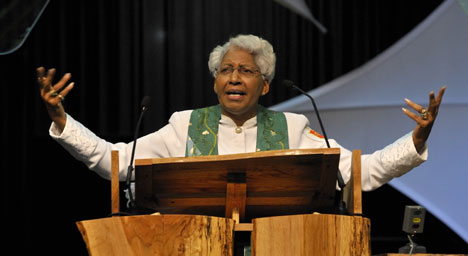
Necessity calls the church to take a more challenging route to end racism, Bishop Violet L. Fisher told to United Methodists in her April 30 sermon to the 2008 General Conference.
"If we're going to be serious about the future of our church around the sin of racism, some tables will have to be overturned," said Fisher, episcopal leader of the New York West area.
Fisher quoted Bishop Leontine T.C. Kelly, and asked the delegates to proclaim with her, "Racism does not belong in the church!"
Preaching about Jesus and the Samaritan woman at the well, Fisher said, "Jesus deliberately and unabashedly modeled for His disciples" both gender and racial inclusiveness by going into Samaria and speaking with the woman.
"Are we willing to go through Samaria?" Fisher asked the conference.
"Like Jesus, we must choose the most difficult route and challenge ourselves to open the doors of diversity in The United Methodist Church," she said.
Fisher said the church must examine itself and its ministries through "sincere and repentant acts of restorative justice." She referenced beliefs United Methodists proclaim through the 2004 Book of Discipline, the Book of Resolutions, the songs in the United Methodist Hymnal and the Council of Bishops' seven vision pathways which all affirm the denomination's commitment to eradicate racism.
"We need to ask ourselves, 'what does it mean to open our hearts for the transformation of God's world and be the Gospel?'" she said.
Still work to do
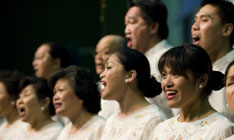
The Spiritual Image choir of South Hayward (Calif.) United Methodist Church provides music. A UMNS photo by Mike DuBose.
The bishop encouraged the denomination not to pretend it has done all it can do to "eliminate racism, white privilege, discrimination and clever tactics of subterfuge that leave our racial and ethnic ministries and pastors of color underfunded, underappreciated and misunderstood."
The church must create and build "ministries that are culturally congruent with God's children," said Fisher. United Methodists must also "confront the institutional racism that infects the structures of the church and perpetuates the forces of oppression in the world," she added.
Fisher challenged the denomination to make the elimination of racism a priority over the next four years so that when leaders return to the 2012 General Conference, they will come bearing the fruit of inclusivity.
"I know that God is calling the church to be the church this day. We are to model to the world that we are the beloved community."
*Rouse is a freelance writer in Nashville, Tenn.
News media contact: Kathy Noble or Tim Tanton, e-mail: [email protected].
Phone calls can be made to the General Conference Newsroom in Fort Worth, Texas, at (817) 698-4405 until May 3. Afterward, call United Methodist News Service in Nashville, Tenn., at (615) 742-5470.
Related Articles
General Conference headlines
Sermon Text: When Necessity Calls
Resources
Like what you're reading? Support the ministry of UM News! Your support ensures the latest denominational news, dynamic stories and informative articles will continue to connect our global community. Make a tax-deductible donation at ResourceUMC.org/GiveUMCom.


