
By Kathy Noble*
Oct. 14, 2009 | NASHVILLE, Tenn. (UMNS)
|
|
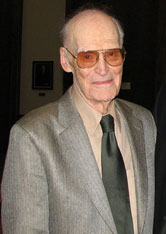
Bishop Eugene M. Frank, the first president of the Council of Bishops of The United Methodist Church, died Oct. 13 at Kingswood Manor in Kansas City, Mo.
At 101, Frank was the oldest United Methodist bishop. When he was elected in 1956, he was the youngest bishop in the Methodist Church.
A passion for racial equality in the church and beyond marked his ministry. During his 16-year tenure as bishop of the Missouri Area, he oversaw the merger of the African-American Southwest Missouri Conference with the two predominantly white annual (regional) conferences in the state.
He saw the dissolution of the African-American Central Jurisdiction that accompanied the 1968 uniting of the Evangelical United Brethren and Methodist churches as evidence "it was a new church" that was forming. Emphases on race relations, increasing ministry in urban settings and youth ministry, he said, indicated "the new church has turned to encounter the realities of her mission."
His family recalled how hard Frank also worked for racial justice in the community. He formed the Metropolitan Planning Commission in Kansas City to address racial equality, human rights and needs. As a result, an urban ministry program was developed that crossed all racial lines.
Late in his retirement, he continued to speak on social issues. In November 2005, he was among 96 retired and active bishops who signed "A Call to Repentance and Peace with Justice" opposing the war in Iraq. In his last column in the Missouri Methodist in June 1972, he wrote, "War will never again be a way to settle arguments between nations."
Retired Bishop Fritz Mutti last summer described Frank as "always unassuming, displaying great humility. &ellipsis; He always worked to 'hold the church together.' I value his sense that, as he would put it, 'effective leadership came from the way you related.'"
As a delegate to the 1956 General Conference, Frank led efforts to gain approval to establish a seminary in Kansas City. When Saint Paul School of Theology opened in 1959, he was chair of the board of trustees and continued in that role until 1972. In an interview for a video to celebrate the seminary's 50th anniversary, he expressed amazement at "what God has done with what we started."
"More than any one person," says the Rev. Lovett H. Weems Jr., "Bishop Frank is responsible for both the establishment of Saint Paul School of Theology and setting its direction as a place for all God's people to prepare to lead." Weems was president of the seminary from 1985 to 2003. Frank was still listed as a trustee at the time of his death.
Born Dec. 11, 1907 in Cherryvale, Kan., Frank was ordained deacon in the Kansas Conference in 1932 and elder in 1933. He earned a bachelor's degree from Pittsburg (Kan.) Teachers College in 1930, then enrolled at Garrett Bible Institute where he received a bachelor of divinity degree in 1932.
As a pastor, he served congregations throughout eastern Kansas and was at First Methodist Church in Topeka for eight years before becoming a bishop. While in Topeka, his sermons were broadcast each Sunday and he wrote a weekly column for the Topeka Daily Capitol. He was also a featured preacher on the nationally broadcast Protestant Hour.
He was bishop of the Missouri Area from 1956 to 1972 and of the Arkansas Area from 1972 until his retirement in 1976. He spent three years on the faculty of Candler School of Theology at Emory University in Atlanta. In 1980, he returned to Kansas City and was bishop-in-residence at Central United Methodist Church until 1988.
Frank served 12 years on the executive committee of the World Methodist Council, led the Commission on Public Relations and Methodist Information (a predecessor of United Methodist Communications) and was on the General Board of Education and the General Committee on Family Life.
Frank is survived by his daughters and sons-in-law, Wilmagene and Lewis Noonan, Leawood, Kan., and Susan and Mark Parsons, Ashbourne, U.K.; a daughter, Gretchen Frank Beal, Knoxville, Tenn.; and a son and daughter-in-law, Thomas E. Frank and Gail O'Day, Atlanta. Seven grandchildren and 14 great-grandchildren also survive him.
A memorial service will be held at 11 a.m. Oct. 17 at Central United Methodist Church in Kansas City. A private burial will be in Pittsburg, Kan., on Oct. 16. In lieu of flowers, the family requests contributions be made to the Eugene and Wilma Frank Scholarship Funds either at Saint Paul School of Theology in Kansas City or Candler School of Theology in Atlanta.
*Noble is editor of Interpreter magazine.
News media contact: Kathy Noble, (615) 742-5441 or [email protected].
Video
Youtube: Why start a seminary here?
Related Articles
Leaders remember Central Jurisdiction's dissolution
Pastor recalls historic Uniting Conference of 1968
Resources
Like what you're reading? Support the ministry of UM News! Your support ensures the latest denominational news, dynamic stories and informative articles will continue to connect our global community. Make a tax-deductible donation at ResourceUMC.org/GiveUMCom.


