
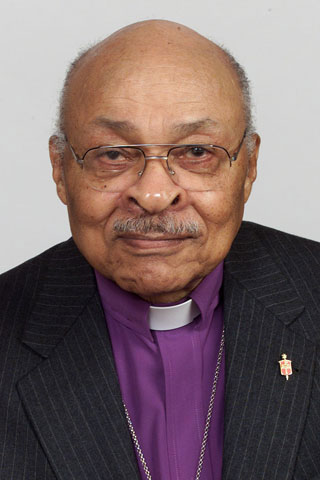
Retired United Methodist Bishop Edsel A. Ammons, who helped lead the church during the transitional time of integration, died Dec. 24 in Evanston, Ill., after a lengthy illness. He was 86.
Ammons was a professor at Garrett-Evangelical Theological Seminary when he became one of the first African-American bishops elected to the episcopacy by the denomination's North Central Jurisdiction in 1976. He served the Michigan Area until 1984. He then served as bishop of the West Ohio Area until his retirement in 1992.
"He was a brilliant person," said retired Bishop Melvin G. Talbert, a friend and colleague who lives in Nashville, Tenn. "He was a person of a strong faith and dedicated to the work and mission of the church. He also had a strong commitment for justice."
Ammons became a bishop less than a decade after The United Methodist Church dissolved the Central Jurisdiction, officially ending the system of racially segregated church governance.
Retired Bishop Forrest C. Stith of Upper Marlboro, Md., pointed out that his friend had a difficult task as an African-American bishop in a predominantly white denomination, serving episcopal areas where the African-American presence was minimal.
"He had a lot of hurdles he had to make, and a lot of transitions he had to lead the church in, and he did that very effectively," Stith said. "He did it primarily because he brought such a respect to his office in terms of his knowledge and intellect and his stature."
Chicago upbringing
Ammons was born the son of noted jazz pianist Albert Ammons and his wife Lila, an occasional church organist, on Feb. 17, 1924, in Chicago. He spent much of his life in and around his hometown, attending grade school, high school and earning his bachelor's degree at Roosevelt University in the Windy City.
After serving in World War II, he was initially ordained a deacon and elder in the African Methodist Episcopal Zion Church.
But he transferred into the Methodist Church's Rock River (now Northern Illinois) Annual (regional) Conference in 1957. Stith said Ammons saw more opportunities for service and ministry within the Methodist Church.
That same year, Ammons completed his final year at Garrett Biblical (now Garrett-Evangelical) Theological Seminary in Evanston, Ill. He later earned a doctor of ministry at Chicago Theological Seminary in 1975. He also received honorary degrees from Westmar College, Albion College, Adrian College and Mount Union College.
As a new elder in the Methodist Church, Ammons was pastor of what is now Ingleside-Whitfield United Methodist Church in Chicago. He later became the director of urban ministry for the Rockford (Ill.) District, and then a member of his annual conference's program staff.
In 1968, he joined the faculty of his alma mater Garrett as professor of church and urban society. There, he developed a program on the church and the black experience before joining the episcopacy.
Minister to all people
Ammons in his early days as bishop assured church members he would minister to all those in his area and promote the strength of the church's pluralism.
"I can't imagine a black bishop, on the basis of his own history of pain and denial of opportunity, not being terribly interested in the hurts and aspirations and the growth needs of all people," he told the Michigan Christian Advocate in 1976. "I think in that sense, I may be able to make a somewhat unique contribution."
Longtime friend, retired Bishop Charles Wesley Jordan of Upland, Calif., has known Ammons since they were both students at Garrett.
Jordan, who will deliver Ammons' eulogy, said his friend brought a sense of clarity and vision to his trailblazing role in the church's racial integration. He also was an articulate advocate for those living in poverty.
"He provided a theological conscience for the Council (of Bishops) and a quiet resolve," Jordan said. "He was always speaking in the context of the gospel."
Talbert also counted on Ammons for invaluable advice when Talbert was the first general secretary of the United Methodist Board of Discipleship and Ammons served on the board.
"He had a keen sense of what it means to be a disciple of Jesus Christ," Talbert said.
And he was eager the share that knowledge with others.
"He just believed every human being is entitled to be treated as a person precious in the sight of God," Talbert said.
Ammons was president of the Board of Discipleship from 1980 to '84. He also served the United Methodist Board of Global Ministries as chairperson of the Health and Welfare Program Department from1984 to 1988 and chairperson of the Missionary Personnel and Resources Program Department from 1988 to 1992. In addition, he was a member of the Black Methodists for Church Renewal, the denomination's black caucus, since its start in 1968.
His survivors include his wife Helen Fannings Ammons and children Edsel Jr., Carol, Kenneth, Carlton, and Lila. He is preceded in death by his daughter Marilyn and his wife of almost 40 years, June B. Ammons, who died in 1990.
Funeral arrangements are pending.
*Hahn is a multimedia news reporter for United Methodist News Service.
News media contact: Heather Hahn, Nashville, Tenn., (615) 742-5470 or [email protected].
Related Articles
Seminary establishes award for leadership in racial justice
Resources
Like what you're reading? Support the ministry of UM News! Your support ensures the latest denominational news, dynamic stories and informative articles will continue to connect our global community. Make a tax-deductible donation at ResourceUMC.org/GiveUMCom.


