
Key points:
- Twenty-four United Methodists were among those killed by attackers suspected to be Fulani herders, said United Methodist Bishop Ande I. Emmanuel.
- More than 40 people died in what a police spokesman described as “an unprovoked massacre, a calculated act of terror that tore apart a peaceful community.”
- United Methodists including the bishop distributed food, sleeping mats and other support to survivors, and more relief is in the works.
- Violence has escalated in the past decade as herders and farmers fight over land access in northern Nigeria.
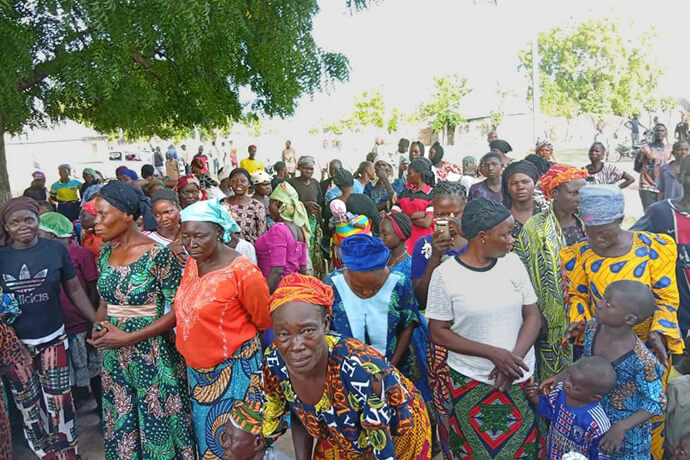
At least 24 United Methodists have been confirmed dead in north central Nigeria following a brutal attack by armed gangs believed to be Fulani herders.
The May 24 violence in the Karim Lamido local government area of Taraba State is the latest in a rural region where predominantly Muslim herders and predominantly Christian farmers have frequently clashed over land access.
Aliyuda Saidu Munga, a local chief from Munga Lelau, told United Methodist News that the conflict started when suspected Fulani herders attacked a 28-year-old man in Bandawa community, a village about 15 kilometers from Munga Lelau.
How to help
People wishing to help are encouraged to give to UMCOR International Disaster Response Advance #982450.
To see photos and video from Bishop Emmanuel’s visit to affected communities, visit the bishop’s Facebook page.
“We were going about our daily business when we saw people running, and then the sound of gunfire,” he said. “On May 25, we buried 42 people that were killed by the herders.”
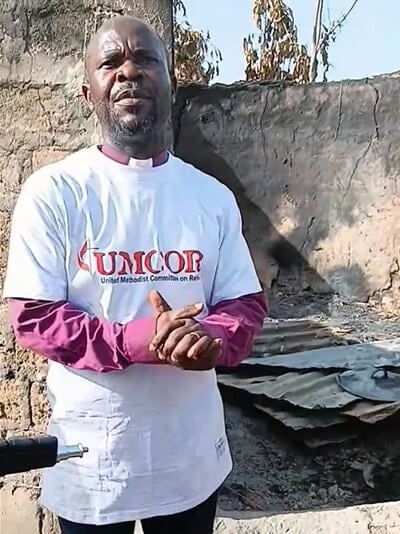
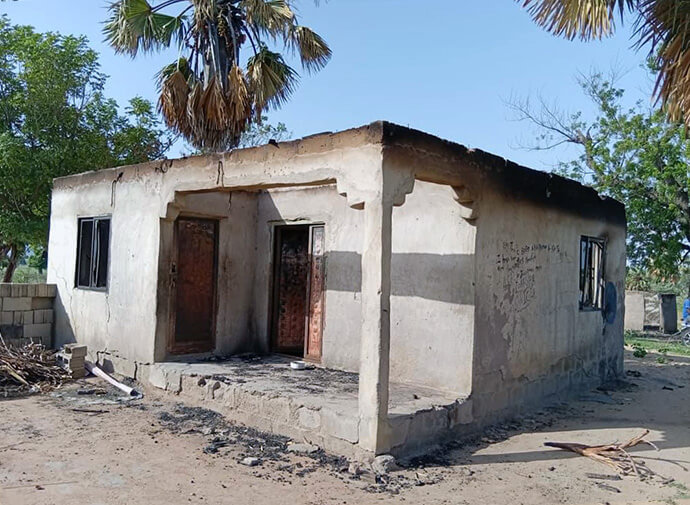
Bishop Ande I. Emmanuel, who leads The United Methodist Church in Nigeria, said that 24 of those killed were fellow United Methodists. He also said 62 homes were destroyed and more than 5,000 people were displaced, plunging communities into mourning.
The bishop visited the affected areas on June 4 to help distribute aid from the Nigeria Episcopal Area. The relief materials, valued at 31 million naira (about $20,000 USD), included rice, maize, guinea corn, beans, cassava flour, palm and vegetable oil, clothes, soap, sleeping mats, mosquito nets and detergent. The support was distributed among the affected communities, regardless of ethnic or religious identity.
“We are here not only with food and supplies but with a message of peace,” Emmanuel said. “Every life matters. We must recognize the value and sanctity of human life and reject any form of violence. I call on all parties to embrace alternative dispute resolution. Our people must learn to settle differences without shedding blood.”
Additional support for survivors is coming. The United Methodist Committee on Relief has approved a solidarity grant of $10,000 to address immediate needs, and the relief agency is expediting an additional grant.
“Given the urgency and the steps already taken on the ground to mobilize resources to assist the most vulnerable, we are moving into the relief phase and are meeting to finalize the grant parameters,” said Roland Fernandes, top executive of the United Methodist Board of Global Ministries and UMCOR. “We anticipate that the grant will ultimately address the needs of 1,000 households in five communities and that we can move toward implementation in a few weeks.”
The bishop listed the hardest-hit circuits as Munga Lelau, Magami, No.1 Munga Dosso, Bunkabu, Bunkachi and Ngurore Jabu. These churches had been ravaged, leaving their members scattered and traumatized, he said.
In a press statement after the incident, Emmanuel described the killings as “senseless and devastating.”
“Violence only breeds more pain and suffering,” he said, calling on both farmers and herders to embrace peace and dialogue. “There is a better way, one rooted in mutual respect, empathy and the recognition of our shared humanity.”
Lashen James, the police public relations officer in Karim Lamido, described the profound emotional and physical toll of the incident.
“Men, women and children who once lived in peace now find themselves displaced, unprotected and largely abandoned,” he said.
“This was not a conflict. It was an unprovoked massacre, a calculated act of terror that tore apart a peaceful community. Before we could get to the venue, the attackers had already left. But police investigations are still in progress.”
During the aid distribution, representatives for both the herdsmen and farmers were on hand.
“This is unprecedented. The church has shown that they care for us all — not just one side,” said Ardo Garko, a leader of the Fulani herdsmen. “We are grateful and pray that this effort will lead to real peace.”
Chief Japhet Aliyuda, the traditional ruler of Munga Lelau, expressed hope for reconciliation.
“Our people have suffered deeply, but today we feel seen. We thank The United Methodist Church for not abandoning us in our pain. This is a new beginning.”
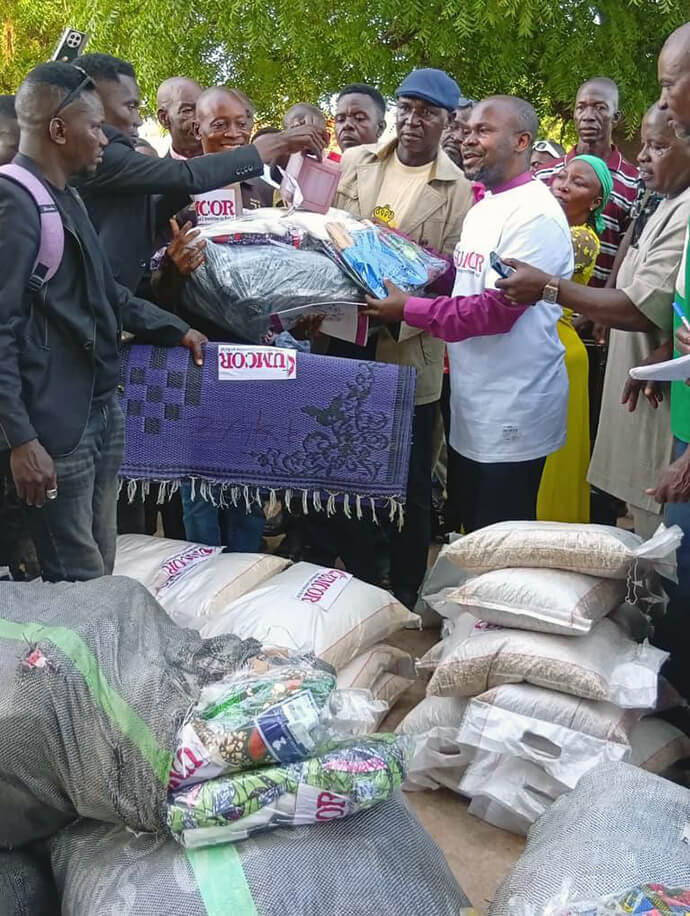
Community members turned out in large numbers to receive the aid, with both Christian and Muslim leaders present, symbolizing a collective desire for healing.
Emmanuel urged state and federal authorities to take action to restore peace, protect vulnerable communities and provide additional humanitarian relief.
“We cannot continue to bury our citizens due to preventable conflicts. Let the government rise to its role as a defender of the people.”
Subscribe to our
e-newsletter
The mass killings have reignited debate over the security crisis in Nigeria’s rural communities and the government’s capacity to protect lives in the face of rising attacks by armed groups.
The farmer-herder violence in Nigeria has increased over the past 10 years in northeastern and north central Nigeria. According to the Africa Center for Strategic Studies, the contributors to the conflict include population pressure, changes in land use and resource access, growing social inequality and declining trust between communities.
In his closing remarks on June 4, Bishop Emmanuel prayed for unity.
“Let what happened here today echo across Nigeria — that the Church stands with the people, that love is stronger than hate, and that peace is possible even in the most broken places.”
Auta is the director of communications for The United Methodist Church’s Nigeria Episcopal Area.
News media contact: Julie Dwyer at (615) 742-5470 or [email protected]. To read more United Methodist news, subscribe to the free UM News Digests.


