

United Methodist female theologians from Africa and Asia gathered recently to discuss their interpretations of the Bible and to find commonalities of gender, race, class and theology.
The Aug. 12-15 conference was designed by the United Methodist Board of Higher Education and Ministry to provide the women with an opportunity “to share their theological viewpoints and experiences,” said the Rev. HiRho Park, the event’s organizer.
“African and Asian women theologians’ voices are appreciated but still have been silenced,” Park said. “This seminar has provided them a place to share their thoughts and insights, and collect them. It is a prophetic event in The United Methodist Church.”
The Rev. Elvira Moises, a professor at the Methodist University of Angola, offered a feminist understanding of God’s breath, the Holy Spirit, and the generational breath of women. The article she presented focused on the challenges of “divine motherhood,” or creation, in relation to Genesis 2:7 and “maternal death in the African context of Angola.”
The Rev. Hyun-Ju Lee, a professor at Methodist Theological University in Korea, discussed “Ewa,” a novel based on the theory of intersectionality written in 1906 by Arthur Noble, an American missionary to Korea.
According to the Merriam-Webster Dictionary, intersectionality is “used to refer to the complex and cumulative way that the effects of different forms of discrimination (such as racism, sexism, and classism) combine, overlap, and yes, intersect — especially in the experiences of marginalized people or groups.”
The novel, Lee pointed out “shows the white man’s patriarchal gender prejudices that an Asian woman could not be a leader even in a church.”
One challenge for the group was interpreting a certain Bible passage that seemed to negatively characterize women.
The Rev. Elaine W. F. Goh, the dean of studies at Seminari Theoloji Malaysia, read Ecclesiastes 7:26 (“I found the woman more bitter than death”) and asked her fellow theologians to answer who was being referenced.
“The woman in the passage is the personification of folly, Lady Folly, the metaphorical portrayal of folly in the book of Proverbs,” Goh suggested. “While Lady Wisdom is more precious than jewels in Proverbs, Lady Folly is more bitter than death in Ecclesiastes.”
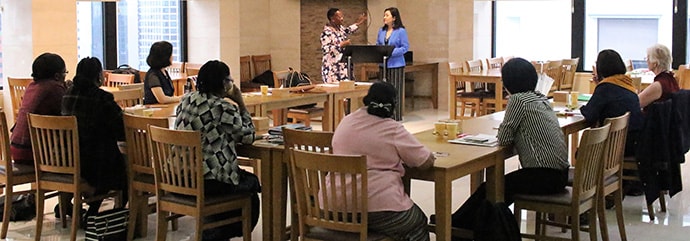
The Rev. Beauty Rosebery Maenzanise, a co-organizer of the event, presented an article on female challenges in ministry in The United Methodist Church of Zimbabwe.
The Rev. Helena Angelica Gustavo Guidione from Mozambique celebrated women’s meaningful and successful achievement in Mozambique but noted there are still struggles for the emancipation of women.
“We have women in great leadership positions in the church and in Mozambican society in general, such as ministers, governors and other positions,” said Maenzanise, who is manager of global formation for new spiritual leaders at Higher Education and Ministry.
Other presenters were the Rev. Memory Chikosi from Zimbabwe; the Rev. Ruth Daniel, Myanmar; the Rev. Maaraidzo Mutambara, Zimbabwe; the Rev. Elizabeth Tapia, the Philippines, and the Rev. Yani Yoo, Korea.
Networking was a key aspect of the event.
“I wanted to network with women theologians from Asia and Africa, and learn from them and share my work with them,” said Mutambara, a professor at Africa University.
“Theology is meaningful and relevant to what it addresses and (how it) questions the social, political, economic, ecological and religious contexts,” she added. “They raised these questions. And through the seminar, I found similarities, differences and diversities amongst us.”
“I came from Zimbabwe to learn about and celebrate the Asian and African commonalities,” Chikosi said. “The seminar has enriched and empowered me to advocate for the transformation of the lives of women as a theologian. I will continue empowering other women and girls in the middle of struggles, and giving hope to the hopeless.”
In addition to the discussions, the group visited places to learn more about Korean culture, history and Christian missions.
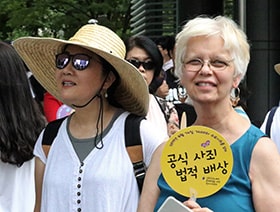
The term refers to Korean women and girls who were forced into sexual slavery by the Japanese Army during World War II. After the theologians left the assembly, they expressed their surprise at the calm and peaceful protest, and also at how many young people were participating.
The Rev. M. Kathryn Armistead, a Higher Education and Ministry executive, said she appreciated seeing the United Methodist connection work at full capacity during the conference and praised the leadership offered by Park and Maenzanise.
One purpose of the conference, Armistead said, is to publish an academic book from the papers presented at the seminar and help raise up the next generation of leaders.
“As these (African and Asian) women blaze new paths in theology,” she noted, “my hope is that they will also cut a trail for those who follow in their footsteps.”
Kim is the Korean news editor for UM News. Contact him at 615-742-5470 or [email protected]. To read more United Methodist news, subscribe to the free Daily or Weekly Digests.
Like what you're reading? Support the ministry of UM News! Your support ensures the latest denominational news, dynamic stories and informative articles will continue to connect our global community. Make a tax-deductible donation at ResourceUMC.org/GiveUMCom.


