
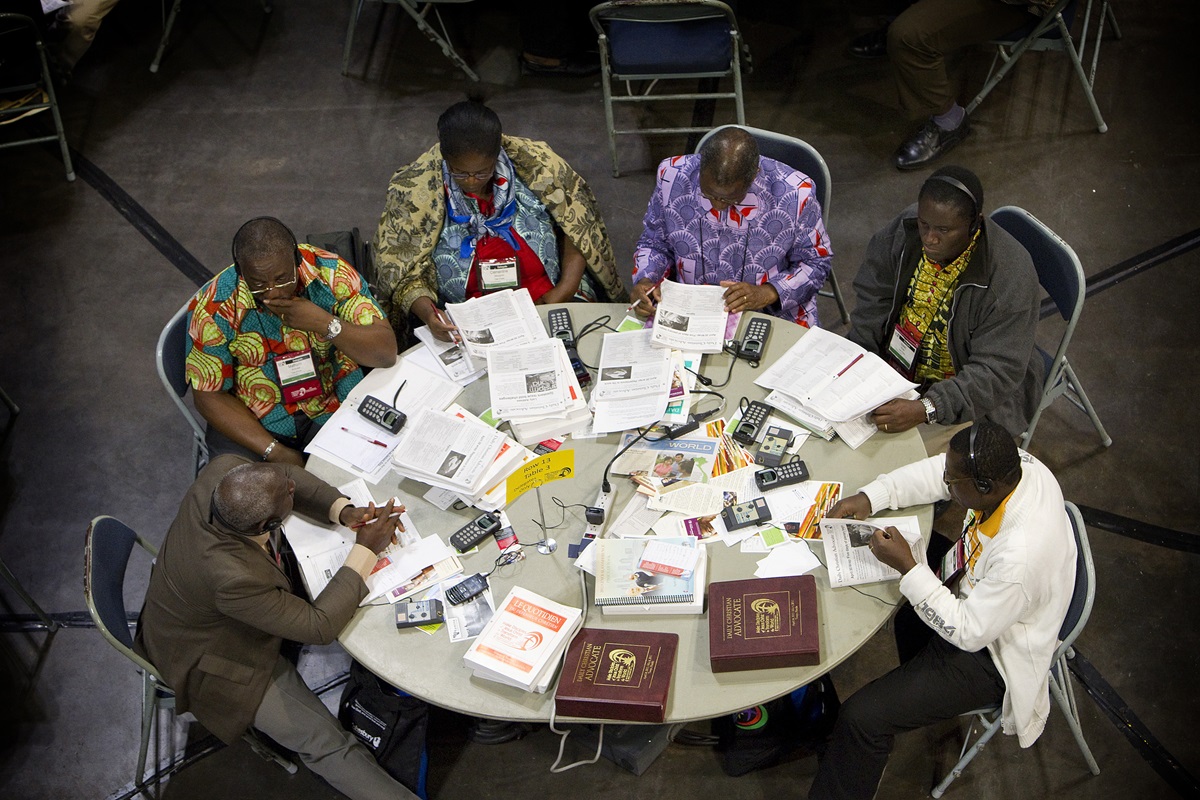
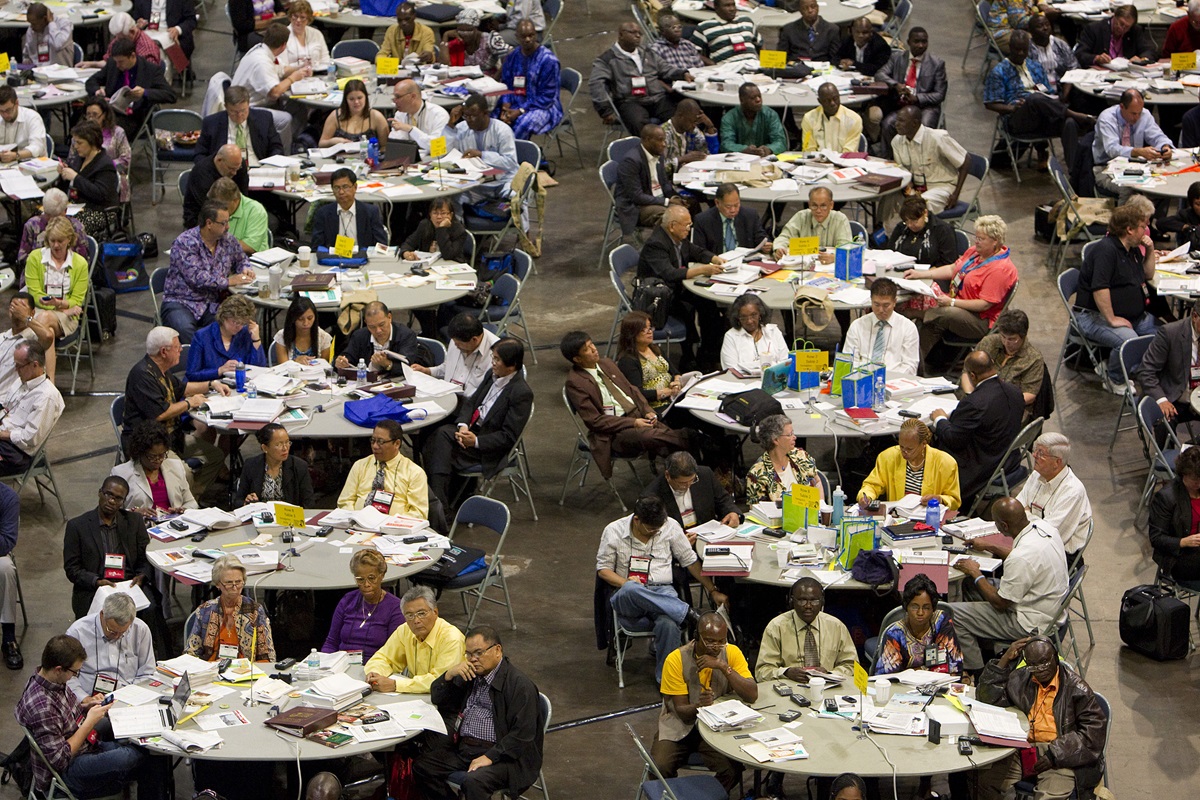
United Methodists in Africa, Europe, the Philippines and the United States are preparing for regional legislative meetings, called annual conferences.
During the gatherings, usually lasting four days, clergy and laity elected by local churches will establish 2015 budgets, receive reports, consider resolutions regarding social justice issues, present awards, deal with property issues, and recognize retiring clergy. Sessions nearly always include sermons and frequently Bible study sessions. A highlight of every session is the service of ordination.
An equal numbers of lay and clergy members are invited to participate in the gatherings. However, in most cases there are more lay members in attendance as some retired clergy members live in other states or are elderly and unable to attend.
The Liberia and Sierra Leone conferences kicked off the meetings in February, and West Zimbabwe and South Africa conferences will conclude the 2014 gatherings in December.
Most U.S. conferences hold their 2014 assemblies in May and June. The Red Bird Missionary Conference, meeting May 2-3, will conduct the first U.S. conference. The Desert Southwest Conference will wrap up U.S. gatherings at a June 25-29 meeting
The denomination’s General Council on Finance Administration has compiled the dates of the annual conferences.
Voting for General Conference delegates
For the first time, some annual conferences will elect lay and clergy delegates to General Conference two years before the meeting of the top legislative body of the denomination.
The 2012 General Conference passed legislation that would allow annual conferences to decide at their 2013 meetings whether to hold elections in 2014 or 2015.
The option was created following the inability of some delegates from Africa, who were elected in December 2011, to obtain passports and visas in time for the 2012 General Conference, held in late April and early May of that year. Some U.S. conferences also decided to hold elections a year early to provide additional months for delegates to plan working strategies and study the issues related to the quadrennial gathering.
U.S. conferences electing lay and clergy delegates in 2014 include California-Pacific, Louisiana, Minnesota, North Alabama, Northern Illinois, Texas, West Michigan, and Wisconsin.
Many U.S. conferences will be electing fewer delegates to the 2016 gathering in Portland, Ore., than they did for the 2012 meeting in Tampa.
Noting that West Michigan Annual Conference will only elect one clergy and one lay delegate to the 2016 assembly, the Rev. Laurie Haller, head of the six-member 2012 delegation, said, “I regret the loss of diversity that is inevitable in only having two delegates. It is also disappointing that there will be even fewer opportunities for the clergy and laity in West Michigan to be involved in the general church.”
Restructure proposals and mergers
The Louisiana Conference will receive a report from its Restructure Taskforce. Following a partial report in 2013, the group was commissioned to continue studying for an additional year whether the conference could be structured more effectively.
Oklahoma Conference members are studying a proposal to reduce, from 12 to eight, the number of districts. If approved, the change will become effective in June 2015.
The Kentucky Conference is considering a realignment that will, over a three-to-four-year period, reduce the conference budget from $9 million to $7 million. This would reduce local church giving to the conference from 15 percent to 12 percent.
Members of the Kansas East, Kansas West and Nebraska conferences held a uniting conference last August and the newly created Great Plains Annual Conference will hold its first session in June.
Following approval of a beginning organizational plan in February, the Rio Grande and Southwest Texas conferences will meet in June as the Rio Texas Annual Conference to refine the new structure.
Considering resolutions
Annual conferences establish deadlines for the submission of resolutions. These requests for action on various matters are generally printed in a pre-conference journal and reviewed by a legislative committee before being considered by a plenary session. Conference members are sometimes invited to pre-conference district meetings where resolutions and proposals are introduced and discussed.
The Texas Conference has established a new policy to consider resolutions. One predetermined speaker for each side of an issue will be allowed a maximum of five minutes to speak on key points. An additional six minutes of alternating one-minute comments will be followed by silent prayer and then the vote.
Conferences frequently pass resolutions on social issues and hot topics such as sexuality and immigration mostly likely will be on the agenda.
The Rocky Mountain Conference will tour the site of the 1864 Sand Creek Massacre, in which a Colorado Territory militia led by Col. John Chivington, a Methodist minister, killed numerous Cheyenne and Arapaho Indians, many of them women and children. The tour is part of a 2012 General Conference-endorsed effort to do penance and bring healing.
Riding and walking
Members and friends of the Western North Carolina Conference will participate in a three-day cycling adventure from Charlotte to Lake Junaluska, site of the June 16-18 conference.
The North Carolina Conference is sponsoring a run/walk to promote fitness and provide fellowship during its June meeting.
United Methodist Men of the Great Plains Annual Conference are sponsoring a one-day ride on the “Cowboy Trail.” Other walkers and riders will leave from a variety of locations.
The Pacific Northwest Conference also plans a four-day bike ride from Vancouver, British Columbia to Vancouver, Wash.
The Florida Conference is sponsoring a 5K run/walk around Lake Hollingsworth to raise funds for the Imagine No Malaria campaign.
Other activities
The Memphis Conference will have science camp for kids from pre-school to fifth grade during its annual gathering.
Each church in the South Carolina Conference is asked to collect 1,000 books with the hope that volunteers will be able to sort, package and place bookplates on 1 million books during annual conference.
The Northern Illinois Conference members will also be bringing and taking home books. Proceeds from a book sale will go to Imagine No Malaria.
Upper New York Annual Conference members plan to work with Stop Hunger Now to package 75,000 dehydrated meals for people in emergency situations.
Local church members in the Virginia Annual Conference are asked to bring funds to conference sessions to support eight mission projects. The goal is $200,000.
*Peck is a retired clergy member of New York Annual Conference living in Franklin, Tenn.
Like what you're reading? Support the ministry of UM News! Your support ensures the latest denominational news, dynamic stories and informative articles will continue to connect our global community. Make a tax-deductible donation at ResourceUMC.org/GiveUMCom.


