
The United Methodist Church in Côte d'Ivoire, the largest regional conference of the worldwide denomination with almost 700,000 members, has received its full rights and responsibilities.
The action came April 27 at the 2008 General Conference, which meets every four years to conduct the business of the church. As a result, United Methodists in the West African country, which has only two delegates at this General Conference, will receive significantly greater representation at future assemblies. Expenses related to its bishop will now be covered by the United Methodist Episcopal Fund instead of by its own conference.
Four years ago, the Methodist Protestant Church of Côte d'Ivoire, an autonomous church, was admitted to the United Methodist fold, but the Judicial Council later ruled that the decision of the 2004 General Conference was incomplete.
In practical terms, the 2004 General Conference short-circuited the process for admission outlined in the United Methodist Book of Discipline, a legal and procedural guide. The church's highest court ruled in 2006 that the disciplinary process required that the 2008 General Conference confirm the action.
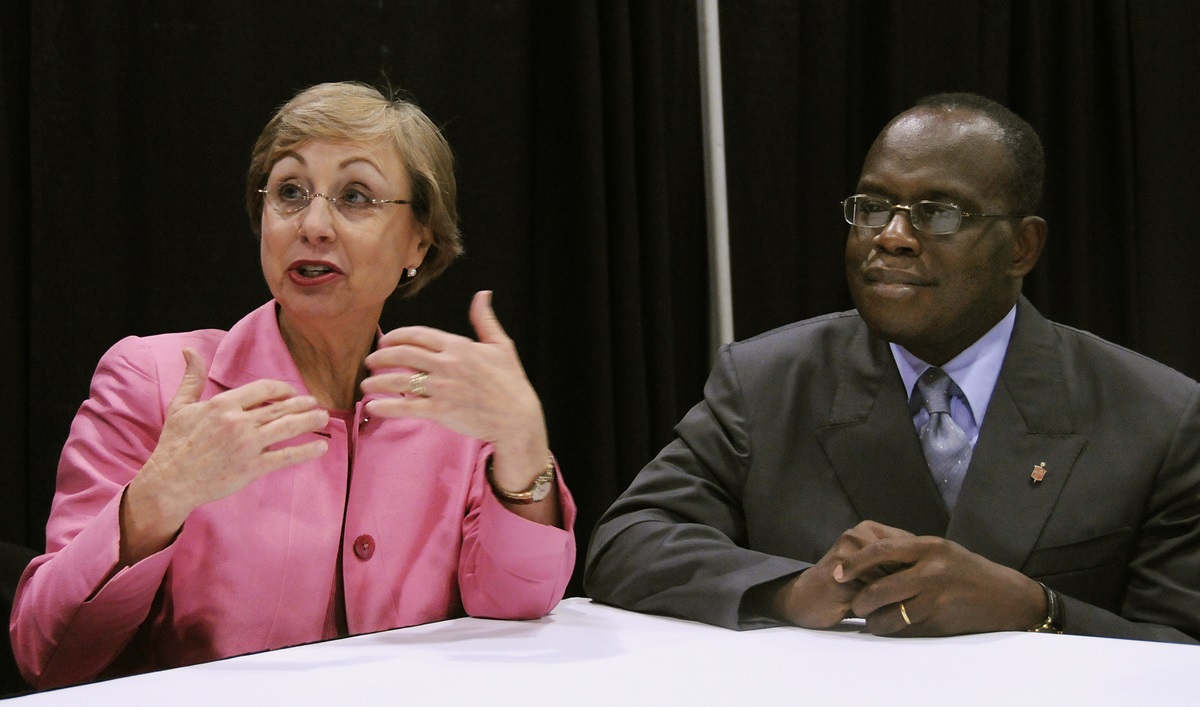
"I am very joyful today, more than yesterday," said Bishop Benjamin Boni, leader of the Côte d'Ivoire Annual (regional) Conference. "We are today fully united in the church, and members in Côte d'Ivoire share together fully with others in The United Methodist Church."
Historic moment
"This is an historical occasion for The United Methodist Church," said Bishop Janice Riggle Huie of Houston, immediate past president of the denomination's Council of Bishops. "I am excited to welcome the Côte d'Ivoire Annual Conference as a full partner. We are connected with a bond that cannot be broken."
She noted that the Texas Annual Conference, which she leads, has a close and active partnership with Côte d'Ivoire.
Action by the 2004 assembly limited Côte d'Ivoire to two delegates to this year's legislative meeting and required it to continue to pay its bishop. United Methodist bishops normally are paid by a churchwide episcopal fund.
In the meantime, the West Africa Central Conference, which oversees the Ivory Coast area, had recognized Côte d'Ivoire and elected Boni to lead it.
With 677,355 members, the Côte d'Ivoire conference becomes by far the largest in The United Methodist Church. By comparison, Virginia, the largest regional conference in the United States, has 341,264 lay members.
Conference representation to General Conference is based on membership. Currently, the assembly's delegate cap is 1,000, and 992 delegates are attending this year's meeting in Fort Worth. One measure under consideration-partly to keep down the costs of General Conference gatherings-would reduce membership to an upper limit of 600. This year's 10-day assembly costs more than $6.6 million.
Journey to full rights
The French-speaking Methodist Protestant Church of Côte d'Ivoire became autonomous in 1985. It was founded years earlier by British Methodist missionaries.
"The church is a worldwide community, but after becoming autonomous we felt separated, cut off and turned in to ourselves," Boni said, explaining why Côte d'Ivoire Methodists want to join the denomination.
The formerly autonomous church first became a United Methodist "mission," relating to the denomination through its Board of Global Ministries, as required by church law. The process was expected to take at least eight years to move toward full annual conference status. However, the 2004 General Conference accelerated the process in a way that the Judicial Council ruled premature.
At this year's General Conference, a petition to complete the membership process was reviewed and passed by a legislative committee. It came to the full body on a "consent calendar" of items agreed to by large majorities in committees. On the assembly floor, the Rev. Charles Boayue of Detroit pointed out the historic importance of the moment that was about to be passed over.
Boayue thanked God for the completion of the process and welcomed the church in Côte d'Ivoire to "full participation in the life and mission of The United Methodist Church."
'One family in the Lord'
Bishop Felton E. May, interim chief executive of the Global Ministries agency, was pleased that the membership process was finally complete.
"We have walked hand-in-hand with the church in Côte d'Ivoire since it became a mission," May said in a statement. "All who have had contact with the church there have come to love the people, their spirit of hope and their zeal for proclaiming the Gospel of Jesus Christ. We have long awaited this day, when the membership process is complete and we are formally one family in the Lord."
Huie said the Texas-Côte d'Ivoire partnership is a reciprocal one. It initially involves health ministries-initially mosquito nets used in malaria control. It is expected to grow to include education and communications.
"It is a fully equal partnership in which both give and both received. We in Texas have much to learn from our friends in (the Ivory Coast). They know how to grow churches, are forthright in proclamation of faith and know how to community with people. They practice personal and social holiness, establishing hospitals, schools and communications outlets. They know that Christ changes the whole person, not only the soul," she said.
*Wright is the public information officer of the United Methodist Board of Global Ministries.
News media contact: Marta Aldrich e-mail: [email protected].
Related Articles
Judicial Council reaffirms decision on Côte d'Ivoire
Côte d'Ivoire denomination joins United Methodist Church
Texas, Côte d'Ivoire conferences join hands
Resources
Like what you're reading? Support the ministry of UM News! Your support ensures the latest denominational news, dynamic stories and informative articles will continue to connect our global community. Make a tax-deductible donation at ResourceUMC.org/GiveUMCom.


