
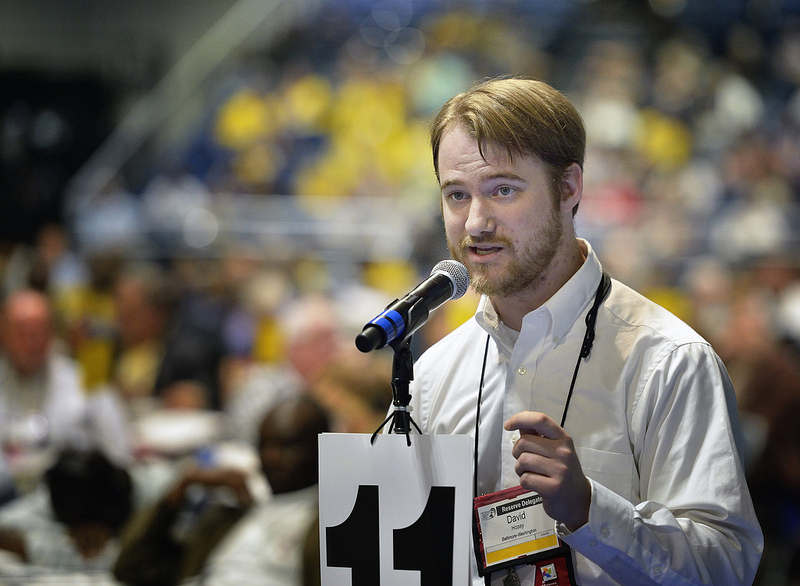
Tampa, Florida, May 2, 2012—“A lot of words,” commented David Hosey after the votes on two resolutions on solidarity with Palestinians were tallied. “The words were there, but the nonviolent actions that could lead to a just peace were not. There is a growing movement in the Middle East, and as it grows, the Palestinians have asked us to act in solidarity with their efforts to bring about a just peace. That’s what this investment realignment would have been.”
Hosey served as a Mission Intern with the General Board of Global Ministries from 2007 to 2010, first in Jerusalem with Sabeel, an ecumenical theology center that works for justice, peace, and reconciliation in Israel and Palestine. For his US term of service, Hosey served with the US Campaign to End the Israeli Occupation, located in Washington, DC.
Delegates to General Conference first passed a resolution that reaffirmed the United Methodist stance opposing Israeli settlements on Palestinian land. The petition strengthened the resolution by including language that referenced the Kairos Palestine document, an urgent call by Palestinian Christians asking Christians around the world to support nonviolent actions—such as divestment—in peaceful resistance to the Israeli occupation of Palestinian lands.
The conference turned back a move to substitute a minority report that would have removed any specific nonviolent actions to oppose Israeli settlements and would have called instead for renewed negotiations between Israel and Palestine and studies to investigate ways to help build trust between the two parties.
The second resolution, entitled “Aligning UMC Investments with Its Resolutions on Israel/Palestine,” passed by a two-thirds majority vote, but in this case, earlier, the legislative committee had, on a close vote, significantly amended the petition to remove any suggestion of specific actions concerning divestment from US companies involved in supporting the occupation. Instead, the resolution left investment decisions up to the General Board of Pensions and Health Benefits.
The original petition called for that board to divest from Caterpillar, Motorola Solutions, and Hewlett Packard until such time as they end their involvement through their products in the occupation. Those specific actions became part of the minority report. Twice the creators of the minority report attempted to reintroduce those specific concerns into the resolution under consideration by the plenary, but they were voted down, and the delegates agreed to the majority report as presented.
David Hosey, a delegate from the Baltimore-Washington conference, pressed the body to accept the minority report on this divestment resolution. He was joined by Mfundo Zonke, a delegate from the South Africa Provisional Annual Conference, who said that divestment actions had been an effective tool in bringing down the apartheid laws in South Africa, and that the Israeli-Palestinian situation was similar to that situation in his home country. In committee, a member of the DR Congo delegation spoke of the ways that war had ravaged the people in his country and also expressed support for Palestinians suffering under occupation and for divestment as a moral action to support those who are oppressed.
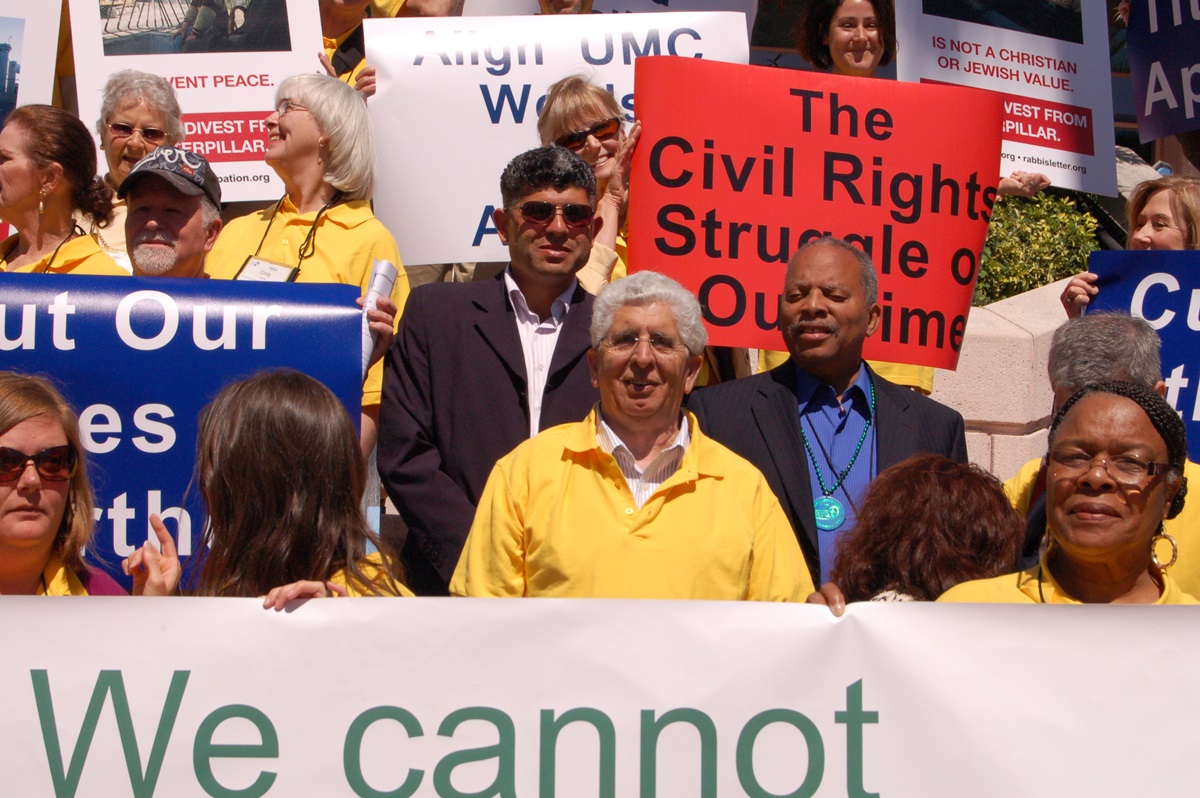
The Rev. Alex Awad, a United Methodist missionary serving in Bethlehem as a pastor and a professor at Bethlehem Bible College, traveled from the Middle East with the United Methodist Kairos Response team to assist delegates in their discernment process. On Tuesday, April 24, the United Methodist Kairos Response held a press conference that included Rev. Awad and other Palestinian Christians, US Christians, Israeli Jewish advocates, US Jewish advocates (including rabbis), and peace activists from both the Israeli and Palestinian communities.
It should be noted that before General Conference convened, every delegate received in the mail a letter signed by more than 1,200 rabbis that asked them to vote against divestment. Members of the United Methodist Kairos Response made themselves available to answer questions and provide information about what the Kairos Document was asking of the global Christian community.
The Rev. Alex Awad said he has to pass through an Israeli checkpoint twice a day, on his way to and from work. He has had firsthand knowledge of the suffering of Palestinians who endure the confiscation of their land and the destruction of their homes, farms, and olive groves. He had hoped that this conference might be the beginning of the end of the suffering for his people. But the votes of the delegates reveal that United Methodists are still conflicted about how to support, with action, the powerful words of solidarity that they consistently vote to accept.
Like what you're reading? Support the ministry of UM News! Your support ensures the latest denominational news, dynamic stories and informative articles will continue to connect our global community. Make a tax-deductible donation at ResourceUMC.org/GiveUMCom.


