
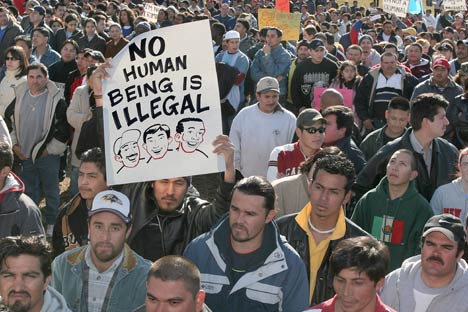
In a letter to the U.S. Senate, seven United Methodist agencies and organizations opposed the Comprehensive Immigration Reform Act of 2007 and called for "genuine reform" that would allow immigrant families to "achieve their American dreams."
The June 19 letter says Senate bill 1348 "fails to achieve" any of the goals advocated by the church and other proponents of genuine comprehensive immigration reform. These goals include reunification of families, a fair earned pathway to citizenship and humanitarian border policies that maintain the civil liberties of all people.
The massive compromise immigration bill collapsed in the Senate June 7 but was resurrected within two weeks and is scheduled to come up for a key vote before the end of June.
The Senate bill shifts from family-based immigration, which has characterized the immigration system for the last 40 years, to a system based on merit that favors educated, highly skilled workers.
Referred to as a "grand bargain," the bipartisan agreement-with 108 amendments-had stalled amid controversy, particularly over provisions envisioning eventual citizenship for the estimated 12 million immigrants now in the United States illegally. The bill, which is supported by the Bush administration, also calls for greater border security and a crackdown on the hiring of illegal workers.
Faith organizations had rallied behind amendments that supported immigrant families. When those amendments failed, the "Senate rejected the importance of family values," the letter states.
"As people of faith the family holds special significance, for it is the family throughout Scripture that God uses to care, train, teach, and preserve the individual."
The letter is signed by the chief executives or other officers of the United Methodist Board of Church and Society, Board of Global Ministries, Women's Division of Global Ministries, General Commission on Religion and Race, National Plan for Hispanic/Latino Ministry, Methodists Associated to Represent the Cause of Hispanic Americans, and National Federation of Asian American United Methodists.
The letter states the current bill includes "burdensome obstacles" that include unreasonable fees and fines as well as mandatory return trips to home countries before a pathway to citizenship can be granted.
In addition, the United Methodist letter spoke out against the proposed guest-worker program, saying it does not guarantee "an increase in the number of visas for future workers with full labor protections and just wages."
In describing the church as "a denomination with many immigrant members," the letter encouraged Congress to "reject the easy road of punishing immigrants," and instead to provide "reasonable and compassionate leadership so that these new immigrant families can also achieve their American dreams."
Under the provisions of this bill immigrant families will remain separated, and illegal immigration will continue.
"The Senate bill contains harsh enforcement provisions that erode civil-liberty protections and do not provide for real security," according to the letter. "Further militarization of the border and denial of due process to immigrants will not stop illegal immigration or secure our borders. National security will be achieved only as genuine reform is enacted that includes legal avenues for citizenship for all undocumented migrants."
Signers of the letter include Jim Winkler, top executive, United Methodist Board of Church and Society; Bishop Joel N. Martinez, president, and the Rev. R. Randy Day, top executive, Board of Global Ministries; Lois M. Dauway, interim top executive Women's Division, Board of Global Ministries; Eliezer Valentin-Castanon, staff, Commission of Religion and Race; Bishop Minerva Carcaño, chair, and Francisco Cañas, national coordinator, National Plan for Hispanic/Latino Ministry; Bishop Elias Galván, executive director, Methodists Associated to Represent the Cause of Hispanic Americans; the Rev. Mark M. Nakagawa, chair, and Inday Day, executive director, National Federation of Asian American United Methodists.
News media contact: Kathy L. Gilbert, Nashville, Tenn., (615) 742-5470 or [email protected].
Resources
United Methodist Board of Church and Society
United Methodist Board of Global Ministries
Like what you're reading? Support the ministry of UM News! Your support ensures the latest denominational news, dynamic stories and informative articles will continue to connect our global community. Make a tax-deductible donation at ResourceUMC.org/GiveUMCom.


