
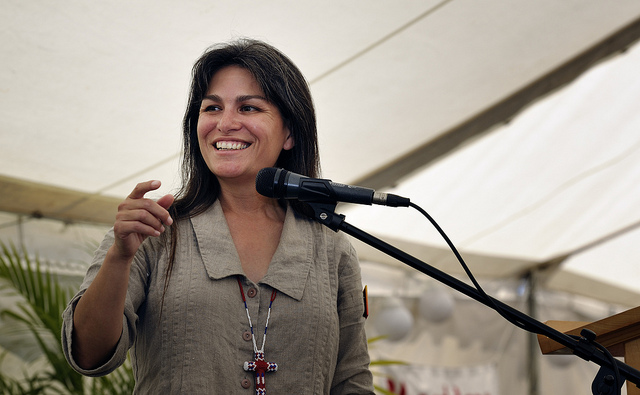
The streets have no name but home

I heard many nuggets of wisdom from the Rev. Lorenza Andrade-Smith during our conversation about her ministry with people living in the streets. For example, the term “homeless” isn’t really accurate.

Andrade-Smith said that a woman in New York City taught her this lesson.“God created the world, remember your home is with God,” the woman told her. “You’re not homeless, you live on the streets.”

For more on Rev. Lorenza Andradre Smith, check out this story from the United Methodist Reporter and this story from UMNS, written last summer.


Like what you're reading? Support the ministry of UM News! Your support ensures the latest denominational news, dynamic stories and informative articles will continue to connect our global community. Make a tax-deductible donation at ResourceUMC.org/GiveUMCom.

Sign up for our newsletter!

Subscribe Now
Social Concerns
The Rev. Christopher P. Momany. Photo by Kristen Schell.

For every righteous ‘no,’ there must be a holy ‘yes’

Methodism’s Wesleyan-Holiness heritage holds principles that can be applied to today’s struggles around human dignity.
Human Rights
An illustration shows Wesley Chapel, built in 1768 and located in downtown Manhattan. The chapel was the first meeting house of John Street United Methodist Church, the New York City church that grew out of the first Methodist Society in North America and still worships near Wall Street today. The church played a role in balancing civic responsibility in the early days of the U.S. republic and faithfulness to God. Photo courtesy of John Street United Methodist Church.

As US 250th nears, bishops discuss democracy

United Methodist bishops and scholars from around the world examined Christian faith and democracy at the spring Council of Bishops meeting. The discussions came as democracy faces threats around the world.
Church History
The Methodist Church’s 1956 General Conference meets from April 25 to May 7 in the municipal auditorium in Minneapolis. On May 4, the first Friday of the legislative assembly, the delegates voted to make women eligible for full clergy rights. “Now it is up to us to prove in clear and deep witness to the whole church our consecration and our loyal devotion to the work of the Kingdom of God,” said Margaret Henrichsen, a General Conference visitor, after the vote. In 1967, she became the first U.S. woman appointed district superintendent. Photo courtesy of Archives and History.

Why the 1956 women-clergy vote matters

Seventy years ago, the Methodist Church supported full conference membership for women clergy — a decision that would have a resounding impact when The United Methodist Church formed in 1968 and even today.

United Methodist Communications is an agency of The United Methodist Church

©2026 United Methodist Communications. All Rights Reserved