
It is time for the church “to put its money where its mouth is” to help awaken the world to the horrors of the global HIV/AIDS pandemic, according to the Rev. Donald Messer.
“Over the past 20 years, the church has passed a number of well-written resolutions but generally has not put the money where their mouth is,” said Messer, author of Breaking the Conspiracy of Silence: Christian Churches and the Global AIDS Crisis. “We have relied heavily on the Board of Global Ministries to carry on the work of AIDS in the world, but we have not given them any special money for that work.”
A proposal is before the General Conference to approve a special global AIDS fund of $4 million that is not included in the denomination’s budget. The church’s top legislative assembly is meeting in Pittsburgh through May 7.
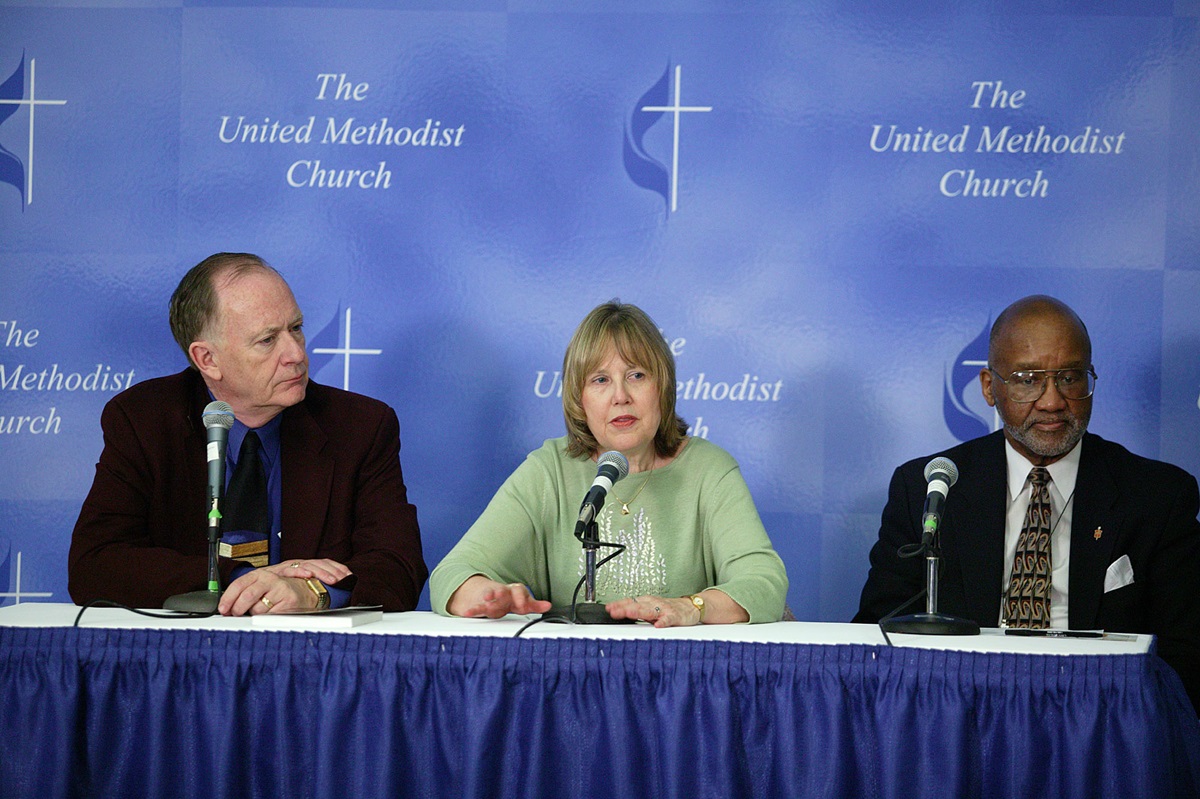
Messer spoke at a news briefing at General Conference, along with Linda Bales, a staff member of the United Methodist Church’s Board of Church and Society; and Bishop Felton E. May of the church’s Washington (D.C.) Area. The briefing was held to focus on the church’s response to the health crisis that is killing millions of people a year and leaving behind countless orphans.
There are 42 million people globally living with HIV/AIDS, and 29.5 million of those reside in sub-Saharan Africa, panelists said.
May suggested there is not more concern on the part of the United States to help the HIV/AIDS crisis in Africa because “the people in Africa are of no economic value.”
“As a church, we can’t really point a finger at the (Bush) administration when we as a church talk and pray and do precious little to leverage the kind of support we really have to deal with this issue,” he said.
The global AIDS fund would be used to help strengthen the programs already in place in the church and to expand those programs to reach out to partner churches and agencies, Messer said.
“It is my hope that 25 percent of the funds raised by annual conferences would stay in the annual conferences and 75 percent would go to the general fund to keep the focus both at home and abroad.
“I would hope it would be more than just a traditional United Methodist program that creates committees and subcommittees within our general boards and agencies,” May said. “If we are going to generate that amount of money, I hope we are going to train people to be advocates to help our government to spend tax dollars in a way that is going to bring wholeness and healing and well-being to communities and nations.”
Bales said she would like to see the funds used in “creative partnerships” in order to maximize the money.
“We need to empower women around the world, to give them choices and economic security,” she said. “The most endangered people in the world are married women.”
“We need a holy and bold attitude to use those funds creatively to make adjustments in a system that excludes the poor and improvised, the diseased and disenfranchised, not only here in this country but around the world,” May said.
*Gilbert is a United Methodist News Service news writer.
News media contact: (412) 325-6080 during General Conference, April 27-May 7. After May 10: (615) 742-5470.
Related
Like what you're reading? Support the ministry of UM News! Your support ensures the latest denominational news, dynamic stories and informative articles will continue to connect our global community. Make a tax-deductible donation at ResourceUMC.org/GiveUMCom.


