
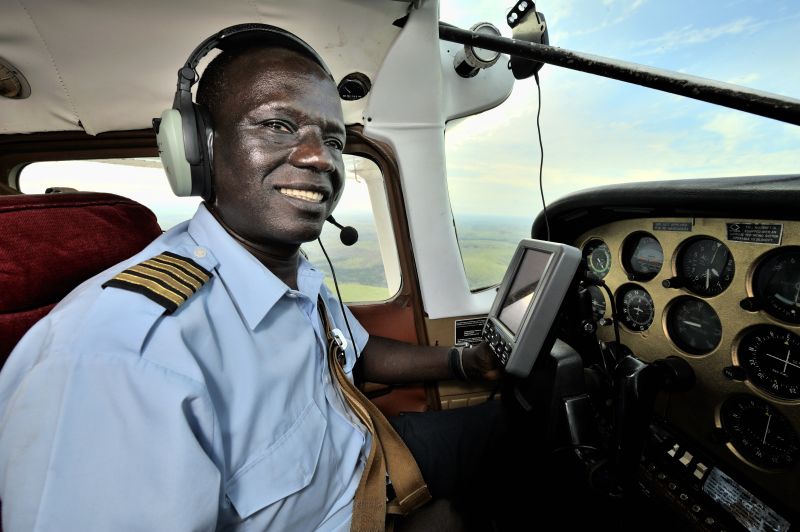
One-handed thanks is still good enough

Missionary pilot Jacques Umembudi, with the Wings of the Morning Aviation Ministry in the Democratic Republic of the Congo, is a delegate to General Conference for the Central Congo Conference. At the Advance display, he told this story:

“Just last year, I had an emergency call concerning a school teacher who was walking close to a river and was attacked by a crocodile. The crocodile snapped off his left arm. He was bleeding to death when I found him, and we flew him to a nearby Presbyterian hospital. Almost 3 weeks later, I was called to fly him back home. He wanted to express his gratitude to us.

“The man started to cry. You see, Africans use both hands to take the two hands of another to say thank you. He said, ‘I cannot express my gratitude. I don’t have my left hand anymore. But please understand, I am very grateful to you for saving my life.’  And I told him, ‘Just stay thanks to God, because he’s the one who provided.’”

UMCOR Aviation Ministries can be supported by giving to Advance #3019626.


Like what you're reading? Support the ministry of UM News! Your support ensures the latest denominational news, dynamic stories and informative articles will continue to connect our global community. Make a tax-deductible donation at ResourceUMC.org/GiveUMCom.

Sign up for our newsletter!

Subscribe Now
Global Health
Sinnika A. Bangura (right), a staffer at the Lowell and Ruth Gess United Methodist Church Eye Hospital in Freetown, Sierra Leone, applies dilating eye drops to a young child with the support of his parents. The eye drops are administered to widen the eye pupil in preparation for examination. The United Methodist eye hospital was established in 1984 by Dr. Lowell Gess, a U.S. missionary. Photo by Eveline Chikwanah, UM News.

Church hospitals restore sight, health in Sierra Leone

The United Methodist Church’s medical facilities provide a wide range of care, drawing patients from neighboring countries as well.
Social Concerns
The Rev. Christopher P. Momany. Photo by Kristen Schell.

For every righteous ‘no,’ there must be a holy ‘yes’

Methodism’s Wesleyan-Holiness heritage holds principles that can be applied to today’s struggles around human dignity.
Church History
The Methodist Church’s 1956 General Conference meets from April 25 to May 7 in the municipal auditorium in Minneapolis. On May 4, the first Friday of the legislative assembly, the delegates voted to make women eligible for full clergy rights. “Now it is up to us to prove in clear and deep witness to the whole church our consecration and our loyal devotion to the work of the Kingdom of God,” said Margaret Henrichsen, a General Conference visitor, after the vote. In 1967, she became the first U.S. woman appointed district superintendent. Photo courtesy of Archives and History.

Why the 1956 women-clergy vote matters

Seventy years ago, the Methodist Church supported full conference membership for women clergy — a decision that would have a resounding impact when The United Methodist Church formed in 1968 and even today.

United Methodist Communications is an agency of The United Methodist Church

©2026 United Methodist Communications. All Rights Reserved