
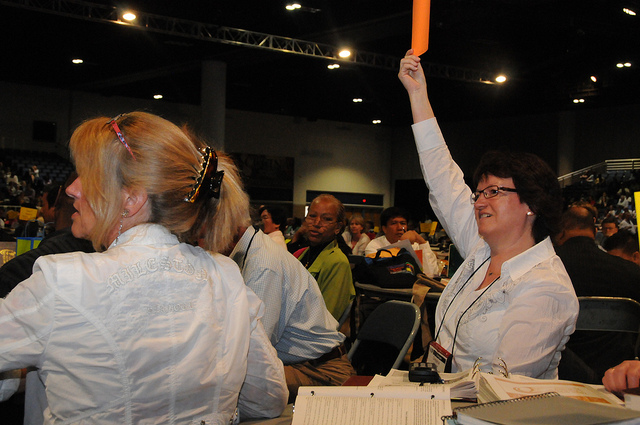
Judicial Council elections

Two clergy, two laity and six alternate clergy and laity were elected on Monday to the Judicial Council, the denomination’s “highest judicial body.” It is composed of 9 members and reflects the diversity of The United Methodist Church. The Council determines the constitutionality of any act of the General Conference, proposed legislation, and shall “pass upon and affirm, modify, or reverse the decisions of law made by Bishops” among other duties and responsibilities.

Laity elected are: N. Oswald Tweh, Sr. and Beth Capen.

Lay alternates: Sandra Lutz, Kurt Glassco, Randall Miller, Deanell Reece Tacha, W, Warren Plowden, Jr., and Reynaldo V. Abdon.

Clergy elected are: J. Kabamba Kiboko and Dennis L. Blackwell.

Clergy alternates: Timothy K. Bruster, John E. Harnish, Susan Henry-Crow, Oyvind Helliesen, Jane A. Tews, and Laura B. Easto.

Listen to our latest story


Like what you're reading? Support the ministry of UM News! Your support ensures the latest denominational news, dynamic stories and informative articles will continue to connect our global community. Make a tax-deductible donation at ResourceUMC.org/GiveUMCom.

Sign up for our newsletter!

Subscribe Now
Worship
Retired Bishop Peggy A. Johnson. Photo courtesy of the author.

Helping people ‘hear the Gospel’ in new ways

May is National Speech-Language-Hearing Month, a good time for United Methodist churches to examine ways to improve hearing accessibility.
Social Concerns
The Rev. Christopher P. Momany. Photo by Kristen Schell.

For every righteous ‘no,’ there must be a holy ‘yes’

Methodism’s Wesleyan-Holiness heritage holds principles that can be applied to today’s struggles around human dignity.
Church History
The Methodist Church’s 1956 General Conference meets from April 25 to May 7 in the municipal auditorium in Minneapolis. On May 4, the first Friday of the legislative assembly, the delegates voted to make women eligible for full clergy rights. “Now it is up to us to prove in clear and deep witness to the whole church our consecration and our loyal devotion to the work of the Kingdom of God,” said Margaret Henrichsen, a General Conference visitor, after the vote. In 1967, she became the first U.S. woman appointed district superintendent. Photo courtesy of Archives and History.

Why the 1956 women-clergy vote matters

Seventy years ago, the Methodist Church supported full conference membership for women clergy — a decision that would have a resounding impact when The United Methodist Church formed in 1968 and even today.

United Methodist Communications is an agency of The United Methodist Church

©2026 United Methodist Communications. All Rights Reserved