
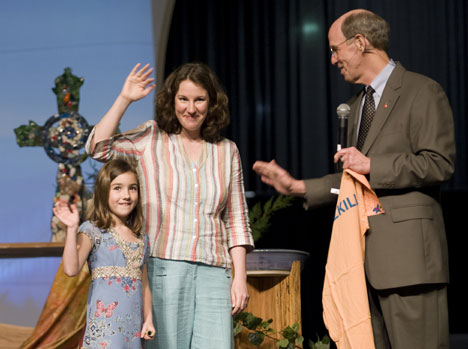
When Katherine Commale learned at age 5 that-somewhere in the world-a child dies from mosquito-borne malaria every 30 seconds, she said, "Mom, we need to send them bed nets right away."
Her mother, Lynda, agreed. Now age 7, Katherine has collected more than $40,000 to send insecticide-treated sleeping nets to Africa as part of the Nothing But Nets campaign, supported by the people of The United Methodist Church.
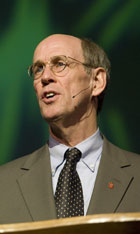
Bishop Hopkins reports on the Connectional Tableand its work to bring the church together in "vision, mission and money."
In a convention center arena filled with thousands of delegates and guests, Katherine told the 2008 United Methodist General Conference that she wants "everyone who needs one to have a bed net."
The brown-eyed youngster was introduced April 24 as a sign of hope in a denomination besieged in recent decades with steady U.S. declines in the numbers of members, worship attendance, professions of faith and baptisms. In 2006, the average age of United Methodists was over age 50, while less than 4 percent of its clergy was under the age of 35.
"Thank you for being a witness, a model for the rest of us," Bishop John Hopkins told Katherine on the assembly stage as the audience applauded.
The presentation was part of a report to General Conference delegates on the work of the Connectional Table, a 60-member body created by the 2004 General Conference to bring "vision, mission and money" together at a common table to help United Methodists to make disciples of Jesus Christ for the transformation of the world.
Every voice is heard
Designed to reflect the church at all levels, the Connectional Table represents the church's five U.S. jurisdictions, the seven central conferences outside of the United States, the presidents and chief executives of churchwide agencies, five racial/ethnic caucuses, youth and young adults, the General Council on Finance and Administration and the Council of Bishops.
"It is a place to prayerfully sustain strategic conversation throughout our global connection," said Hopkins, who serves as chairman. "It is a place to initiate collaboration and share vision."
The conversation has included the denomination's four new areas of focus: cultivating principled Christian leaders, starting new congregations and revitalizing existing ones, engaging in ministry with the poor and stamping out the diseases of poverty.
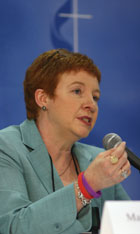
Executive director Mary Brooke Casad answers questions about the Connectional Table's first years of work.
Collaborating with churchwide agencies and the General Council on Finance and Administration, the table helped develop a proposed $642 million denominational budget around the four focus areas for the next four years. General Conference delegates must approve a budget before adjourning May 2.
"This momentum is greater than any legislative proposal or line-item in the budget. This momentum is shaped by our identity and driven by our mission," said Mary Brooke Casad, executive director of the Connectional Table.
State of the church
The Connectional Table has been a place to talk about the challenges facing the 11.5 million-member worldwide denomination.
In 2005, the table commissioned a State of the Church report to give a snapshot of the church. Based on a survey of about 3,000 United Methodist clergy, lay leaders and members from across the globe, the report was released last June and presented some "hard realities"-particularly related to the declining vitality of the U.S. church and perceptions about the denomination. For instance, 42 percent of U.S. churches reported no profession of faith in 2006.
"The easy, natural urge is to blame, deny or even hide," said Casad. "Or we can do something radical. We can confess our shortcomings, ask for God's guidance and take personal responsibility for our United Methodist movement."
Against the backdrop of such sobering data, Hopkins and Casad urged General Conference delegates to "join us in choosing hope" over gloom and "to break the bonds of our own despair."
Playing off the assembly theme of "A Future with Hope," the Connectional Table outlined significant signs of hope in the church:
- Unity in reliance on God's grace and salvation; on Scripture as the primary source of Christian teaching and living; and in keeping an open table for Holy Communion;
- Strong church growth in Africa and the Philippines, especially among young people; 35 percent of U.S. congregations consistently report growth; new church starts in racial/ethnic communities;
- Record response to disaster relief and an increase in conferences paying 100 percent of apportionments, the shares requested of annual (regional) conferences to fund churchwide ministries and administration.
"We appreciate what God is doing among us rather than seeing the church as a problem to be solved," Hopkins said. "The church is not a child to be corrected. It is a grandchild to be celebrated and supported. Can we imagine going from General Conference bragging about our church?"
*Aldrich is news editor of United Methodist News Service.
News media contact: Marta Aldrich, e-mail: [email protected].
Phone calls can be made to the General Conference Newsroom in Fort Worth, Texas, at (817) 698-4405 (817) 698-4405 until May 3. Afterward, call United Methodist News Service in Nashville, Tenn., at (615) 742-5470(615) 742-5470.
Video
Mary Brooke Casad and Bishop John Hopkins:
"We appreciate what God is doing among us."
Related Articles
General Conference headlines
Nothing But Nets raises $18 million in first year
Resource
General Conference 2008
Connectional Table
State of the Church Report
Nothing But Nets
Like what you're reading? Support the ministry of UM News! Your support ensures the latest denominational news, dynamic stories and informative articles will continue to connect our global community. Make a tax-deductible donation at ResourceUMC.org/GiveUMCom.


