
{lv_east_congo_pygmies}
United Methodist Bishop Gabriel Yemba Unda has a heavy heart for tribes of pygmies who suffer in the far-flung areas under his care.
*Click on the i in the upper left-hand corner above the slideshow to display caption information. To turn captions off, simply click on the caption.
View slideshow full screen»
In one of the poorest countries in the world — deep in the forests and savannas — live tribes of pygmies who are among the poorest members of Congo’s society.
Isolated, without access to education, health care, food or clean water and without representation in society and government, the pygmy tribes are especially vulnerable to the armed conflict that has plagued the Democratic Republic of Congo for years.
For decades, soldiers and rebels have driven these tribes from their homes, captured them, sold them as slaves, raped and murdered hundreds.
Bishop Gabriel Yemba Unda has a heavy heart for these people who suffer in the far-flung areas under his care.
As bishop, he said it is especially important to think about those who are the least, the last and the lost. He worries about the “forest people’s” lack of access to education and healthcare, but he is most concerned about their souls.
two visitors to east congo
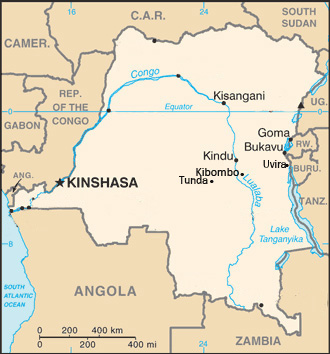
Two white Christians from Nashville, Tennessee, stand out in a crowd in the Democratic Republic of Congo. Mike DuBose, photographer, and myself, Kathy L. Gilbert, news writer, visited the United Methodist East Congo episcopal area – the newest episcopal area in The United Methodist Church – in October. We traveled by car, motorcycle, boat and plane to parts of the world not often visited by most United Methodists. This series is a peek into an area where United Methodists are offering the Good News to thousands.
Learn about ongoing projects supported by United Methodists through United Methodist Global Ministries.
“We must bring them the gospel and evangelize them. We cannot ask them to leave their homes; it is for us to go where they live,” he said. He said efforts to gather them into one village have proven “to no avail.”
“The United Methodist Church is the channel through which the good news of God’s love and salvation through Jesus Christ will be proclaimed,” he said.
Churches, schools and clinics will come after people know and feel God’s love for all of God’s children, he said.
Unda pointed out medical researchers could learn much from the tribes because they use plants and roots of trees to heal themselves.
Off the beaten path
United Methodists in Tunda are some of the pygmies’ closest neighbors, but they are still far away.
No road signs point to the village of Kanana. In fact, there are no roads into the village.
A narrow dirt trail – wide enough for motorcycles, bicycles and feet – cuts through the lush vegetation. Motorcycle is the fastest means of travel, but fallen trees or other obstacles that bog down in the soft, sandy soil often deter traffic.
Sharp blades of tall grass slap riders on both sides, while drivers and passengers must dodge large, hanging branches and rotting fruit.
Calling on the chief
Planes and cars will get you to Tunda, but it is roughly another 100 kilometers (about 62 miles) to Kanana, the pygmy village where Kyungu Pene Ove is the chief.
It takes determination and a strong back to make a pastoral call on the villagers.
In October 2015, a group of United Methodists visited the village to extend a hand of Christian fellowship.
Standing in his barren village, Ove didn’t act like a man who seldom got visitors. He calmly waited for United Methodists to kick up the dust with their caravan of motorcycles. A row of village women clapped and sang in the brutal sunshine.
Dressed in tattered knee-length pants and a purple-and-red striped shirt, Ove tipped his gray baseball hat and pointed to a hut.
Everyone had to duck and dodge the pointed sticks covering the roof and doorway. Among the visitors today was at least one familiar face – Prospère Tunda. He is chief of Tunda and a lifelong United Methodist. He had talked to Ove before and invited him to become a Christian and a United Methodist.
The Rev. Nyenda Okoko, district superintendent for Tunda, shook the dust off his blue suit and shook hands with Ove with a grin as bright and shiny as his blue clerical shirt.
Ove cut to the core of his concerns as soon as everyone was seated in the small hut. “We need a health center in our area. We need primary and secondary schools. That’s what we need, health center and schools,” he said.
Pygmies are hunters, but Ove said they lack basics tools needed to capture animals for food – knives, weapons and nets.
“Look at our houses; just look,” he said gesturing toward the thatch roof and mud walls. “Look at how we live,” he said, placing his hands over his heart. “We are men; we are human beings!”
Ove said if someone becomes sick in the village, it is a three-day walk to reach Tunda – for a man. It can take a woman a week to walk to Tunda, he added.
Ove took the group on a tour around the small village.
Sitting on a log getting his hair cut was Ngoy Lunganga Amour, a village boy who travels several kilometers to attend school at Abanga. His teacher, Assani Tshomba Lebien, was part of the United Methodist visiting group.
Amour said he knows education is important and he hopes to become a lawyer one day. When asked why that profession, he said he wants to fight for equality for his people.
Grinning, he also added, “I want to make lots of money.”
Pygmy villages also exist in other provinces in the East Congo episcopal area in North Kivu at Beni and in Equato-Oriental, Unda said.
He agrees that education is essential. Educated people read the Bible and teach others.
“People who have been saved are those who give their money and time to build a church or a school or a clinic because they love all God's children.”
Gilbert is a multimedia news reporter for United Methodist News Service. Contact her at (615) 742-5470 or [email protected].
Like what you're reading? Support the ministry of UM News! Your support ensures the latest denominational news, dynamic stories and informative articles will continue to connect our global community. Make a tax-deductible donation at ResourceUMC.org/GiveUMCom.


