
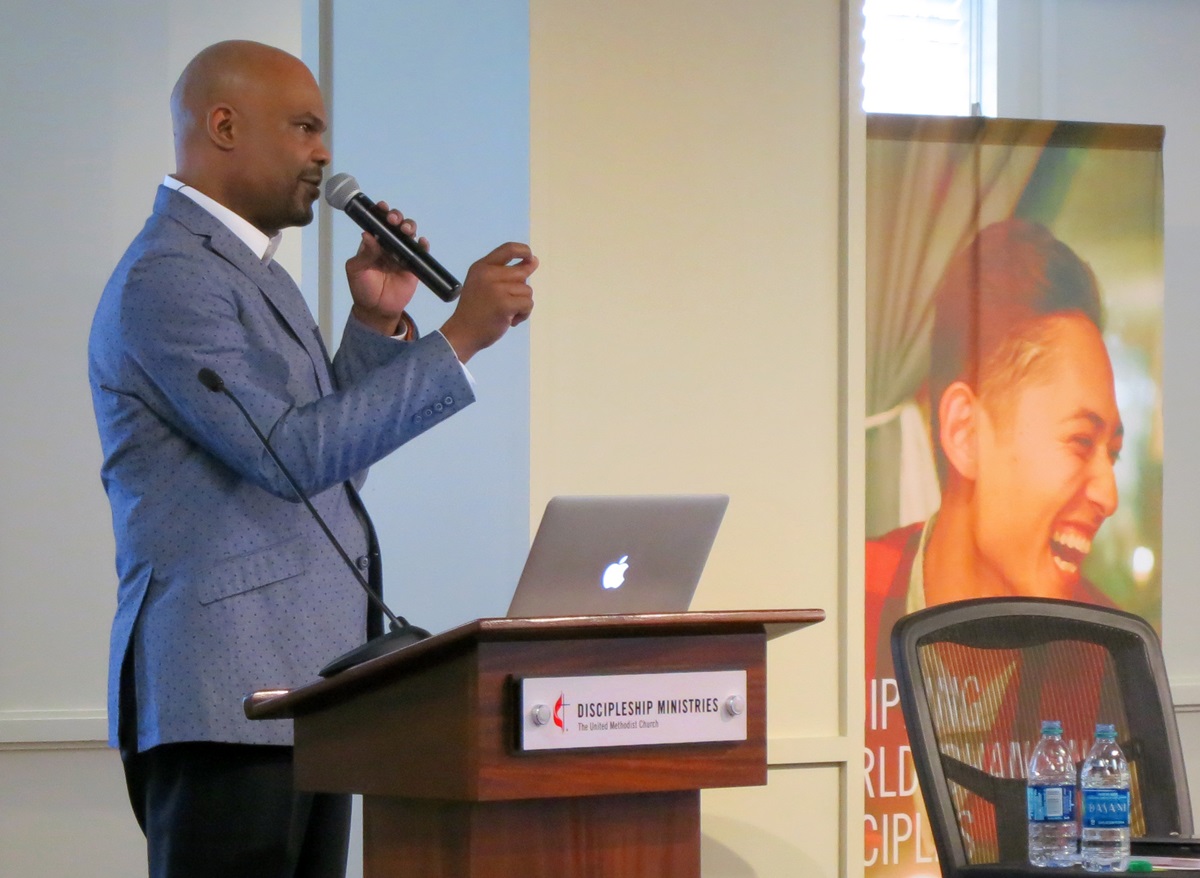
The top executive of Discipleship Ministries has a message for a denomination struggling with dwindling numbers in the U.S.
“Let’s stop fixing churches and start seeing the people Christ called us to reach.”
The Rev. Junius B. Dotson made that declaration to the Discipleship Ministries board as he laid out his agency’s disciple-making strategies for the multinational United Methodist Church. The board met March 15-17 at the agency’s office in Nashville.
At General Conference 2016, church leaders announced the denomination’s goal to make 1 million new disciples in the next four years. Dotson explained how his agency, which is responsible for supporting local churches and annual conferences in disciple-making, plans to help United Methodists reach that goal.
The intent, he said, is “not to save or to preserve an institution but for the sake of living out one of our scriptural values — it’s called the Great Commission.”
In Matthew 28: 19-20, Christ commissions his followers to “go and make disciples of all nations, baptizing them in the name of the Father and of the Son and of the Holy Spirit, and teaching them to obey everything I have commanded you.”
The United Methodist Church has struggled to fulfill that commission. While the denomination has grown globally, particularly in Africa, it has seen overall U.S. membership and worship attendance slide for decades.
“We have tried to reverse this decline by trying to offering technical fixes,” Dotson said, “tinkering with our worship services, collecting huge amounts of data, tinkering with metrics and then when the metrics didn’t fit the picture we wanted, we readjusted the metrics.”
United Methodists, he warned, “can’t program our way back to vitality; there is no quick fix.”
However, they can reframe the conversation from preserving an institution to reaching people for Jesus.
To that end, Dotson and other staff at Discipleship Ministries, after prayer and in consultation with church leaders, have developed the following three strategic priorities:
- Improving discipleship-making systems in local churches
- Increasing engagement with people outside the church who claim “no religious preference” and consider church irrelevant
- Resourcing new ministry development in central conferences, United Methodist regions in Africa, Asia and Europe
As part of these priorities, the agency expects to revamp its training. It plans to develop resources that respond directly to local church needs and build two-year covenant partnerships with annual conferences for training and supporting local church leaders. The agency also plans to continue its work through Path1 New Church Starts, the division that works across the denomination to help foster new faith communities. It also plans to develop messages that explain the “why” of disciple-making.
To Watch
The Rev. Junius B. Dotson’s 33-minute address to Discipleship Ministries board, is here.
He offers practical ideas for maximizing discipleship at Easter here.
Discipleship Ministries board members responded to Dotson’s address with a standing ovation and enthusiastic talk about how they could help the agency carry out its strategies.
“This is what I’ve been hoping for,” said the Rev. Piula E. Ala’ilima, pastor of the multiethnic Wesley United Methodist Church in Honolulu. He saw the strategies as empowering people in local churches in the journey of discipleship.
“To me, everything begins in the local church because I believe in indigenous wisdom on structure, on direction,” he said. “That way we have everyone involved.”
Ann Peat, a member of Church of the Master United Methodist in Westerville, Ohio, said she has seen pastors who saw their roles mostly as marrying and burying people already involved in the faith community. She hopes Discipleship Ministries can help pastors help grow the church and empower laity to be evangelists.
Toward the end of the board meeting, Zimbabwe Area Bishop Eben K. Nhiwatiwa led his fellow board members in praying for Dotson and the agency’s work ahead. In his prayer, he described disciple-making as the “way forward” for the church.
Nhiwatiwa serves on the denomination’s Commission on a Way Forward, which has the responsibility of fostering church unity amid deep divisions on homosexuality. Some leaders have raised doubts that the denomination can stay together. However, the bishop disputed such pessimism.
“The people here are full of hope; they are planning for the future,” Nhiwatiwa told United Methodist News Service. “That’s why I said in my prayer, ‘Oh God, may you make us see the way of hope is here — making disciples of Jesus Christ through The United Methodist Church.'”
Dotson, who came to Discipleship Ministries with experience as a multi-campus church pastor and as a church planter, continually spoke of his hope for the people called United Methodist.
“I believe that when we make this shift from fixing churches to intentional discipleship that our denomination will be on a path that is future-focused and mission-driven,” he said at the end of his address.
“I refuse to believe that our church cannot rise to the challenges confronting us today.”
Hahn is a multimedia news reporter for United Methodist News Service. Contact her at (615) 742-5470 or [email protected]. To read more United Methodist news, subscribe to the free Daily or Weekly Digests
Like what you're reading? Support the ministry of UM News! Your support ensures the latest denominational news, dynamic stories and informative articles will continue to connect our global community. Make a tax-deductible donation at ResourceUMC.org/GiveUMCom.


