
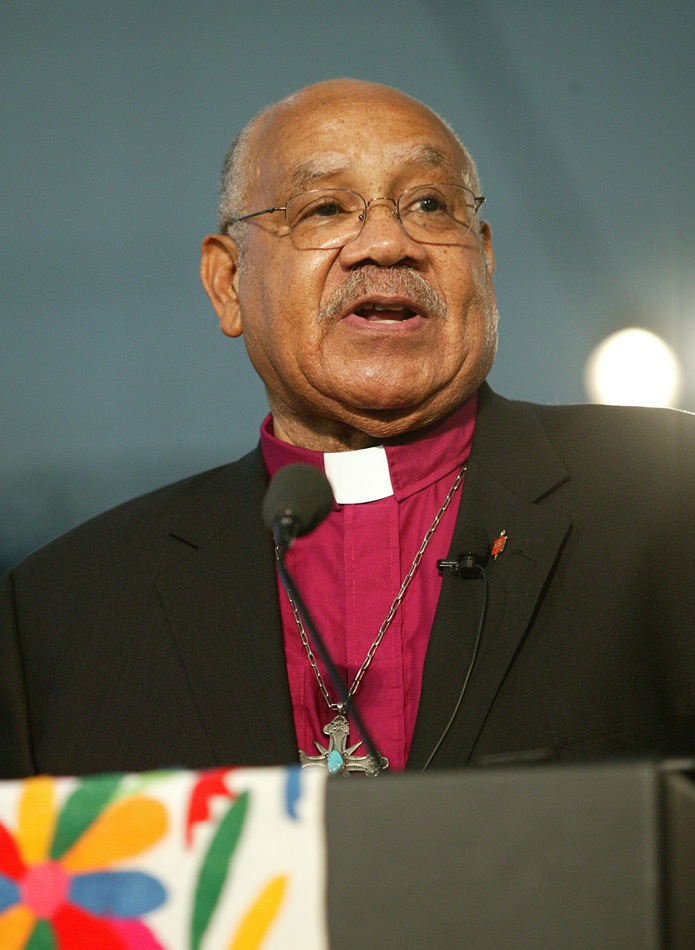
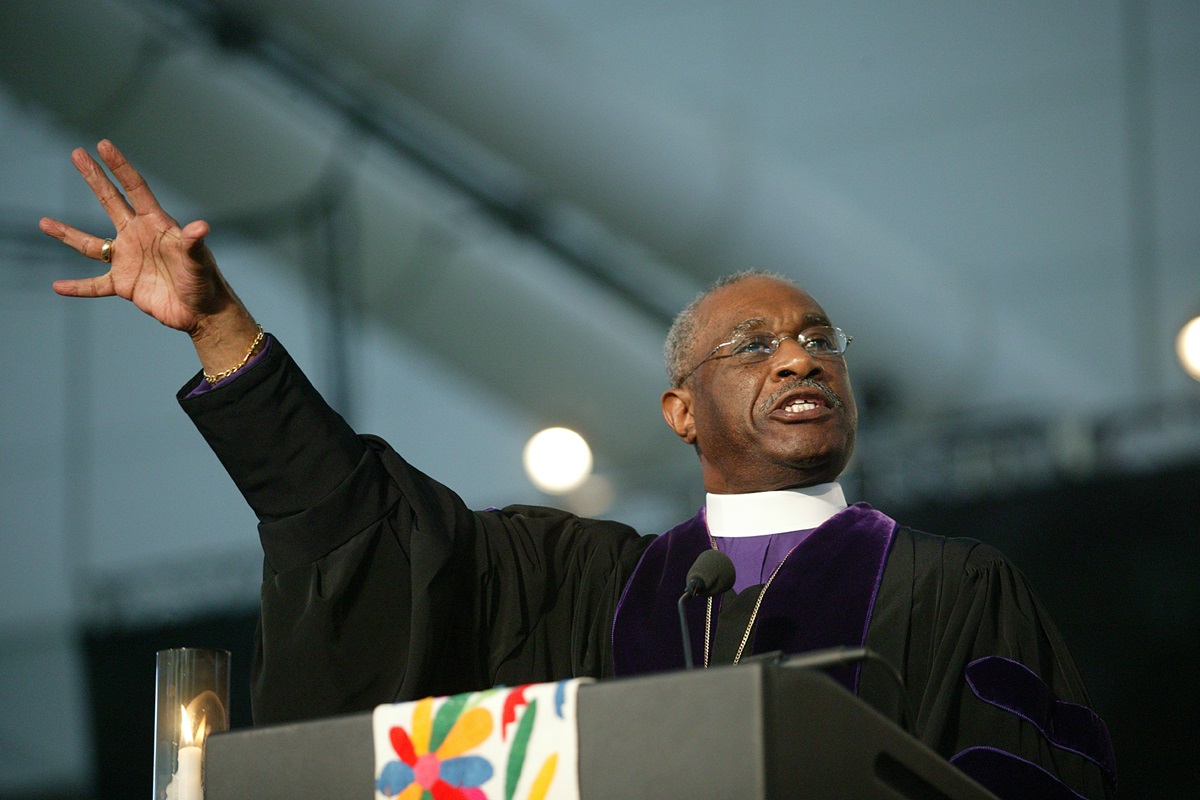
God is calling the churches “to do together what we cannot do apart.”
That was the message of Bishop McKinley Young, presiding bishop of the 10th Episcopal District in Dallas for the African Methodist Episcopal Church, to delegates at the United Methodist General Conference.
The bishop spoke during the May 4 Service of Christian Unity at General Conference, held before a wide array of ecumenical guests. Featured music was performed by a mass children’s choir.
Young –– who has been prominent in the National Council of Churches, World Council of Churches and World Methodist Council –– reminded the gathering that the ecumenical movement has a collective commitment to society. “We, as the church, must not become the hands of government but must remain the conscience of government,” he said.
Citing concerns over public education, health care and housing, the bishop argued that churches “must demand” that the comprehensive resources of the nation are made available.
He said the proposed Bush administration budget for 2005 eliminates more than 60 federal programs addressing needs ranging from elementary and secondary school counseling to educational programs for prison inmates.
In the face of such social service cuts, Young called upon churches to speak “boldly and daringly and courageously about what needs to be done” and not allow the government to shift the burdens of societal care to local congregations “that are already overworked and understaffed.
“We’re also called to speak boldly and courageously against a faith-based war,” said Young. He added that churches cannot allow threats from society and politicians or intimidation from the Internal Revenue Service to stop them from speaking boldly.
He expressed gratitude for the ministry of Bishop Melvin Talbert, ecumenical officer of the United Methodist Council of Bishops, and the Rev. Robert Edgar, a United Methodist pastor who serves as chief executive of the National Council of Churches. Both were outspoken advocates of peaceful alternatives to a war in Iraq.
Young said he also was gratified by the denomination’s confession of its sin of racism and encouraged church members to go beyond talk and “find credible, doable ways to show we are a new people. We have the capacity. All that’s required is that we have the will.”
He told General Conference delegates to take home “a new sense of urgency,” with the realization that “we don’t have forever to do the will of God.”
Following the worship service, the Rev. Robina Winbush, a representative of the Presbyterian Church (USA) thanked United Methodists, on behalf of the ecumenical guests, for being faithful partners “in the sharing of your gifts, your resources and your talents.
“We share many concerns with you,” she reminded the delegates. “Your struggle is not (just) your own.”
Two United Methodists were recognized May 4 for their ecumenical leadership. Bishop Albert “Fritz” Mutti, president of the United Methodist Commission on Christian Unity and Interreligious Concerns, presented a certificate of appreciation to Edgar for his work in restoring “vitality and visibility” to the National Council of Churches over the past four years.
In accepting the certificate, Edgar thanked the denomination for its help with the council’s financial turnaround and new focus on poverty, the environment, and peace and justice issues. “It is the commitment of the United Methodist Church to the ecumenical movement that gives me hope as I work day to day,” he said.
On behalf of the United Methodist Council of Bishops, Talbert presented an award for ecumenical witness to the Rev. Bruce Robbins, who served as chief executive of the Commission on Christian Unity from 1990 to 2003. Robbins’ many achievements, he said, included the development of the church’s Acts of Repentance against racism, the fostering of dialogue both inside and outside the denomination, and the push for the advancement of youth and young adults in ecumenical work.
*Bloom is a United Methodist News Service news writer.
News media contact: (412) 325-6080 during General Conference, April 27-May 7. After May 10: (615) 742-5470.
Like what you're reading? Support the ministry of UM News! Your support ensures the latest denominational news, dynamic stories and informative articles will continue to connect our global community. Make a tax-deductible donation at ResourceUMC.org/GiveUMCom.


