
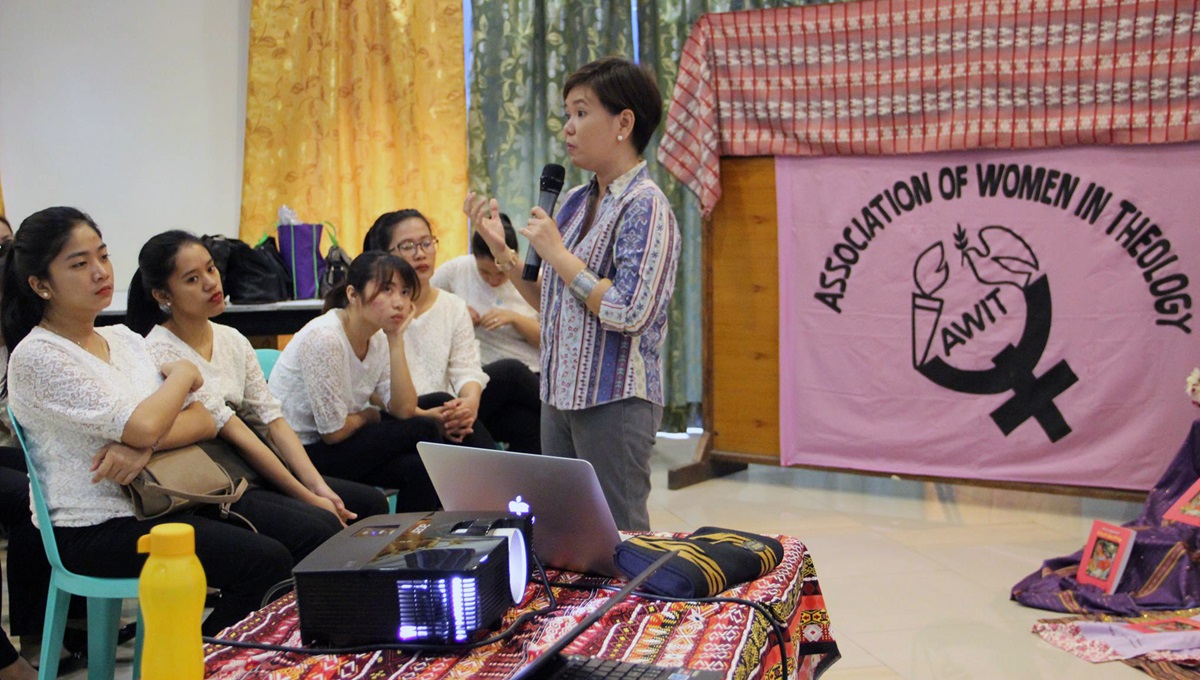
United Methodist deaconesses took part in an ecumenical gathering that addressed the vulnerability of women to violence and called for an end to that violence.
The National Council of Churches in the Philippines and the Association of Women in Theology sponsored the observance of the International Day for Elimination of Violence Against Women.
"We cannot simply ignore the fact that within any tyrannical or dictatorial rule, women become more vulnerable to violence,” said Darlene Marquez-Caramanzana, a United Methodist deaconess. She spoke at the event held on Nov. 25, 2017, at the Cathedral of St. Mary and St. John Episcopal Church here.
Women's activists have marked Nov. 25 as a day against violence since 1981. This date came from the assassination in 1960 of the three Mirabal sisters, political activists in the Dominican Republic, on orders of Dominican ruler Rafael Trujillo.
In 1993, the United Nations adopted the Declaration on the Elimination of Violence against Women. In 1999, the U.N. designated Nov. 25 as the International Day for the Elimination of Violence against Women.
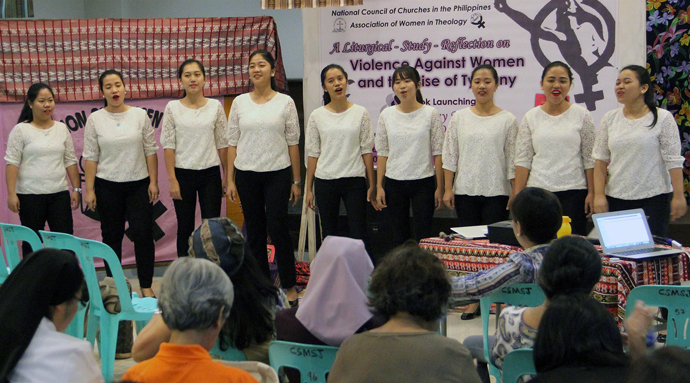
Student deaconesses perform music during the International Declaration on the Elimination of Violence against Women in Quezon City, Philippines. United Methodist deaconesses took part in the ecumenical gathering that addressed the vulnerability of women to violence and called for an end to that violence. Photo by Jonathan Sta. Rosa.
Many remember how women were victimized by martial law under Ferdinand Marcos, said Marquez-Caramanzana, who added that it was important to call attention to violence against women right now because of the "rising fascism and tyranny of President (Rodrigo) Duterte."
"We are women and we want to send our voices — loud and clear — that we will not allow another dictator, and that we will oppose tyranny. History would tell us that many accounts of violence against women and their loved ones have been perpetrated by state personnel," she said. Marquez-Caramanzana is also chief executive of the Education and Nurture unit of the National Council of Churches here.
The event was also the book launch for “Pinay Magnificat: Living Out Our Theology,” a collection of poems and essays published by the Association of Women in Theology, an ecumenical organization of women doing theology through justice- and peace-making ministries.
The National Council of Churches in the Philippines and the Foundation for Theological Education in Southeast Asia supported the publication.
Norma Dollaga, a United Methodist deaconess and one of the authors, said that the book contains Filipino women’s stories of seeking to bring into the light God’s many acts of liberation through the people’s collective action for peace and justice.
"This collection of narratives is the fruit of ecumenical women’s participation in the struggle of Filipino women to be free from national, class and gender oppression. Our struggle does not end in the words and letters collected in a book. The greatest challenge awaiting us after having published this book is how to faithfully immerse ourselves in the struggles and hopes of Filipino women," Dollaga said.
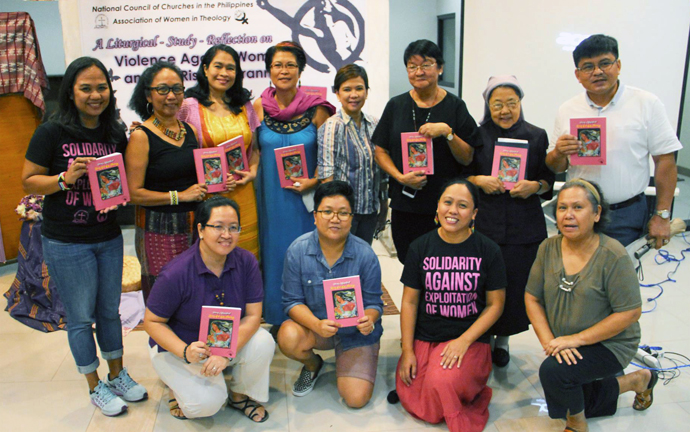
The authors of the book, “Pinay Magnificat: Living Out Our Theology,” a collection of poems and essays published by the Association of Women in Theology, pose during the event in Quezon City, Philippines. Photo by Jonathan Sta. Rosa.
Arceli Bile, another United Methodist deaconess who helped organize the gathering, said that the call was a collective affirmation and resistance.
"I believe that the activity is not just a commemoration, but a collective affirmation of church women’s commitment to resist all forms of violence."
Jennifer Ferariza-Meneses, executive secretary of the Board of Women's Work of the Philippines Central Conference, is also one of the authors.
"The book tells different stories of violence and injustices being experienced by women and yet, it tells more of women's stories and testaments of faith, hope, love and courage in the midst of violence and oppression in our present time,” she said.
Ferariza-Meneses added that the book is a living testimony of faith and courage of women — poor women, women who have been victims of trafficking or sexual violence and the mothers, sisters and daughters of victims of extrajudicial killings and human rights violations.
Marquez-Caramanzana said that in the midst of a grueling fight against violence and the rising tyranny, women will continue to raise their voices, use all their strength and efforts to fight dictatorship.
"As we see the looming face of fascism and tyranny that this government is bent on imposing, women will never be downtrodden, they would always bravely draw water from the springs of hope and strength."
Mangiduyos is a United Methodist News Service correspondent based in the Philippines. News media contact: Vicki Brown, Nashville, Tennessee, (615) 742-5470 or [email protected]. To get more United Methodist news, subscribe to the free Daily or Weekly Digests.
Like what you're reading? Support the ministry of UM News! Your support ensures the latest denominational news, dynamic stories and informative articles will continue to connect our global community. Make a tax-deductible donation at ResourceUMC.org/GiveUMCom.


