
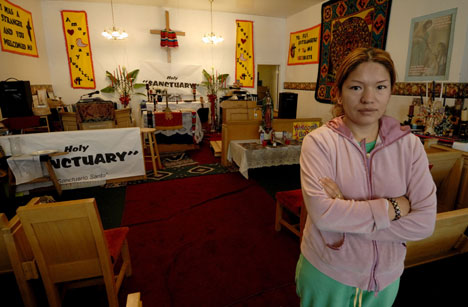
The United Methodist Church is urging justice for migrants worldwide and reform of U.S. immigration laws.
Delegates to the denomination's top legislative body, meeting April 23-May 2, adopted resolutions covering both global migration and immigration issues in the United States.
U.S. immigration
The U.S. domestic resolution calls for "full protection of all workers, which includes the opportunity to gain legal status for all migrants." It also urges U.S. lawmakers to ensure that immigrant laws do not rip apart families.
"To refuse to welcome migrants to this country and to stand by in silence while families are separated, individual freedoms are ignored, and the migrant community in the United States is demonized by members of Congress and the media, is complicity to sin," it states
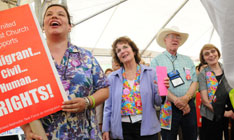
United Methodists rally for immigrants' rights during the 2008 United Methodist General Conference. A UMNS photo by John C. Goodwin.
General Conference also added a new section on "Rights of Immigrants" to the denomination's Social Principles. It states in part, "We affirm the right of all persons to equal opportunities for employment, access to housing, health care, education and freedom from social discrimination." The global economic system has led to migration and many challenges for migrants.
The resolution, "Welcoming the Migrant to the United States," was written to incorporate six other resolutions that currently appear in the church's Book of Resolutions. Amendments in legislative committee further incorporated proposed actions dealing with immigration.
A third resolution, proposed by Metodistas Associados Representando la Causa de Hispano-Americanos (MARCHA), addressed both U.S. immigration reform and the church's responsibility to ensure fair treatment to immigrants.
"The broken immigration system in the United States and the xenophobic responses to migrants reflect the former social order," according to "Welcoming the Migrant to the United States." It states: "The calling of the people of God is to advocate for the creation of a new immigration system that reflects Jesus' beloved community."
"We challenge and pray for comprehensive reform," said Bishop Joel Martinez of San Antonio, president of Global Ministries, who supported the resolutions. "This is no time to demean the immigrant." The bishop said he is confident that the church will "rally behind" the adopted resolutions.
Global migration
The "Global Migration and the Quest for Justice" resolution stresses both the economic needs that contribute to massive movements of people today and the difficulties encountered by migrants. It states, "While money and products easily flow across borders, the movement of people is increasingly restricted, leading to concentrations of the poor along borders and, often, to the building of literal and figurative walls of exclusion."
The resolution commits the church to help all types of migrants and to engage in advocacy on their behalf. It urges investigation of the causes of displacement and marginalization and calls for the preparation of "educational resources for the achievement of these objectives."
Responsibility for these resources lies with the Board of Global Ministries, the Board of Church and Society, and other church agencies.
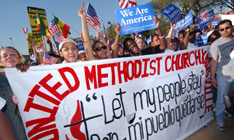
Members of First United Methodist Church of Hyattsville, Md., demonstrate during an April 2006 rally for immigrant rights. A UMNS file photo by Jay Mallin.
The global resolution advocates for the unification of families divided by borders and commends refugee resettlement work of the United Methodist Committee on Relief.
A revision of the Social Principles replaces a statement on migrant workers with a more global perspective. "We call upon governments and all workers to ensure for foreign workers the same economic, educational and social benefits enjoyed by other citizens," the new statement says.
Two additional resolutions call for specific groups to be permitted to migrate to the United States. These petitions call for the right of immigration and citizenship for children of U.S. citizens in Japan and the Philippines. One of the resolutions specifies welcoming "the sons and daughters of Filipino World War II veterans who are or were naturalized citizens of the United States."
The two lengthy resolutions were prepared through the United Methodist Task Force on Immigration, a unit composed of representatives from the various program agencies and ethnic caucuses of the denomination.
*Schleicher is on the General Conference communications team for the Board of Global Ministries.
News media contact: Kathy L. Gilbert, Nashville, Tenn., (615) 742-5470 or [email protected].
Related Articles
General Conference headlines
Church leaders support sanctuary for immigrants
Church urges humane treatment of immigrants
United Methodist groups oppose immigration bill
Arrest of mother puts 'human face' on immigration
Resources
Like what you're reading? Support the ministry of UM News! Your support ensures the latest denominational news, dynamic stories and informative articles will continue to connect our global community. Make a tax-deductible donation at ResourceUMC.org/GiveUMCom.


