

Key Points:
- With financial support from the United Methodist Committee on Relief, more than 12,000 people displaced by conflict received food and other needed supplies.
- According to Jean Tshomba, coordinator of UMCOR’s disaster management office in eastern Congo, recurring clashes between armed groups in the region have forced tens of thousands of people to flee their homes.
- Bishop Gabriel Yemba Unda condemned the violence and urged all parties to work toward a peaceful resolution.
The United Methodist Church is serving as a beacon of hope for people displaced by longtime conflict in the North Kivu province.
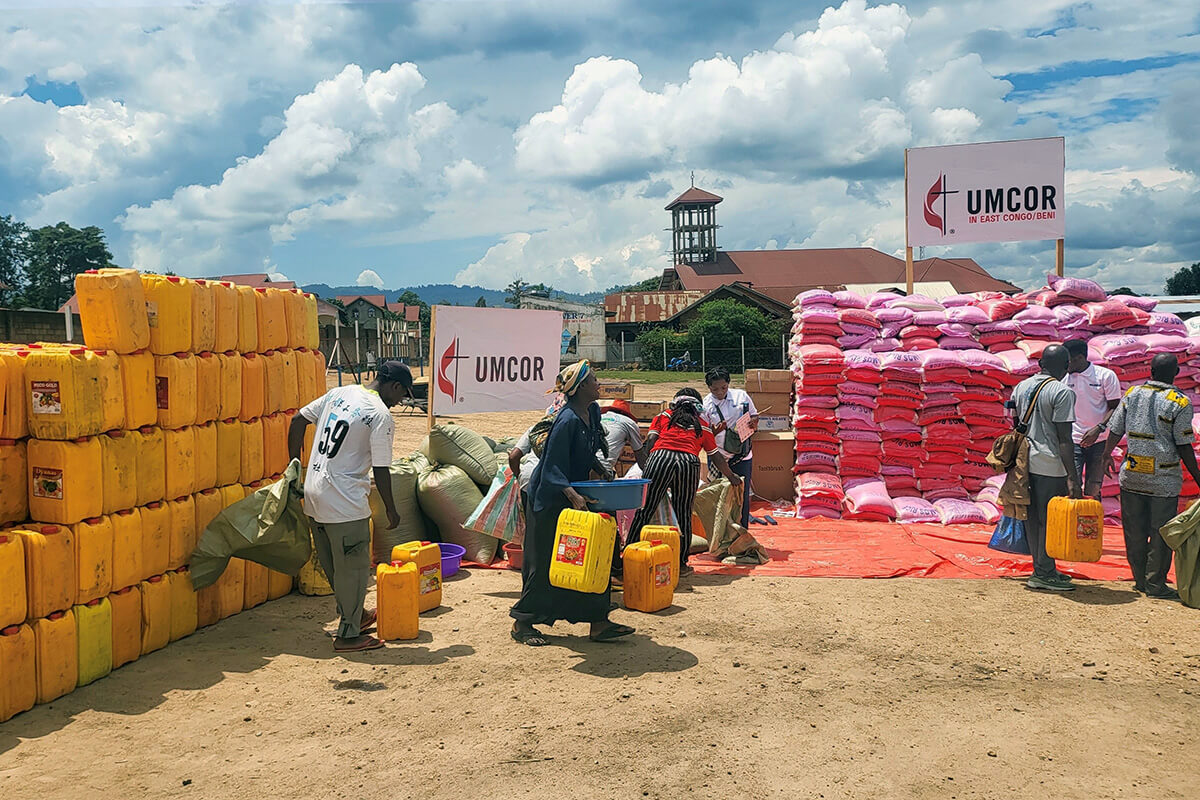
With financial support from the United Methodist Committee on Relief, the East Congo Episcopal Area responded to the humanitarian crisis in Beni, assisting more than 12,000 people. The $150,000 grant funded the distribution of 125 tons of food rations, non-food items and hygiene products to 1,750 households.
According to Jean Tshomba, coordinator of UMCOR’s disaster management office in eastern Congo, recurring clashes between armed groups in the region have forced tens of thousands of people to flee their homes, particularly in Kanyabayonga, which recently fell to the March 23 (M23) Movement, a Congolese-Tutsi-led rebel military group.
“Recent attacks attributed to the ADF (Allied Democratic Forces), CODECO (Cooperative for the Development of the Congo) and M23 armed groups have forced over 70,000 people to leave their homes, including those in the recently captured Kanyabayonga,” Tshomba said. These displaced people, flocking to Beni, find themselves in desperate need of food, drinking water and hygiene products.
Fighting also has intensified in Goma, where at least 100 people, including eight United Methodists, have been killed in recent days.
Read story United Methodists killed in Congo conflict
Tshomba said that the food rations the church distributed were calculated to cover a household’s nutritional needs for a month. Items such as basins and fuel containers also were distributed.
Each household received 66 pounds of rice, 66 pounds of maize flour, one gallon of vegetable oil, two pounds of salt and nine pounds of beans, as well as six bars of laundry soap, six toothbrushes and six tubes of toothpaste.
Tshomba noted that surveys conducted with the displaced population identified priority needs. Following strict compliance with health protocols, the distribution was done in close collaboration with local authorities and humanitarian organizations.
Bishop Gabriel Yemba Unda, resident bishop and legal representative of The United Methodist Church in eastern Congo, expressed sorrow at the suffering endured by the displaced population.
How to help
Calling for peace in eastern Congo, he condemned the violence and urged all parties involved to work toward a peaceful resolution of the regional conflict. Unda stressed the importance of showing Christian compassion by taking concrete action to alleviate misery.
“We don’t just distribute food and clothing,” he explained. “We also give psychological and spiritual support to people who have suffered so much. We want to show them that they are not alone and that they can count on us.
“God is always present in times of trial, and with his grace, we can overcome any difficulty. I encourage you not to lose hope, courage and faith in a better future.”
Kavira Alexandrine, a widow, heads a household of 15 people.
“Since my husband’s death, everything collapsed. I found myself alone with 15 mouths to feed. We lost everything in the fighting. I didn’t know how to cope. Thanks to the church’s help, we finally have enough to eat. I’m so grateful. I don’t know what I would do without the help of The United Methodist Church,” she said.
“I’ve regained a little hope, thanks to your support. I will be able to rebuild my life and that of my children. I thank God for you.”
Furaha Muke, head of a household of eight, said families had their lives turned upside down overnight.
“Life as a displaced person is difficult. We have no home, no work. It’s very complicated to feed my family.”
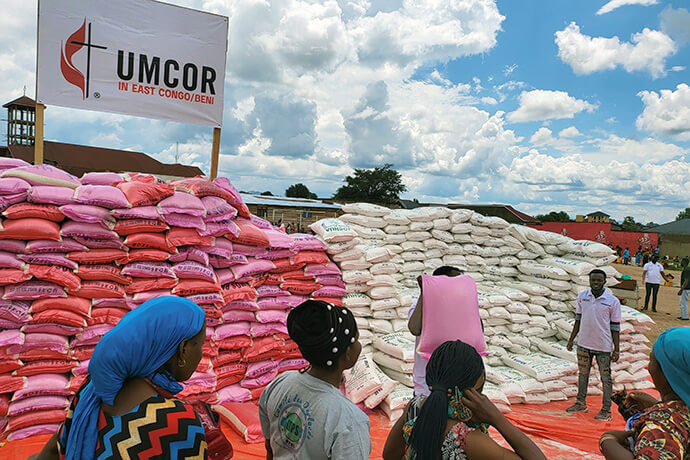
Speaking about the importance of food aid, she said, “The food rations we received saved our lives. We can finally eat our fill. It’s a great relief. I’m very touched by the solidarity of the church. It shows us that we are not alone.”
Masika Bunga, who heads a household of nine, spoke of her fear and uncertainty. “We fled our village in fear. We didn’t know where we were going. I thought we were going to starve to death. Thanks to your help, we’ve been able to settle down and start rebuilding our lives. The children go to school, and we have a roof over our heads.
“It wasn’t just the food that helped us, but also your presence and your listening. Your preaching. You put the smile back on our faces.”
Tshomba said the emergency aid is part of a long-term commitment by The United Methodist Church to the region’s most vulnerable populations.
“The aim is not only to alleviate the immediate suffering of the displaced, but also to contribute to their long-term resilience,” he said.
Urging the international community to increase support of the people of eastern Congo, Unda said, “Every donation counts to help these people rebuild their lives.”
Quoting Matthew 25:35-40, he encouraged United Methodists to help those most in need.
“We are all called to be the hands and feet of Christ on earth,” he said.
Londe is a UM News correspondent in Congo.
News contact: Julie Dwyer, news editor, [email protected] or 615-742-5469. To read more United Methodist News, subscribe to the free UM News Digest.


